Jump to
S2C1
Energy calculated at CCSD(T)/aug-cc-pVTZ
| | hartrees |
|---|
| Energy at 0K | -151.798183 |
| Energy at 298.15K | |
| HF Energy | -151.232354 |
| Nuclear repulsion energy | 63.077819 |
The energy at 298.15K was derived from the energy at 0K
and an integrated heat capacity that used the calculated vibrational frequencies.
Vibrational Frequencies calculated at CCSD(T)/aug-cc-pVTZ
| Mode Number |
Symmetry |
Frequency
(cm-1) |
Scaled Frequency
(cm-1) |
IR Intensities
(km mol-1) |
Raman Act
(Å4/u) |
Dep P |
Dep U |
|---|
| 1 |
Σg |
2093 |
2030 |
0.00 |
|
|
|
| 2 |
Σg |
916 |
889 |
0.00 |
|
|
|
| 3 |
Σu |
1560 |
1513 |
0.00 |
|
|
|
| 4 |
Πg |
324 |
314 |
0.00 |
|
|
|
| 4 |
Πg |
324 |
314 |
0.00 |
|
|
|
| 5 |
Πu |
144 |
140 |
0.00 |
|
|
|
| 5 |
Πu |
144 |
140 |
0.00 |
|
|
|
Unscaled Zero Point Vibrational Energy (zpe) 2752.6 cm
-1
Scaled (by 0.9699) Zero Point Vibrational Energy (zpe) 2669.7 cm
-1
See section
III.C.1 List or set vibrational scaling factors
to change the scale factors used here.
See section
III.C.2
Calculate a vibrational scaling factor for a given set of molecules
to determine the least squares best scaling factor.
Geometric Data calculated at CCSD(T)/aug-cc-pVTZ
Point Group is D∞h
Cartesians (Å)
| Atom |
x (Å) |
y (Å) |
z (Å) |
|---|
| C1 |
0.000 |
0.000 |
0.648 |
| C2 |
0.000 |
0.000 |
-0.648 |
| C3 |
0.000 |
0.000 |
1.965 |
| C4 |
0.000 |
0.000 |
-1.965 |
Atom - Atom Distances (Å)
| |
C1 |
C2 |
C3 |
C4 |
| C1 | | 1.2961 | 1.3165 | 2.6127 |
C2 | 1.2961 | | 2.6127 | 1.3165 | C3 | 1.3165 | 2.6127 | | 3.9292 | C4 | 2.6127 | 1.3165 | 3.9292 | |
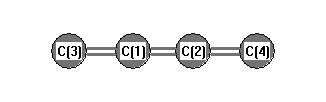 More geometry information
Calculated Bond Angles
| atom1 |
atom2 |
atom3 |
angle |
|
atom1 |
atom2 |
atom3 |
angle |
| C1 |
C2 |
C4 |
180.000 |
|
C2 |
C1 |
C3 |
180.000 |
Electronic energy levels
Charges, Dipole, Quadrupole and Polarizability
Jump to
S1C1
Energy calculated at CCSD(T)/aug-cc-pVTZ
| | hartrees |
|---|
| Energy at 0K | -151.784302 |
| Energy at 298.15K | |
| HF Energy | -151.181717 |
| Nuclear repulsion energy | 62.798825 |
The energy at 298.15K was derived from the energy at 0K
and an integrated heat capacity that used the calculated vibrational frequencies.
Vibrational Frequencies calculated at CCSD(T)/aug-cc-pVTZ
| Mode Number |
Symmetry |
Frequency
(cm-1) |
Scaled Frequency
(cm-1) |
IR Intensities
(km mol-1) |
Raman Act
(Å4/u) |
Dep P |
Dep U |
|---|
| 1 |
Σg |
2026 |
1965 |
0.00 |
|
|
|
| 2 |
Σg |
899 |
872 |
0.00 |
|
|
|
| 3 |
Σu |
1548 |
1502 |
0.00 |
|
|
|
| 4 |
Πg |
420 |
407 |
0.00 |
|
|
|
| 4 |
Πg |
208 |
202 |
0.00 |
|
|
|
| 5 |
Πu |
193 |
187 |
0.00 |
|
|
|
| 5 |
Πu |
116 |
112 |
0.00 |
|
|
|
Unscaled Zero Point Vibrational Energy (zpe) 2705.2 cm
-1
Scaled (by 0.9699) Zero Point Vibrational Energy (zpe) 2623.7 cm
-1
See section
III.C.1 List or set vibrational scaling factors
to change the scale factors used here.
See section
III.C.2
Calculate a vibrational scaling factor for a given set of molecules
to determine the least squares best scaling factor.
Geometric Data calculated at CCSD(T)/aug-cc-pVTZ
Point Group is D∞h
Cartesians (Å)
| Atom |
x (Å) |
y (Å) |
z (Å) |
|---|
| C1 |
0.000 |
0.000 |
0.652 |
| C2 |
0.000 |
0.000 |
-0.652 |
| C3 |
0.000 |
0.000 |
1.973 |
| C4 |
0.000 |
0.000 |
-1.973 |
Atom - Atom Distances (Å)
| |
C1 |
C2 |
C3 |
C4 |
| C1 | | 1.3046 | 1.3202 | 2.6248 |
C2 | 1.3046 | | 2.6248 | 1.3202 | C3 | 1.3202 | 2.6248 | | 3.9450 | C4 | 2.6248 | 1.3202 | 3.9450 | |
More geometry information
Electronic energy levels
Charges, Dipole, Quadrupole and Polarizability
