Jump to
S1C2
Energy calculated at CCSD(T)/aug-cc-pVTZ
| | hartrees |
|---|
| Energy at 0K | -117.039948 |
| Energy at 298.15K | -117.044183 |
| HF Energy | -116.512373 |
| Nuclear repulsion energy | 64.879898 |
The energy at 298.15K was derived from the energy at 0K
and an integrated heat capacity that used the calculated vibrational frequencies.
Vibrational Frequencies calculated at CCSD(T)/aug-cc-pVTZ
| Mode Number |
Symmetry |
Frequency
(cm-1) |
Scaled Frequency
(cm-1) |
IR Intensities
(km mol-1) |
Raman Act
(Å4/u) |
Dep P |
Dep U |
|---|
| 1 |
A1 |
3250 |
3153 |
|
|
|
|
| 2 |
A1 |
3153 |
3058 |
|
|
|
|
| 3 |
A1 |
3146 |
3052 |
|
|
|
|
| 4 |
A1 |
1522 |
1477 |
|
|
|
|
| 5 |
A1 |
1272 |
1233 |
|
|
|
|
| 6 |
A1 |
1035 |
1004 |
|
|
|
|
| 7 |
A1 |
420 |
408 |
|
|
|
|
| 8 |
A2 |
779 |
755 |
|
|
|
|
| 9 |
A2 |
543 |
526 |
|
|
|
|
| 10 |
B1 |
995 |
965 |
|
|
|
|
| 11 |
B1 |
798 |
774 |
|
|
|
|
| 12 |
B1 |
519 |
503 |
|
|
|
|
| 13 |
B2 |
3247 |
3149 |
|
|
|
|
| 14 |
B2 |
3146 |
3052 |
|
|
|
|
| 15 |
B2 |
1511 |
1466 |
|
|
|
|
| 16 |
B2 |
1417 |
1374 |
|
|
|
|
| 17 |
B2 |
1183 |
1148 |
|
|
|
|
| 18 |
B2 |
931 |
903 |
|
|
|
|
Unscaled Zero Point Vibrational Energy (zpe) 14433.5 cm
-1
Scaled (by 0.9699) Zero Point Vibrational Energy (zpe) 13999.0 cm
-1
See section
III.C.1 List or set vibrational scaling factors
to change the scale factors used here.
See section
III.C.2
Calculate a vibrational scaling factor for a given set of molecules
to determine the least squares best scaling factor.
Geometric Data calculated at CCSD(T)/aug-cc-pVTZ
Point Group is C2v
Cartesians (Å)
| Atom |
x (Å) |
y (Å) |
z (Å) |
|---|
| C1 |
0.000 |
0.000 |
0.450 |
| H2 |
0.000 |
0.000 |
1.537 |
| C3 |
0.000 |
1.227 |
-0.199 |
| C4 |
0.000 |
-1.227 |
-0.199 |
| H5 |
0.000 |
2.156 |
0.354 |
| H6 |
0.000 |
-2.156 |
0.354 |
| H7 |
0.000 |
1.279 |
-1.281 |
| H8 |
0.000 |
-1.279 |
-1.281 |
Atom - Atom Distances (Å)
| |
C1 |
H2 |
C3 |
C4 |
H5 |
H6 |
H7 |
H8 |
| C1 | | 1.0869 | 1.3877 | 1.3877 | 2.1585 | 2.1585 | 2.1529 | 2.1529 |
H2 | 1.0869 | | 2.1254 | 2.1254 | 2.4595 | 2.4595 | 3.0952 | 3.0952 | C3 | 1.3877 | 2.1254 | | 2.4534 | 1.0816 | 3.4279 | 1.0841 | 2.7300 | C4 | 1.3877 | 2.1254 | 2.4534 | | 3.4279 | 1.0816 | 2.7300 | 1.0841 | H5 | 2.1585 | 2.4595 | 1.0816 | 3.4279 | | 4.3127 | 1.8559 | 3.8051 | H6 | 2.1585 | 2.4595 | 3.4279 | 1.0816 | 4.3127 | | 3.8051 | 1.8559 | H7 | 2.1529 | 3.0952 | 1.0841 | 2.7300 | 1.8559 | 3.8051 | | 2.5586 | H8 | 2.1529 | 3.0952 | 2.7300 | 1.0841 | 3.8051 | 1.8559 | 2.5586 | |
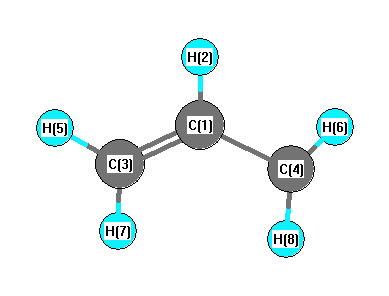 More geometry information
Calculated Bond Angles
| atom1 |
atom2 |
atom3 |
angle |
|
atom1 |
atom2 |
atom3 |
angle |
| C1 |
C3 |
H5 |
121.391 |
|
C1 |
C3 |
H7 |
120.653 |
| C1 |
C4 |
H6 |
121.391 |
|
C1 |
C4 |
H8 |
120.653 |
| H2 |
C1 |
C3 |
117.872 |
|
H2 |
C1 |
C4 |
117.872 |
| C3 |
C1 |
C4 |
124.257 |
|
H5 |
C3 |
H7 |
117.957 |
| H6 |
C4 |
H8 |
117.957 |
|
Electronic energy levels
Charges, Dipole, Quadrupole and Polarizability
Jump to
S1C1
Energy calculated at CCSD(T)/aug-cc-pVTZ
| | hartrees |
|---|
| Energy at 0K | -117.018011 |
| Energy at 298.15K | |
| HF Energy | -116.512263 |
| Nuclear repulsion energy | 64.821017 |
The energy at 298.15K was derived from the energy at 0K
and an integrated heat capacity that used the calculated vibrational frequencies.
Vibrational Frequencies calculated at CCSD(T)/aug-cc-pVTZ
Geometric Data calculated at CCSD(T)/aug-cc-pVTZ
Point Group is Cs
Electronic energy levels
Charges, Dipole, Quadrupole and Polarizability
