Jump to
S1C2
Energy calculated at B2PLYP/aug-cc-pVTZ
| | hartrees |
|---|
| Energy at 0K | -90.546271 |
| Energy at 298.15K | -90.546071 |
| HF Energy | -90.456232 |
| Nuclear repulsion energy | 17.479473 |
The energy at 298.15K was derived from the energy at 0K
and an integrated heat capacity that used the calculated vibrational frequencies.
Vibrational Frequencies calculated at B2PLYP/aug-cc-pVTZ
| Mode Number |
Symmetry |
Frequency
(cm-1) |
Scaled Frequency
(cm-1) |
IR Intensities
(km mol-1) |
Raman Act
(Å4/u) |
Dep P |
Dep U |
|---|
| 1 |
A' |
4004 |
3848 |
137.21 |
114.16 |
0.17 |
0.29 |
| 2 |
A' |
1268 |
1219 |
122.46 |
4.24 |
0.56 |
0.71 |
| 3 |
A' |
337 |
324 |
169.05 |
4.53 |
0.74 |
0.85 |
Unscaled Zero Point Vibrational Energy (zpe) 2804.5 cm
-1
Scaled (by 0.961) Zero Point Vibrational Energy (zpe) 2695.1 cm
-1
See section
III.C.1 List or set vibrational scaling factors
to change the scale factors used here.
See section
III.C.2
Calculate a vibrational scaling factor for a given set of molecules
to determine the least squares best scaling factor.
Geometric Data calculated at B2PLYP/aug-cc-pVTZ
Point Group is Cs
Cartesians (Å)
| Atom |
x (Å) |
y (Å) |
z (Å) |
|---|
| O1 |
0.046 |
-0.375 |
0.000 |
| Be2 |
0.046 |
1.027 |
0.000 |
| H3 |
-0.556 |
-1.111 |
0.000 |
Atom - Atom Distances (Å)
| |
O1 |
Be2 |
H3 |
| O1 | | 1.4022 | 0.9513 |
Be2 | 1.4022 | | 2.2217 | H3 | 0.9513 | 2.2217 | |
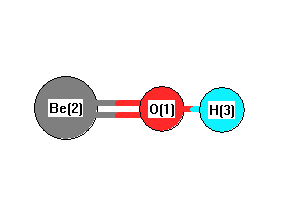 More geometry information
Calculated Bond Angles
| atom1 |
atom2 |
atom3 |
angle |
|
atom1 |
atom2 |
atom3 |
angle |
| Be2 |
O1 |
H3 |
140.710 |
|
Electronic energy levels
Charges, Dipole, Quadrupole and Polarizability
Charges from optimized geometry at B2PLYP/aug-cc-pVTZ
Charges (e)
| Number |
Element |
Mulliken |
CHELPG |
AIM |
ESP |
| 1 |
O |
-0.294 |
|
|
|
| 2 |
Be |
0.162 |
|
|
|
| 3 |
H |
0.132 |
|
|
|
Electric dipole moments
Electric dipole components in Debye
(What's a Debye? See section
VII.A.3)
| |
x |
y |
z |
Total |
| |
-0.995 |
-0.580 |
0.000 |
1.151 |
| CHELPG |
|
|
|
|
| AIM |
|
|
|
|
| ESP |
|
|
|
|
Electric Quadrupole moment
Quadrupole components in D Å
| Primitive |
|---|
| | x | y | z |
|---|
| x |
-11.277 |
1.523 |
-0.001 |
| y |
1.523 |
-12.459 |
-0.036 |
| z |
-0.001 |
-0.036 |
-12.205 |
|
| Traceless |
|---|
| | x | y | z |
|---|
| x |
1.055 |
1.523 |
-0.001 |
| y |
1.523 |
-0.718 |
-0.036 |
| z |
-0.001 |
-0.036 |
-0.337 |
|
| Polar |
|---|
| 3z2-r2 | -0.675 |
|---|
| x2-y2 | 1.182 |
|---|
| xy | 1.523 |
|---|
| xz | -0.001 |
|---|
| yz | -0.036 |
|---|
|
Polarizabilities
Components of the polarizability tensor.
Units are
Å
3 (Angstrom cubed)
Change units.
| |
x |
y |
z |
| x |
5.381 |
0.059 |
-0.000 |
| y |
0.059 |
4.555 |
0.001 |
| z |
-0.000 |
0.001 |
5.171 |
<r2> (average value of r
2) Å
2
| <r2> |
14.398 |
| (<r2>)1/2 |
3.794 |
Jump to
S1C1
Energy calculated at B2PLYP/aug-cc-pVTZ
| | hartrees |
|---|
| Energy at 0K | -90.545634 |
| Energy at 298.15K | |
| HF Energy | -90.455675 |
| Nuclear repulsion energy | 17.640486 |
The energy at 298.15K was derived from the energy at 0K
and an integrated heat capacity that used the calculated vibrational frequencies.
Vibrational Frequencies calculated at B2PLYP/aug-cc-pVTZ
| Mode Number |
Symmetry |
Frequency
(cm-1) |
Scaled Frequency
(cm-1) |
IR Intensities
(km mol-1) |
Raman Act
(Å4/u) |
Dep P |
Dep U |
|---|
| 1 |
Σ |
4083 |
3924 |
201.58 |
|
|
|
| 2 |
Σ |
1315 |
1264 |
157.81 |
|
|
|
| 3 |
Π |
226i |
217i |
143.57 |
|
|
|
| 3 |
Π |
226i |
217i |
143.58 |
|
|
|
Unscaled Zero Point Vibrational Energy (zpe) 2473.0 cm
-1
Scaled (by 0.961) Zero Point Vibrational Energy (zpe) 2376.6 cm
-1
See section
III.C.1 List or set vibrational scaling factors
to change the scale factors used here.
See section
III.C.2
Calculate a vibrational scaling factor for a given set of molecules
to determine the least squares best scaling factor.
Geometric Data calculated at B2PLYP/aug-cc-pVTZ
Point Group is C∞v
Cartesians (Å)
| Atom |
x (Å) |
y (Å) |
z (Å) |
|---|
| O1 |
0.000 |
0.000 |
0.352 |
| Be2 |
0.000 |
0.000 |
-1.029 |
| H3 |
0.000 |
0.000 |
1.298 |
Atom - Atom Distances (Å)
| |
O1 |
Be2 |
H3 |
| O1 | | 1.3816 | 0.9461 |
Be2 | 1.3816 | | 2.3277 | H3 | 0.9461 | 2.3277 | |
More geometry information
Calculated Bond Angles
| atom1 |
atom2 |
atom3 |
angle |
|
atom1 |
atom2 |
atom3 |
angle |
| Be2 |
O1 |
H3 |
180.000 |
|
Electronic energy levels
Charges, Dipole, Quadrupole and Polarizability
Charges from optimized geometry at B2PLYP/aug-cc-pVTZ
Charges (e)
| Number |
Element |
Mulliken |
CHELPG |
AIM |
ESP |
| 1 |
O |
-0.343 |
|
|
|
| 2 |
Be |
0.145 |
|
|
|
| 3 |
H |
0.199 |
|
|
|
Electric dipole moments
Electric dipole components in Debye
(What's a Debye? See section
VII.A.3)
| |
x |
y |
z |
Total |
| |
0.000 |
0.000 |
1.178 |
1.178 |
| CHELPG |
|
|
|
|
| AIM |
|
|
|
|
| ESP |
|
|
|
|
Electric Quadrupole moment
Quadrupole components in D Å
| Primitive |
|---|
| | x | y | z |
|---|
| x |
-12.182 |
0.000 |
0.000 |
| y |
0.000 |
-12.182 |
0.000 |
| z |
0.000 |
0.000 |
-11.299 |
|
| Traceless |
|---|
| | x | y | z |
|---|
| x |
-0.442 |
0.000 |
0.000 |
| y |
0.000 |
-0.442 |
0.000 |
| z |
0.000 |
0.000 |
0.884 |
|
| Polar |
|---|
| 3z2-r2 | 1.767 |
|---|
| x2-y2 | 0.000 |
|---|
| xy | 0.000 |
|---|
| xz | 0.000 |
|---|
| yz | 0.000 |
|---|
|
Polarizabilities
Components of the polarizability tensor.
Units are
Å
3 (Angstrom cubed)
Change units.
| |
x |
y |
z |
| x |
5.213 |
0.000 |
0.000 |
| y |
0.000 |
5.213 |
0.000 |
| z |
0.000 |
0.000 |
4.638 |
<r2> (average value of r
2) Å
2
| <r2> |
14.341 |
| (<r2>)1/2 |
3.787 |
