Jump to
S2C1
Energy calculated at CCSD(T)/aug-cc-pVTZ
| | hartrees |
|---|
| Energy at 0K | -77.121998 |
| Energy at 298.15K | -77.121672 |
| HF Energy | -76.794443 |
| Nuclear repulsion energy | 23.757219 |
The energy at 298.15K was derived from the energy at 0K
and an integrated heat capacity that used the calculated vibrational frequencies.
Vibrational Frequencies calculated at CCSD(T)/aug-cc-pVTZ
| Mode Number |
Symmetry |
Frequency
(cm-1) |
Scaled Frequency
(cm-1) |
IR Intensities
(km mol-1) |
Raman Act
(Å4/u) |
Dep P |
Dep U |
|---|
| 1 |
A1 |
3121 |
3027 |
|
|
|
|
| 2 |
A1 |
1660 |
1610 |
|
|
|
|
| 3 |
A1 |
1219 |
1182 |
|
|
|
|
| 4 |
B1 |
737 |
715 |
|
|
|
|
| 5 |
B2 |
3210 |
3113 |
|
|
|
|
| 6 |
B2 |
329 |
319 |
|
|
|
|
Unscaled Zero Point Vibrational Energy (zpe) 5138.0 cm
-1
Scaled (by 0.9699) Zero Point Vibrational Energy (zpe) 4983.3 cm
-1
See section
III.C.1 List or set vibrational scaling factors
to change the scale factors used here.
See section
III.C.2
Calculate a vibrational scaling factor for a given set of molecules
to determine the least squares best scaling factor.
Geometric Data calculated at CCSD(T)/aug-cc-pVTZ
Point Group is C2v
Cartesians (Å)
| Atom |
x (Å) |
y (Å) |
z (Å) |
|---|
| C1 |
0.000 |
0.000 |
-0.482 |
| C2 |
0.000 |
0.000 |
0.825 |
| H3 |
0.000 |
0.940 |
-1.028 |
| H4 |
0.000 |
-0.940 |
-1.028 |
Atom - Atom Distances (Å)
| |
C1 |
C2 |
H3 |
H4 |
| C1 | | 1.3066 | 1.0874 | 1.0874 |
C2 | 1.3066 | | 2.0776 | 2.0776 | H3 | 1.0874 | 2.0776 | | 1.8808 | H4 | 1.0874 | 2.0776 | 1.8808 | |
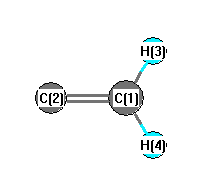 More geometry information
Calculated Bond Angles
| atom1 |
atom2 |
atom3 |
angle |
|
atom1 |
atom2 |
atom3 |
angle |
| C2 |
C1 |
H3 |
120.136 |
|
C2 |
C1 |
H4 |
120.136 |
| H3 |
C1 |
H4 |
119.728 |
|
Electronic energy levels
Charges, Dipole, Quadrupole and Polarizability
Jump to
S1C1
Energy calculated at CCSD(T)/aug-cc-pVTZ
| | hartrees |
|---|
| Energy at 0K | -77.048292 |
| Energy at 298.15K | -77.048362 |
| HF Energy | -76.760893 |
| Nuclear repulsion energy | 23.524562 |
The energy at 298.15K was derived from the energy at 0K
and an integrated heat capacity that used the calculated vibrational frequencies.
Vibrational Frequencies calculated at CCSD(T)/aug-cc-pVTZ
| Mode Number |
Symmetry |
Frequency
(cm-1) |
Scaled Frequency
(cm-1) |
IR Intensities
(km mol-1) |
Raman Act
(Å4/u) |
Dep P |
Dep U |
|---|
| 1 |
A1 |
3057 |
2965 |
|
|
|
|
| 2 |
A1 |
1561 |
1514 |
|
|
|
|
| 3 |
A1 |
1404 |
1362 |
|
|
|
|
| 4 |
B1 |
785 |
761 |
|
|
|
|
| 5 |
B2 |
3135 |
3041 |
|
|
|
|
| 6 |
B2 |
999 |
969 |
|
|
|
|
Unscaled Zero Point Vibrational Energy (zpe) 5470.4 cm
-1
Scaled (by 0.9699) Zero Point Vibrational Energy (zpe) 5305.7 cm
-1
See section
III.C.1 List or set vibrational scaling factors
to change the scale factors used here.
See section
III.C.2
Calculate a vibrational scaling factor for a given set of molecules
to determine the least squares best scaling factor.
Geometric Data calculated at CCSD(T)/aug-cc-pVTZ
Point Group is C2v
Cartesians (Å)
| Atom |
x (Å) |
y (Å) |
z (Å) |
|---|
| C1 |
0.000 |
0.000 |
-0.487 |
| C2 |
0.000 |
0.000 |
0.836 |
| H3 |
0.000 |
0.935 |
-1.047 |
| H4 |
0.000 |
-0.935 |
-1.047 |
Atom - Atom Distances (Å)
| |
C1 |
C2 |
H3 |
H4 |
| C1 | | 1.3236 | 1.0895 | 1.0895 |
C2 | 1.3236 | | 2.1022 | 2.1022 | H3 | 1.0895 | 2.1022 | | 1.8702 | H4 | 1.0895 | 2.1022 | 1.8702 | |
More geometry information
Electronic energy levels
Charges, Dipole, Quadrupole and Polarizability
