Jump to
S2C1
Energy calculated at MP2/aug-cc-pVTZ
| | hartrees |
|---|
| Energy at 0K | -77.081323 |
| Energy at 298.15K | -77.080806 |
| HF Energy | -76.794839 |
| Nuclear repulsion energy | 23.874653 |
The energy at 298.15K was derived from the energy at 0K
and an integrated heat capacity that used the calculated vibrational frequencies.
Vibrational Frequencies calculated at MP2/aug-cc-pVTZ
| Mode Number |
Symmetry |
Frequency
(cm-1) |
Scaled Frequency
(cm-1) |
IR Intensities
(km mol-1) |
Raman Act
(Å4/u) |
Dep P |
Dep U |
|---|
| 1 |
A1 |
3161 |
3012 |
58.11 |
|
|
|
| 2 |
A1 |
1685 |
1605 |
90.52 |
|
|
|
| 3 |
A1 |
1210 |
1153 |
19.61 |
|
|
|
| 4 |
B1 |
719 |
685 |
76.66 |
|
|
|
| 5 |
B2 |
3258 |
3104 |
24.33 |
|
|
|
| 6 |
B2 |
190 |
181 |
11.00 |
|
|
|
Unscaled Zero Point Vibrational Energy (zpe) 5110.9 cm
-1
Scaled (by 0.9529) Zero Point Vibrational Energy (zpe) 4870.1 cm
-1
See section
III.C.1 List or set vibrational scaling factors
to change the scale factors used here.
See section
III.C.2
Calculate a vibrational scaling factor for a given set of molecules
to determine the least squares best scaling factor.
Geometric Data calculated at MP2/aug-cc-pVTZ
Point Group is C2v
Cartesians (Å)
| Atom |
x (Å) |
y (Å) |
z (Å) |
|---|
| C1 |
0.000 |
0.000 |
-0.480 |
| C2 |
0.000 |
0.000 |
0.819 |
| H3 |
0.000 |
0.943 |
-1.016 |
| H4 |
0.000 |
-0.943 |
-1.016 |
Atom - Atom Distances (Å)
| |
C1 |
C2 |
H3 |
H4 |
| C1 | | 1.2994 | 1.0845 | 1.0845 |
C2 | 1.2994 | | 2.0634 | 2.0634 | H3 | 1.0845 | 2.0634 | | 1.8854 | H4 | 1.0845 | 2.0634 | 1.8854 | |
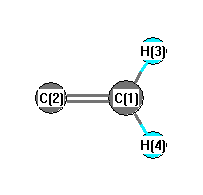 More geometry information
Calculated Bond Angles
| atom1 |
atom2 |
atom3 |
angle |
|
atom1 |
atom2 |
atom3 |
angle |
| C2 |
C1 |
H3 |
119.626 |
|
C2 |
C1 |
H4 |
119.626 |
| H3 |
C1 |
H4 |
120.748 |
|
Electronic energy levels
Charges, Dipole, Quadrupole and Polarizability
Jump to
S1C1
Energy calculated at MP2/aug-cc-pVTZ
| | hartrees |
|---|
| Energy at 0K | -77.000172 |
| Energy at 298.15K | -77.000298 |
| HF Energy | -76.759671 |
| Nuclear repulsion energy | 23.906181 |
The energy at 298.15K was derived from the energy at 0K
and an integrated heat capacity that used the calculated vibrational frequencies.
Vibrational Frequencies calculated at MP2/aug-cc-pVTZ
| Mode Number |
Symmetry |
Frequency
(cm-1) |
Scaled Frequency
(cm-1) |
IR Intensities
(km mol-1) |
Raman Act
(Å4/u) |
Dep P |
Dep U |
|---|
| 1 |
A1 |
3127 |
2980 |
2.39 |
|
|
|
| 2 |
A1 |
1661 |
1583 |
2.23 |
|
|
|
| 3 |
A1 |
1430 |
1362 |
5.88 |
|
|
|
| 4 |
B1 |
968 |
923 |
29.11 |
|
|
|
| 5 |
B2 |
3214 |
3062 |
1.01 |
|
|
|
| 6 |
B2 |
1017 |
969 |
1.58 |
|
|
|
Unscaled Zero Point Vibrational Energy (zpe) 5708.4 cm
-1
Scaled (by 0.9529) Zero Point Vibrational Energy (zpe) 5439.5 cm
-1
See section
III.C.1 List or set vibrational scaling factors
to change the scale factors used here.
See section
III.C.2
Calculate a vibrational scaling factor for a given set of molecules
to determine the least squares best scaling factor.
Geometric Data calculated at MP2/aug-cc-pVTZ
Point Group is C2v
Cartesians (Å)
| Atom |
x (Å) |
y (Å) |
z (Å) |
|---|
| C1 |
0.000 |
0.000 |
-0.475 |
| C2 |
0.000 |
0.000 |
0.820 |
| H3 |
0.000 |
0.930 |
-1.034 |
| H4 |
0.000 |
-0.930 |
-1.034 |
Atom - Atom Distances (Å)
| |
C1 |
C2 |
H3 |
H4 |
| C1 | | 1.2952 | 1.0851 | 1.0851 |
C2 | 1.2952 | | 2.0744 | 2.0744 | H3 | 1.0851 | 2.0744 | | 1.8600 | H4 | 1.0851 | 2.0744 | 1.8600 | |
More geometry information
Electronic energy levels
Charges, Dipole, Quadrupole and Polarizability
