Jump to
S1C2
S1C3
Energy calculated at CCSD(T)/aug-cc-pVTZ
| | hartrees |
|---|
| Energy at 0K | -100.182400 |
| Energy at 298.15K | -100.181438 |
| HF Energy | -99.809685 |
| Nuclear repulsion energy | 27.442386 |
The energy at 298.15K was derived from the energy at 0K
and an integrated heat capacity that used the calculated vibrational frequencies.
Geometric Data calculated at CCSD(T)/aug-cc-pVTZ
Point Group is C∞v
Cartesians (Å)
| Atom |
x (Å) |
y (Å) |
z (Å) |
|---|
| Li1 |
0.000 |
0.000 |
-2.084 |
| C2 |
0.000 |
0.000 |
-0.151 |
| N3 |
0.000 |
0.000 |
1.023 |
Atom - Atom Distances (Å)
| |
Li1 |
C2 |
N3 |
| Li1 | | 1.9332 | 3.1071 |
C2 | 1.9332 | | 1.1739 | N3 | 3.1071 | 1.1739 | |
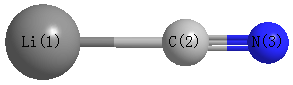 More geometry information
Calculated Bond Angles
| atom1 |
atom2 |
atom3 |
angle |
|
atom1 |
atom2 |
atom3 |
angle |
| Li1 |
C2 |
N3 |
180.000 |
|
Li1 |
N3 |
C2 |
0.000 |
| C2 |
Li1 |
N3 |
0.000 |
|
Electronic energy levels
Charges, Dipole, Quadrupole and Polarizability
Jump to
S1C1
S1C3
Energy calculated at CCSD(T)/aug-cc-pVTZ
| | hartrees |
|---|
| Energy at 0K | -100.185379 |
| Energy at 298.15K | -100.184610 |
| HF Energy | -99.815743 |
| Nuclear repulsion energy | 29.116805 |
The energy at 298.15K was derived from the energy at 0K
and an integrated heat capacity that used the calculated vibrational frequencies.
Geometric Data calculated at CCSD(T)/aug-cc-pVTZ
Point Group is Cs
Cartesians (Å)
| Atom |
x (Å) |
y (Å) |
z (Å) |
|---|
| Li1 |
1.430 |
-0.619 |
0.000 |
| C2 |
-0.715 |
-0.367 |
0.000 |
| N3 |
0.000 |
0.579 |
0.000 |
Atom - Atom Distances (Å)
| |
Li1 |
C2 |
N3 |
| Li1 | | 2.1591 | 1.8651 |
C2 | 2.1591 | | 1.1857 | N3 | 1.8651 | 1.1857 | |
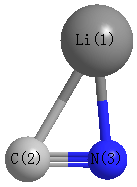 More geometry information
Calculated Bond Angles
| atom1 |
atom2 |
atom3 |
angle |
|
atom1 |
atom2 |
atom3 |
angle |
| Li1 |
C2 |
N3 |
59.626 |
|
Li1 |
N3 |
C2 |
87.114 |
| C2 |
Li1 |
N3 |
33.261 |
|
Electronic energy levels
Charges, Dipole, Quadrupole and Polarizability
Jump to
S1C1
S1C2
Energy calculated at CCSD(T)/aug-cc-pVTZ
| | hartrees |
|---|
| Energy at 0K | -100.185941 |
| Energy at 298.15K | -100.184818 |
| HF Energy | -99.820240 |
| Nuclear repulsion energy | 28.205438 |
The energy at 298.15K was derived from the energy at 0K
and an integrated heat capacity that used the calculated vibrational frequencies.
Geometric Data calculated at CCSD(T)/aug-cc-pVTZ
Point Group is C∞v
Cartesians (Å)
| Atom |
x (Å) |
y (Å) |
z (Å) |
|---|
| Li1 |
0.000 |
0.000 |
1.895 |
| C2 |
0.000 |
0.000 |
-1.075 |
| N3 |
0.000 |
0.000 |
0.109 |
Atom - Atom Distances (Å)
| |
Li1 |
C2 |
N3 |
| Li1 | | 2.9694 | 1.7859 |
C2 | 2.9694 | | 1.1835 | N3 | 1.7859 | 1.1835 | |
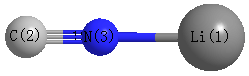 More geometry information
Calculated Bond Angles
| atom1 |
atom2 |
atom3 |
angle |
|
atom1 |
atom2 |
atom3 |
angle |
| Li1 |
C2 |
N3 |
0.000 |
|
Li1 |
N3 |
C2 |
180.000 |
| C2 |
Li1 |
N3 |
0.000 |
|
Electronic energy levels
Charges, Dipole, Quadrupole and Polarizability
