Jump to
S1C2
Energy calculated at CCD/aug-cc-pVTZ
| | hartrees |
|---|
| Energy at 0K | -188.813190 |
| Energy at 298.15K | -188.814295 |
| HF Energy | -188.209197 |
| Nuclear repulsion energy | 63.429485 |
The energy at 298.15K was derived from the energy at 0K
and an integrated heat capacity that used the calculated vibrational frequencies.
Vibrational Frequencies calculated at CCD/aug-cc-pVTZ
| Mode Number |
Symmetry |
Frequency
(cm-1) |
Scaled Frequency
(cm-1) |
IR Intensities
(km mol-1) |
Raman Act
(Å4/u) |
Dep P |
Dep U |
|---|
| 1 |
A' |
3732 |
3572 |
49.64 |
|
|
|
| 2 |
A' |
1933 |
1850 |
365.26 |
|
|
|
| 3 |
A' |
1333 |
1276 |
0.06 |
|
|
|
| 4 |
A' |
1117 |
1069 |
204.78 |
|
|
|
| 5 |
A' |
621 |
594 |
34.37 |
|
|
|
| 6 |
A" |
580 |
555 |
114.38 |
|
|
|
Unscaled Zero Point Vibrational Energy (zpe) 4657.5 cm
-1
Scaled (by 0.957) Zero Point Vibrational Energy (zpe) 4457.2 cm
-1
See section
III.C.1 List or set vibrational scaling factors
to change the scale factors used here.
See section
III.C.2
Calculate a vibrational scaling factor for a given set of molecules
to determine the least squares best scaling factor.
Geometric Data calculated at CCD/aug-cc-pVTZ
Point Group is Cs
Cartesians (Å)
| Atom |
x (Å) |
y (Å) |
z (Å) |
|---|
| C1 |
0.000 |
0.439 |
0.000 |
| O2 |
-1.057 |
-0.362 |
0.000 |
| O3 |
1.151 |
0.193 |
0.000 |
| H4 |
-0.747 |
-1.280 |
0.000 |
Atom - Atom Distances (Å)
| |
C1 |
O2 |
O3 |
H4 |
| C1 | | 1.3265 | 1.1769 | 1.8749 |
O2 | 1.3265 | | 2.2767 | 0.9694 | O3 | 1.1769 | 2.2767 | | 2.4027 | H4 | 1.8749 | 0.9694 | 2.4027 | |
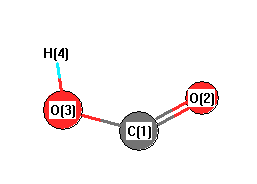 More geometry information
Calculated Bond Angles
| atom1 |
atom2 |
atom3 |
angle |
|
atom1 |
atom2 |
atom3 |
angle |
| C1 |
O2 |
H4 |
108.494 |
|
O2 |
C1 |
O3 |
130.771 |
Electronic energy levels
Charges, Dipole, Quadrupole and Polarizability
Jump to
S1C1
Energy calculated at CCD/aug-cc-pVTZ
| | hartrees |
|---|
| Energy at 0K | -188.816106 |
| Energy at 298.15K | -188.817188 |
| HF Energy | -188.210104 |
| Nuclear repulsion energy | 63.204399 |
The energy at 298.15K was derived from the energy at 0K
and an integrated heat capacity that used the calculated vibrational frequencies.
Vibrational Frequencies calculated at CCD/aug-cc-pVTZ
| Mode Number |
Symmetry |
Frequency
(cm-1) |
Scaled Frequency
(cm-1) |
IR Intensities
(km mol-1) |
Raman Act
(Å4/u) |
Dep P |
Dep U |
|---|
| 1 |
A' |
3876 |
3709 |
136.56 |
|
|
|
| 2 |
A' |
1972 |
1887 |
267.86 |
|
|
|
| 3 |
A' |
1283 |
1228 |
257.46 |
|
|
|
| 4 |
A' |
1118 |
1070 |
74.25 |
|
|
|
| 5 |
A' |
633 |
606 |
4.32 |
|
|
|
| 6 |
A" |
539 |
515 |
85.65 |
|
|
|
Unscaled Zero Point Vibrational Energy (zpe) 4709.9 cm
-1
Scaled (by 0.957) Zero Point Vibrational Energy (zpe) 4507.4 cm
-1
See section
III.C.1 List or set vibrational scaling factors
to change the scale factors used here.
See section
III.C.2
Calculate a vibrational scaling factor for a given set of molecules
to determine the least squares best scaling factor.
Geometric Data calculated at CCD/aug-cc-pVTZ
Point Group is Cs
Cartesians (Å)
| Atom |
x (Å) |
y (Å) |
z (Å) |
|---|
| C1 |
0.000 |
0.404 |
0.000 |
| O2 |
-0.938 |
-0.550 |
0.000 |
| O3 |
1.163 |
0.262 |
0.000 |
| H4 |
-1.799 |
-0.123 |
0.000 |
Atom - Atom Distances (Å)
| |
C1 |
O2 |
O3 |
H4 |
| C1 | | 1.3381 | 1.1719 | 1.8748 |
O2 | 1.3381 | | 2.2529 | 0.9611 | O3 | 1.1719 | 2.2529 | | 2.9874 | H4 | 1.8748 | 0.9611 | 2.9874 | |
More geometry information
Calculated Bond Angles
| atom1 |
atom2 |
atom3 |
angle |
|
atom1 |
atom2 |
atom3 |
angle |
| C1 |
O2 |
H4 |
108.134 |
|
O2 |
C1 |
O3 |
127.554 |
Electronic energy levels
Charges, Dipole, Quadrupole and Polarizability
