Jump to
S1C2
Energy calculated at ROHF/aug-cc-pVTZ
| | hartrees |
|---|
| Energy at 0K | -188.206510 |
| Energy at 298.15K | -188.207680 |
| HF Energy | -188.206510 |
| Nuclear repulsion energy | 64.405884 |
The energy at 298.15K was derived from the energy at 0K
and an integrated heat capacity that used the calculated vibrational frequencies.
Vibrational Frequencies calculated at ROHF/aug-cc-pVTZ
| Mode Number |
Symmetry |
Frequency
(cm-1) |
Scaled Frequency
(cm-1) |
IR Intensities
(km mol-1) |
Raman Act
(Å4/u) |
Dep P |
Dep U |
|---|
| 1 |
A' |
4015 |
4015 |
103.47 |
|
|
|
| 2 |
A' |
2063 |
2063 |
531.31 |
|
|
|
| 3 |
A' |
1416 |
1416 |
5.50 |
|
|
|
| 4 |
A' |
1227 |
1227 |
240.69 |
|
|
|
| 5 |
A' |
673 |
673 |
49.96 |
|
|
|
| 6 |
A" |
615 |
615 |
148.98 |
|
|
|
Unscaled Zero Point Vibrational Energy (zpe) 5004.2 cm
-1
Scaled (by 1) Zero Point Vibrational Energy (zpe) 5004.2 cm
-1
See section
III.C.1 List or set vibrational scaling factors
to change the scale factors used here.
See section
III.C.2
Calculate a vibrational scaling factor for a given set of molecules
to determine the least squares best scaling factor.
Geometric Data calculated at ROHF/aug-cc-pVTZ
Point Group is Cs
Cartesians (Å)
| Atom |
x (Å) |
y (Å) |
z (Å) |
|---|
| C1 |
0.000 |
0.429 |
0.000 |
| O2 |
-1.040 |
-0.359 |
0.000 |
| O3 |
1.135 |
0.196 |
0.000 |
| H4 |
-0.762 |
-1.268 |
0.000 |
Atom - Atom Distances (Å)
| |
C1 |
O2 |
O3 |
H4 |
| C1 | | 1.3047 | 1.1587 | 1.8606 |
O2 | 1.3047 | | 2.2444 | 0.9503 | O3 | 1.1587 | 2.2444 | | 2.3966 | H4 | 1.8606 | 0.9503 | 2.3966 | |
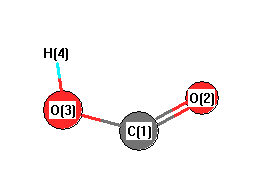 More geometry information
Calculated Bond Angles
| atom1 |
atom2 |
atom3 |
angle |
|
atom1 |
atom2 |
atom3 |
angle |
| C1 |
O2 |
H4 |
110.200 |
|
O2 |
C1 |
O3 |
131.222 |
Electronic energy levels
Charges, Dipole, Quadrupole and Polarizability
Charges from optimized geometry at ROHF/aug-cc-pVTZ
Charges (e)
| Number |
Element |
Mulliken |
CHELPG |
AIM |
ESP |
| 1 |
C |
0.325 |
|
|
|
| 2 |
O |
-0.186 |
|
|
|
| 3 |
O |
-0.341 |
|
|
|
| 4 |
H |
0.202 |
|
|
|
Electric dipole moments
Electric dipole components in Debye
(What's a Debye? See section
VII.A.3)
| |
x |
y |
z |
Total |
| |
-1.423 |
-1.483 |
0.000 |
2.055 |
| CHELPG |
|
|
|
|
| AIM |
|
|
|
|
| ESP |
|
|
|
|
Electric Quadrupole moment
Quadrupole components in D Å
| Primitive |
|---|
| | x | y | z |
|---|
| x |
-20.814 |
0.618 |
-0.001 |
| y |
0.618 |
-13.551 |
-0.003 |
| z |
-0.001 |
-0.003 |
-16.073 |
|
| Traceless |
|---|
| | x | y | z |
|---|
| x |
-6.001 |
0.618 |
-0.001 |
| y |
0.618 |
4.892 |
-0.003 |
| z |
-0.001 |
-0.003 |
1.109 |
|
| Polar |
|---|
| 3z2-r2 | 2.219 |
|---|
| x2-y2 | -7.262 |
|---|
| xy | 0.618 |
|---|
| xz | -0.001 |
|---|
| yz | -0.003 |
|---|
|
Polarizabilities
Components of the polarizability tensor.
Units are
Å
3 (Angstrom cubed)
Change units.
| |
x |
y |
z |
| x |
0.000 |
0.000 |
0.000 |
| y |
0.000 |
0.000 |
0.000 |
| z |
0.000 |
0.000 |
0.000 |
<r2> (average value of r
2) Å
2
| <r2> |
34.088 |
| (<r2>)1/2 |
5.839 |
Jump to
S1C1
Energy calculated at ROHF/aug-cc-pVTZ
| | hartrees |
|---|
| Energy at 0K | -188.206971 |
| Energy at 298.15K | -188.208103 |
| HF Energy | -188.206971 |
| Nuclear repulsion energy | 64.211446 |
The energy at 298.15K was derived from the energy at 0K
and an integrated heat capacity that used the calculated vibrational frequencies.
Vibrational Frequencies calculated at ROHF/aug-cc-pVTZ
| Mode Number |
Symmetry |
Frequency
(cm-1) |
Scaled Frequency
(cm-1) |
IR Intensities
(km mol-1) |
Raman Act
(Å4/u) |
Dep P |
Dep U |
|---|
| 1 |
A' |
4132 |
4132 |
173.64 |
|
|
|
| 2 |
A' |
2114 |
2114 |
446.06 |
|
|
|
| 3 |
A' |
1379 |
1379 |
355.42 |
|
|
|
| 4 |
A' |
1216 |
1216 |
33.44 |
|
|
|
| 5 |
A' |
697 |
697 |
7.15 |
|
|
|
| 6 |
A" |
541 |
541 |
89.61 |
|
|
|
Unscaled Zero Point Vibrational Energy (zpe) 5039.9 cm
-1
Scaled (by 1) Zero Point Vibrational Energy (zpe) 5039.9 cm
-1
See section
III.C.1 List or set vibrational scaling factors
to change the scale factors used here.
See section
III.C.2
Calculate a vibrational scaling factor for a given set of molecules
to determine the least squares best scaling factor.
Geometric Data calculated at ROHF/aug-cc-pVTZ
Point Group is Cs
Cartesians (Å)
| Atom |
x (Å) |
y (Å) |
z (Å) |
|---|
| C1 |
0.000 |
0.388 |
0.000 |
| O2 |
-0.924 |
-0.544 |
0.000 |
| O3 |
1.147 |
0.272 |
0.000 |
| H4 |
-1.786 |
-0.159 |
0.000 |
Atom - Atom Distances (Å)
| |
C1 |
O2 |
O3 |
H4 |
| C1 | | 1.3123 | 1.1531 | 1.8676 |
O2 | 1.3123 | | 2.2263 | 0.9434 | O3 | 1.1531 | 2.2263 | | 2.9645 | H4 | 1.8676 | 0.9434 | 2.9645 | |
More geometry information
Calculated Bond Angles
| atom1 |
atom2 |
atom3 |
angle |
|
atom1 |
atom2 |
atom3 |
angle |
| C1 |
O2 |
H4 |
110.713 |
|
O2 |
C1 |
O3 |
128.995 |
Electronic energy levels
Charges, Dipole, Quadrupole and Polarizability
Charges from optimized geometry at ROHF/aug-cc-pVTZ
Charges (e)
| Number |
Element |
Mulliken |
CHELPG |
AIM |
ESP |
| 1 |
C |
0.319 |
|
|
|
| 2 |
O |
-0.235 |
|
|
|
| 3 |
O |
-0.338 |
|
|
|
| 4 |
H |
0.254 |
|
|
|
Electric dipole moments
Electric dipole components in Debye
(What's a Debye? See section
VII.A.3)
| |
x |
y |
z |
Total |
| |
-3.457 |
0.560 |
0.000 |
3.502 |
| CHELPG |
|
|
|
|
| AIM |
|
|
|
|
| ESP |
|
|
|
|
Electric Quadrupole moment
Quadrupole components in D Å
| Primitive |
|---|
| | x | y | z |
|---|
| x |
-14.441 |
-1.153 |
-0.004 |
| y |
-1.153 |
-17.888 |
-0.000 |
| z |
-0.004 |
-0.000 |
-16.118 |
|
| Traceless |
|---|
| | x | y | z |
|---|
| x |
2.562 |
-1.153 |
-0.004 |
| y |
-1.153 |
-2.608 |
-0.000 |
| z |
-0.004 |
-0.000 |
0.047 |
|
| Polar |
|---|
| 3z2-r2 | 0.094 |
|---|
| x2-y2 | 3.447 |
|---|
| xy | -1.153 |
|---|
| xz | -0.004 |
|---|
| yz | -0.000 |
|---|
|
Polarizabilities
Components of the polarizability tensor.
Units are
Å
3 (Angstrom cubed)
Change units.
| |
x |
y |
z |
| x |
0.000 |
0.000 |
0.000 |
| y |
0.000 |
0.000 |
0.000 |
| z |
0.000 |
0.000 |
0.000 |
<r2> (average value of r
2) Å
2
| <r2> |
34.523 |
| (<r2>)1/2 |
5.876 |
