Jump to
S1C2
S2C1
S2C2
Energy calculated at QCISD(T)/aug-cc-pVTZ
| | hartrees |
|---|
| Energy at 0K | -131.197978 |
| Energy at 298.15K | -131.197337 |
| HF Energy | -130.724320 |
| Nuclear repulsion energy | 47.117146 |
The energy at 298.15K was derived from the energy at 0K
and an integrated heat capacity that used the calculated vibrational frequencies.
Vibrational Frequencies calculated at QCISD(T)/aug-cc-pVTZ
| Mode Number |
Symmetry |
Frequency
(cm-1) |
Scaled Frequency
(cm-1) |
IR Intensities
(km mol-1) |
Raman Act
(Å4/u) |
Dep P |
Dep U |
|---|
| 1 |
A' |
3337 |
3227 |
|
|
|
|
| 2 |
A' |
1805 |
1745 |
|
|
|
|
| 3 |
A' |
1158 |
1119 |
|
|
|
|
| 4 |
A' |
583 |
563 |
|
|
|
|
| 5 |
A' |
382 |
369 |
|
|
|
|
| 6 |
A" |
418 |
404 |
|
|
|
|
Unscaled Zero Point Vibrational Energy (zpe) 3841.2 cm
-1
Scaled (by 0.9668) Zero Point Vibrational Energy (zpe) 3713.7 cm
-1
See section
III.C.1 List or set vibrational scaling factors
to change the scale factors used here.
See section
III.C.2
Calculate a vibrational scaling factor for a given set of molecules
to determine the least squares best scaling factor.
Geometric Data calculated at QCISD(T)/aug-cc-pVTZ
Point Group is Cs
Cartesians (Å)
| Atom |
x (Å) |
y (Å) |
z (Å) |
|---|
| C1 |
0.088 |
-1.234 |
0.000 |
| C2 |
0.000 |
0.092 |
0.000 |
| N3 |
-0.183 |
1.275 |
0.000 |
| H4 |
0.753 |
-2.074 |
0.000 |
Atom - Atom Distances (Å)
| |
C1 |
C2 |
N3 |
H4 |
| C1 | | 1.3286 | 2.5237 | 1.0717 |
C2 | 1.3286 | | 1.1975 | 2.2931 | N3 | 2.5237 | 1.1975 | | 3.4777 | H4 | 1.0717 | 2.2931 | 3.4777 | |
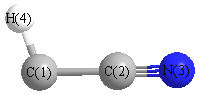 More geometry information
Calculated Bond Angles
| atom1 |
atom2 |
atom3 |
angle |
|
atom1 |
atom2 |
atom3 |
angle |
| C1 |
C2 |
N3 |
175.004 |
|
C2 |
C1 |
H4 |
145.416 |
Electronic energy levels
Charges, Dipole, Quadrupole and Polarizability
Jump to
S1C1
S2C1
S2C2
Energy calculated at QCISD(T)/aug-cc-pVTZ
| | hartrees |
|---|
| Energy at 0K | -131.196214 |
| Energy at 298.15K | |
| HF Energy | -130.722299 |
| Nuclear repulsion energy | 47.230243 |
The energy at 298.15K was derived from the energy at 0K
and an integrated heat capacity that used the calculated vibrational frequencies.
Vibrational Frequencies calculated at QCISD(T)/aug-cc-pVTZ
| Mode Number |
Symmetry |
Frequency
(cm-1) |
Scaled Frequency
(cm-1) |
IR Intensities
(km mol-1) |
Raman Act
(Å4/u) |
Dep P |
Dep U |
|---|
| 1 |
Σ |
3412 |
3299 |
|
|
|
|
| 2 |
Σ |
1677 |
1621 |
|
|
|
|
| 3 |
Σ |
1230 |
1189 |
|
|
|
|
| 4 |
Π |
421 |
407 |
|
|
|
|
| 4 |
Π |
421 |
407 |
|
|
|
|
| 5 |
Π |
397i |
384i |
|
|
|
|
| 5 |
Π |
397i |
384i |
|
|
|
|
Unscaled Zero Point Vibrational Energy (zpe) 3182.5 cm
-1
Scaled (by 0.9668) Zero Point Vibrational Energy (zpe) 3076.9 cm
-1
See section
III.C.1 List or set vibrational scaling factors
to change the scale factors used here.
See section
III.C.2
Calculate a vibrational scaling factor for a given set of molecules
to determine the least squares best scaling factor.
Geometric Data calculated at QCISD(T)/aug-cc-pVTZ
Point Group is C∞v
Cartesians (Å)
| Atom |
x (Å) |
y (Å) |
z (Å) |
|---|
| C1 |
0.000 |
0.000 |
-1.215 |
| C2 |
0.000 |
0.000 |
0.084 |
| N3 |
0.000 |
0.000 |
1.295 |
| H4 |
0.000 |
0.000 |
-2.280 |
Atom - Atom Distances (Å)
| |
C1 |
C2 |
N3 |
H4 |
| C1 | | 1.2986 | 2.5100 | 1.0653 |
C2 | 1.2986 | | 1.2114 | 2.3639 | N3 | 2.5100 | 1.2114 | | 3.5753 | H4 | 1.0653 | 2.3639 | 3.5753 | |
More geometry information
Calculated Bond Angles
| atom1 |
atom2 |
atom3 |
angle |
|
atom1 |
atom2 |
atom3 |
angle |
| C1 |
C2 |
N3 |
180.000 |
|
C2 |
C1 |
H4 |
180.000 |
Electronic energy levels
Charges, Dipole, Quadrupole and Polarizability
Charges from optimized geometry at QCISD(T)/aug-cc-pVTZ
Charges (e)
| Number |
Element |
Mulliken |
CHELPG |
AIM |
ESP |
| 1 |
C |
-0.849 |
|
|
|
| 2 |
C |
0.806 |
|
|
|
| 3 |
N |
-0.509 |
|
|
|
| 4 |
H |
0.552 |
|
|
|
Electric dipole moments
Electric Quadrupole moment
Quadrupole components in D Å
Polarizabilities
Components of the polarizability tensor.
Units are
Å
3 (Angstrom cubed)
Change units.
| |
x |
y |
z |
| x |
0.000 |
0.000 |
0.000 |
| y |
0.000 |
0.000 |
0.000 |
| z |
0.000 |
0.000 |
0.000 |
<r2> (average value of r
2) Å
2
| <r2> |
36.394 |
| (<r2>)1/2 |
6.033 |
Jump to
S1C1
S1C2
S2C2
Energy calculated at QCISD(T)/aug-cc-pVTZ
| | hartrees |
|---|
| Energy at 0K | -131.179082 |
| Energy at 298.15K | -131.178476 |
| HF Energy | -130.662085 |
| Nuclear repulsion energy | 46.694534 |
The energy at 298.15K was derived from the energy at 0K
and an integrated heat capacity that used the calculated vibrational frequencies.
Vibrational Frequencies calculated at QCISD(T)/aug-cc-pVTZ
| Mode Number |
Symmetry |
Frequency
(cm-1) |
Scaled Frequency
(cm-1) |
IR Intensities
(km mol-1) |
Raman Act
(Å4/u) |
Dep P |
Dep U |
|---|
| 1 |
A' |
3049 |
2947 |
|
|
|
|
| 2 |
A' |
2039 |
1971 |
|
|
|
|
| 3 |
A' |
1053 |
1018 |
|
|
|
|
| 4 |
A' |
970 |
937 |
|
|
|
|
| 5 |
A' |
424 |
410 |
|
|
|
|
| 6 |
A" |
290 |
280 |
|
|
|
|
Unscaled Zero Point Vibrational Energy (zpe) 3912.0 cm
-1
Scaled (by 0.9668) Zero Point Vibrational Energy (zpe) 3782.2 cm
-1
See section
III.C.1 List or set vibrational scaling factors
to change the scale factors used here.
See section
III.C.2
Calculate a vibrational scaling factor for a given set of molecules
to determine the least squares best scaling factor.
Geometric Data calculated at QCISD(T)/aug-cc-pVTZ
Point Group is Cs
Cartesians (Å)
| Atom |
x (Å) |
y (Å) |
z (Å) |
|---|
| C1 |
0.101 |
-1.294 |
0.000 |
| C2 |
0.000 |
0.097 |
0.000 |
| N3 |
-0.253 |
1.253 |
0.000 |
| H4 |
1.163 |
-1.582 |
0.000 |
Atom - Atom Distances (Å)
| |
C1 |
C2 |
N3 |
H4 |
| C1 | | 1.3946 | 2.5714 | 1.1002 |
C2 | 1.3946 | | 1.1833 | 2.0422 | N3 | 2.5714 | 1.1833 | | 3.1685 | H4 | 1.1002 | 2.0422 | 3.1685 | |
More geometry information
Electronic energy levels
Charges, Dipole, Quadrupole and Polarizability
Jump to
S1C1
S1C2
S2C1
Energy calculated at QCISD(T)/aug-cc-pVTZ
| | hartrees |
|---|
| Energy at 0K | -131.179082 |
| Energy at 298.15K | -131.178476 |
| HF Energy | -130.662085 |
| Nuclear repulsion energy | 46.694534 |
The energy at 298.15K was derived from the energy at 0K
and an integrated heat capacity that used the calculated vibrational frequencies.
Vibrational Frequencies calculated at QCISD(T)/aug-cc-pVTZ
Geometric Data calculated at QCISD(T)/aug-cc-pVTZ
Point Group is Cs
Electronic energy levels
Charges, Dipole, Quadrupole and Polarizability
