Jump to
S1C2
S2C1
S2C2
Energy calculated at B2PLYP/aug-cc-pVTZ
| | hartrees |
|---|
| Energy at 0K | -131.360630 |
| Energy at 298.15K | -131.360006 |
| HF Energy | -131.215652 |
| Nuclear repulsion energy | 47.530014 |
The energy at 298.15K was derived from the energy at 0K
and an integrated heat capacity that used the calculated vibrational frequencies.
Vibrational Frequencies calculated at B2PLYP/aug-cc-pVTZ
| Mode Number |
Symmetry |
Frequency
(cm-1) |
Scaled Frequency
(cm-1) |
IR Intensities
(km mol-1) |
Raman Act
(Å4/u) |
Dep P |
Dep U |
|---|
| 1 |
A' |
3375 |
3243 |
32.87 |
|
|
|
| 2 |
A' |
1860 |
1787 |
20.97 |
|
|
|
| 3 |
A' |
1188 |
1142 |
13.87 |
|
|
|
| 4 |
A' |
536 |
515 |
27.13 |
|
|
|
| 5 |
A' |
396 |
380 |
12.04 |
|
|
|
| 6 |
A" |
453 |
435 |
1.46 |
|
|
|
Unscaled Zero Point Vibrational Energy (zpe) 3903.5 cm
-1
Scaled (by 0.961) Zero Point Vibrational Energy (zpe) 3751.3 cm
-1
See section
III.C.1 List or set vibrational scaling factors
to change the scale factors used here.
See section
III.C.2
Calculate a vibrational scaling factor for a given set of molecules
to determine the least squares best scaling factor.
Geometric Data calculated at B2PLYP/aug-cc-pVTZ
Point Group is Cs
Cartesians (Å)
| Atom |
x (Å) |
y (Å) |
z (Å) |
|---|
| C1 |
0.027 |
-1.224 |
0.000 |
| C2 |
0.000 |
0.092 |
0.000 |
| N3 |
-0.110 |
1.273 |
0.000 |
| H4 |
0.605 |
-2.121 |
0.000 |
Atom - Atom Distances (Å)
| |
C1 |
C2 |
N3 |
H4 |
| C1 | | 1.3160 | 2.5004 | 1.0674 |
C2 | 1.3160 | | 1.1860 | 2.2945 | N3 | 2.5004 | 1.1860 | | 3.4687 | H4 | 1.0674 | 2.2945 | 3.4687 | |
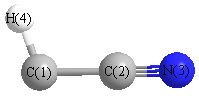 More geometry information
Calculated Bond Angles
| atom1 |
atom2 |
atom3 |
angle |
|
atom1 |
atom2 |
atom3 |
angle |
| C1 |
C2 |
N3 |
175.877 |
|
C2 |
C1 |
H4 |
148.419 |
Electronic energy levels
Charges, Dipole, Quadrupole and Polarizability
Jump to
S1C1
S2C1
S2C2
Energy calculated at B2PLYP/aug-cc-pVTZ
| | hartrees |
|---|
| Energy at 0K | -131.359653 |
| Energy at 298.15K | |
| HF Energy | -131.215086 |
| Nuclear repulsion energy | 47.636592 |
The energy at 298.15K was derived from the energy at 0K
and an integrated heat capacity that used the calculated vibrational frequencies.
Vibrational Frequencies calculated at B2PLYP/aug-cc-pVTZ
| Mode Number |
Symmetry |
Frequency
(cm-1) |
Scaled Frequency
(cm-1) |
IR Intensities
(km mol-1) |
Raman Act
(Å4/u) |
Dep P |
Dep U |
|---|
| 1 |
Σ |
3449 |
3315 |
70.43 |
|
|
|
| 2 |
Σ |
1711 |
1644 |
29.66 |
|
|
|
| 3 |
Σ |
1262 |
1213 |
9.86 |
|
|
|
| 4 |
Π |
450 |
433 |
0.15 |
|
|
|
| 4 |
Π |
450 |
433 |
0.15 |
|
|
|
| 5 |
Π |
325i |
312i |
46.15 |
|
|
|
| 5 |
Π |
325i |
312i |
46.15 |
|
|
|
Unscaled Zero Point Vibrational Energy (zpe) 3336.4 cm
-1
Scaled (by 0.961) Zero Point Vibrational Energy (zpe) 3206.3 cm
-1
See section
III.C.1 List or set vibrational scaling factors
to change the scale factors used here.
See section
III.C.2
Calculate a vibrational scaling factor for a given set of molecules
to determine the least squares best scaling factor.
Geometric Data calculated at B2PLYP/aug-cc-pVTZ
Point Group is C∞v
Cartesians (Å)
| Atom |
x (Å) |
y (Å) |
z (Å) |
|---|
| C1 |
0.000 |
0.000 |
-1.205 |
| C2 |
0.000 |
0.000 |
0.085 |
| N3 |
0.000 |
0.000 |
1.283 |
| H4 |
0.000 |
0.000 |
-2.266 |
Atom - Atom Distances (Å)
| |
C1 |
C2 |
N3 |
H4 |
| C1 | | 1.2894 | 2.4880 | 1.0613 |
C2 | 1.2894 | | 1.1986 | 2.3508 | N3 | 2.4880 | 1.1986 | | 3.5493 | H4 | 1.0613 | 2.3508 | 3.5493 | |
More geometry information
Calculated Bond Angles
| atom1 |
atom2 |
atom3 |
angle |
|
atom1 |
atom2 |
atom3 |
angle |
| C1 |
C2 |
N3 |
180.000 |
|
C2 |
C1 |
H4 |
180.000 |
Electronic energy levels
Charges, Dipole, Quadrupole and Polarizability
Charges from optimized geometry at B2PLYP/aug-cc-pVTZ
Charges (e)
| Number |
Element |
Mulliken |
CHELPG |
AIM |
ESP |
| 1 |
C |
-0.752 |
|
|
|
| 2 |
C |
0.728 |
|
|
|
| 3 |
N |
-0.503 |
|
|
|
| 4 |
H |
0.527 |
|
|
|
Electric dipole moments
Electric dipole components in Debye
(What's a Debye? See section
VII.A.3)
| |
x |
y |
z |
Total |
| |
0.000 |
0.000 |
-3.399 |
3.399 |
| CHELPG |
|
|
|
|
| AIM |
|
|
|
|
| ESP |
|
|
|
|
Electric Quadrupole moment
Quadrupole components in D Å
| Primitive |
|---|
| | x | y | z |
|---|
| x |
-17.550 |
0.000 |
0.000 |
| y |
0.000 |
-17.550 |
0.000 |
| z |
0.000 |
0.000 |
-15.917 |
|
| Traceless |
|---|
| | x | y | z |
|---|
| x |
-0.816 |
0.000 |
0.000 |
| y |
0.000 |
-0.816 |
0.000 |
| z |
0.000 |
0.000 |
1.633 |
|
| Polar |
|---|
| 3z2-r2 | 3.266 |
|---|
| x2-y2 | 0.000 |
|---|
| xy | 0.000 |
|---|
| xz | 0.000 |
|---|
| yz | 0.000 |
|---|
|
Polarizabilities
Components of the polarizability tensor.
Units are
Å
3 (Angstrom cubed)
Change units.
| |
x |
y |
z |
| x |
3.127 |
0.000 |
0.000 |
| y |
0.000 |
3.127 |
0.000 |
| z |
0.000 |
0.000 |
7.108 |
<r2> (average value of r
2) Å
2
| <r2> |
36.035 |
| (<r2>)1/2 |
6.003 |
Jump to
S1C1
S1C2
S2C2
Energy calculated at B2PLYP/aug-cc-pVTZ
| | hartrees |
|---|
| Energy at 0K | -131.341893 |
| Energy at 298.15K | -131.341341 |
| HF Energy | -131.181002 |
| Nuclear repulsion energy | 47.040446 |
The energy at 298.15K was derived from the energy at 0K
and an integrated heat capacity that used the calculated vibrational frequencies.
Vibrational Frequencies calculated at B2PLYP/aug-cc-pVTZ
| Mode Number |
Symmetry |
Frequency
(cm-1) |
Scaled Frequency
(cm-1) |
IR Intensities
(km mol-1) |
Raman Act
(Å4/u) |
Dep P |
Dep U |
|---|
| 1 |
A' |
3095 |
2974 |
3.92 |
|
|
|
| 2 |
A' |
2073 |
1992 |
25.12 |
|
|
|
| 3 |
A' |
1080 |
1038 |
47.38 |
|
|
|
| 4 |
A' |
960 |
923 |
33.02 |
|
|
|
| 5 |
A' |
449 |
431 |
21.71 |
|
|
|
| 6 |
A" |
315 |
303 |
11.55 |
|
|
|
Unscaled Zero Point Vibrational Energy (zpe) 3985.6 cm
-1
Scaled (by 0.961) Zero Point Vibrational Energy (zpe) 3830.2 cm
-1
See section
III.C.1 List or set vibrational scaling factors
to change the scale factors used here.
See section
III.C.2
Calculate a vibrational scaling factor for a given set of molecules
to determine the least squares best scaling factor.
Geometric Data calculated at B2PLYP/aug-cc-pVTZ
Point Group is Cs
Cartesians (Å)
| Atom |
x (Å) |
y (Å) |
z (Å) |
|---|
| C1 |
0.075 |
-1.281 |
0.000 |
| C2 |
0.000 |
0.092 |
0.000 |
| N3 |
-0.223 |
1.250 |
0.000 |
| H4 |
1.114 |
-1.622 |
0.000 |
Atom - Atom Distances (Å)
| |
C1 |
C2 |
N3 |
H4 |
| C1 | | 1.3749 | 2.5487 | 1.0943 |
C2 | 1.3749 | | 1.1796 | 2.0447 | N3 | 2.5487 | 1.1796 | | 3.1687 | H4 | 1.0943 | 2.0447 | 3.1687 | |
More geometry information
Electronic energy levels
Charges, Dipole, Quadrupole and Polarizability
Charges from optimized geometry at B2PLYP/aug-cc-pVTZ
Charges (e)
| Number |
Element |
Mulliken |
CHELPG |
AIM |
ESP |
| 1 |
C |
-0.497 |
|
|
|
| 2 |
C |
0.370 |
|
|
|
| 3 |
N |
-0.245 |
|
|
|
| 4 |
H |
0.371 |
|
|
|
Electric dipole moments
Electric dipole components in Debye
(What's a Debye? See section
VII.A.3)
| |
x |
y |
z |
Total |
| |
1.719 |
-1.449 |
0.000 |
2.249 |
| CHELPG |
|
|
|
|
| AIM |
|
|
|
|
| ESP |
|
|
|
|
Electric Quadrupole moment
Quadrupole components in D Å
| Primitive |
|---|
| | x | y | z |
|---|
| x |
-17.302 |
-2.430 |
0.000 |
| y |
-2.430 |
-21.393 |
0.000 |
| z |
0.000 |
0.000 |
-16.225 |
|
| Traceless |
|---|
| | x | y | z |
|---|
| x |
1.507 |
-2.430 |
0.000 |
| y |
-2.430 |
-4.630 |
0.000 |
| z |
0.000 |
0.000 |
3.123 |
|
| Polar |
|---|
| 3z2-r2 | 6.246 |
|---|
| x2-y2 | 4.092 |
|---|
| xy | -2.430 |
|---|
| xz | 0.000 |
|---|
| yz | 0.000 |
|---|
|
Polarizabilities
Components of the polarizability tensor.
Units are
Å
3 (Angstrom cubed)
Change units.
| |
x |
y |
z |
| x |
3.538 |
-0.501 |
0.000 |
| y |
-0.501 |
7.029 |
0.000 |
| z |
0.000 |
0.000 |
3.413 |
<r2> (average value of r
2) Å
2
| <r2> |
36.528 |
| (<r2>)1/2 |
6.044 |
Jump to
S1C1
S1C2
S2C1
Energy calculated at B2PLYP/aug-cc-pVTZ
| | hartrees |
|---|
| Energy at 0K | -131.341893 |
| Energy at 298.15K | -131.341341 |
| HF Energy | -131.181002 |
| Nuclear repulsion energy | 47.040446 |
The energy at 298.15K was derived from the energy at 0K
and an integrated heat capacity that used the calculated vibrational frequencies.
Vibrational Frequencies calculated at B2PLYP/aug-cc-pVTZ
Geometric Data calculated at B2PLYP/aug-cc-pVTZ
Point Group is Cs
Electronic energy levels
Charges, Dipole, Quadrupole and Polarizability
