Jump to
S1C2
S2C1
S2C2
Energy calculated at CCSD(T)=FULL/aug-cc-pVTZ
| | hartrees |
|---|
| Energy at 0K | -131.247209 |
| Energy at 298.15K | -131.246566 |
| HF Energy | -130.724557 |
| Nuclear repulsion energy | 47.406098 |
The energy at 298.15K was derived from the energy at 0K
and an integrated heat capacity that used the calculated vibrational frequencies.
Vibrational Frequencies calculated at CCSD(T)=FULL/aug-cc-pVTZ
| Mode Number |
Symmetry |
Frequency
(cm-1) |
Scaled Frequency
(cm-1) |
IR Intensities
(km mol-1) |
Raman Act
(Å4/u) |
Dep P |
Dep U |
|---|
| 1 |
A' |
3380 |
3257 |
|
|
|
|
| 2 |
A' |
1822 |
1756 |
|
|
|
|
| 3 |
A' |
1184 |
1141 |
|
|
|
|
| 4 |
A' |
541 |
521 |
|
|
|
|
| 5 |
A' |
387 |
373 |
|
|
|
|
| 6 |
A" |
437 |
421 |
|
|
|
|
Unscaled Zero Point Vibrational Energy (zpe) 3875.3 cm
-1
Scaled (by 0.9637) Zero Point Vibrational Energy (zpe) 3734.6 cm
-1
See section
III.C.1 List or set vibrational scaling factors
to change the scale factors used here.
See section
III.C.2
Calculate a vibrational scaling factor for a given set of molecules
to determine the least squares best scaling factor.
Geometric Data calculated at CCSD(T)=FULL/aug-cc-pVTZ
Point Group is Cs
Cartesians (Å)
| Atom |
x (Å) |
y (Å) |
z (Å) |
|---|
| C1 |
0.045 |
-1.227 |
0.000 |
| C2 |
0.000 |
0.091 |
0.000 |
| N3 |
-0.130 |
1.275 |
0.000 |
| H4 |
0.642 |
-2.107 |
0.000 |
Atom - Atom Distances (Å)
| |
C1 |
C2 |
N3 |
H4 |
| C1 | | 1.3183 | 2.5079 | 1.0639 |
C2 | 1.3183 | | 1.1914 | 2.2899 | N3 | 2.5079 | 1.1914 | | 3.4693 | H4 | 1.0639 | 2.2899 | 3.4693 | |
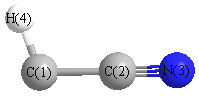 More geometry information
Calculated Bond Angles
| atom1 |
atom2 |
atom3 |
angle |
|
atom1 |
atom2 |
atom3 |
angle |
| C1 |
C2 |
N3 |
175.679 |
|
C2 |
C1 |
H4 |
147.810 |
Electronic energy levels
Charges, Dipole, Quadrupole and Polarizability
Jump to
S1C1
S2C1
S2C2
Energy calculated at CCSD(T)=FULL/aug-cc-pVTZ
| | hartrees |
|---|
| Energy at 0K | -131.245921 |
| Energy at 298.15K | |
| HF Energy | -130.722580 |
| Nuclear repulsion energy | 47.500197 |
The energy at 298.15K was derived from the energy at 0K
and an integrated heat capacity that used the calculated vibrational frequencies.
Vibrational Frequencies calculated at CCSD(T)=FULL/aug-cc-pVTZ
| Mode Number |
Symmetry |
Frequency
(cm-1) |
Scaled Frequency
(cm-1) |
IR Intensities
(km mol-1) |
Raman Act
(Å4/u) |
Dep P |
Dep U |
|---|
| 1 |
Σ |
3430 |
3305 |
|
|
|
|
| 2 |
Σ |
1704 |
1642 |
|
|
|
|
| 3 |
Σ |
1249 |
1204 |
|
|
|
|
| 4 |
Π |
445 |
428 |
|
|
|
|
| 4 |
Π |
444 |
428 |
|
|
|
|
| 5 |
Π |
345i |
332i |
|
|
|
|
| 5 |
Π |
345i |
332i |
|
|
|
|
Unscaled Zero Point Vibrational Energy (zpe) 3290.8 cm
-1
Scaled (by 0.9637) Zero Point Vibrational Energy (zpe) 3171.3 cm
-1
See section
III.C.1 List or set vibrational scaling factors
to change the scale factors used here.
See section
III.C.2
Calculate a vibrational scaling factor for a given set of molecules
to determine the least squares best scaling factor.
Geometric Data calculated at CCSD(T)=FULL/aug-cc-pVTZ
Point Group is C∞v
Cartesians (Å)
| Atom |
x (Å) |
y (Å) |
z (Å) |
|---|
| C1 |
0.000 |
0.000 |
-1.208 |
| C2 |
0.000 |
0.000 |
0.084 |
| N3 |
0.000 |
0.000 |
1.288 |
| H4 |
0.000 |
0.000 |
-2.267 |
Atom - Atom Distances (Å)
| |
C1 |
C2 |
N3 |
H4 |
| C1 | | 1.2920 | 2.4959 | 1.0590 |
C2 | 1.2920 | | 1.2039 | 2.3510 | N3 | 2.4959 | 1.2039 | | 3.5549 | H4 | 1.0590 | 2.3510 | 3.5549 | |
More geometry information
Calculated Bond Angles
| atom1 |
atom2 |
atom3 |
angle |
|
atom1 |
atom2 |
atom3 |
angle |
| C1 |
C2 |
N3 |
180.000 |
|
C2 |
C1 |
H4 |
180.000 |
Electronic energy levels
Charges, Dipole, Quadrupole and Polarizability
Charges from optimized geometry at CCSD(T)=FULL/aug-cc-pVTZ
Charges (e)
| Number |
Element |
Mulliken |
CHELPG |
AIM |
ESP |
| 1 |
C |
-0.844 |
|
|
|
| 2 |
C |
0.797 |
|
|
|
| 3 |
N |
-0.512 |
|
|
|
| 4 |
H |
0.558 |
|
|
|
Electric dipole moments
Electric Quadrupole moment
Quadrupole components in D Å
Polarizabilities
Components of the polarizability tensor.
Units are
Å
3 (Angstrom cubed)
Change units.
| |
x |
y |
z |
| x |
0.000 |
0.000 |
0.000 |
| y |
0.000 |
0.000 |
0.000 |
| z |
0.000 |
0.000 |
0.000 |
<r2> (average value of r
2) Å
2
| <r2> |
36.095 |
| (<r2>)1/2 |
6.008 |
Jump to
S1C1
S1C2
S2C2
Energy calculated at CCSD(T)=FULL/aug-cc-pVTZ
| | hartrees |
|---|
| Energy at 0K | -131.227700 |
| Energy at 298.15K | -131.227110 |
| HF Energy | -130.663196 |
| Nuclear repulsion energy | 46.970589 |
The energy at 298.15K was derived from the energy at 0K
and an integrated heat capacity that used the calculated vibrational frequencies.
Vibrational Frequencies calculated at CCSD(T)=FULL/aug-cc-pVTZ
| Mode Number |
Symmetry |
Frequency
(cm-1) |
Scaled Frequency
(cm-1) |
IR Intensities
(km mol-1) |
Raman Act
(Å4/u) |
Dep P |
Dep U |
|---|
| 1 |
A' |
3093 |
2981 |
|
|
|
|
| 2 |
A' |
2076 |
2001 |
|
|
|
|
| 3 |
A' |
1064 |
1025 |
|
|
|
|
| 4 |
A' |
973 |
938 |
|
|
|
|
| 5 |
A' |
430 |
415 |
|
|
|
|
| 6 |
A" |
296 |
285 |
|
|
|
|
Unscaled Zero Point Vibrational Energy (zpe) 3966.3 cm
-1
Scaled (by 0.9637) Zero Point Vibrational Energy (zpe) 3822.3 cm
-1
See section
III.C.1 List or set vibrational scaling factors
to change the scale factors used here.
See section
III.C.2
Calculate a vibrational scaling factor for a given set of molecules
to determine the least squares best scaling factor.
Geometric Data calculated at CCSD(T)=FULL/aug-cc-pVTZ
Point Group is Cs
Cartesians (Å)
| Atom |
x (Å) |
y (Å) |
z (Å) |
|---|
| C1 |
0.055 |
-1.289 |
0.000 |
| C2 |
0.000 |
0.095 |
0.000 |
| N3 |
-0.204 |
1.255 |
0.000 |
| H4 |
1.097 |
-1.617 |
0.000 |
Atom - Atom Distances (Å)
| |
C1 |
C2 |
N3 |
H4 |
| C1 | | 1.3845 | 2.5564 | 1.0925 |
C2 | 1.3845 | | 1.1776 | 2.0329 | N3 | 2.5564 | 1.1776 | | 3.1522 | H4 | 1.0925 | 2.0329 | 3.1522 | |
More geometry information
Electronic energy levels
Charges, Dipole, Quadrupole and Polarizability
Jump to
S1C1
S1C2
S2C1
Energy calculated at CCSD(T)=FULL/aug-cc-pVTZ
| | hartrees |
|---|
| Energy at 0K | -131.227700 |
| Energy at 298.15K | -131.227110 |
| HF Energy | -130.663196 |
| Nuclear repulsion energy | 46.970589 |
The energy at 298.15K was derived from the energy at 0K
and an integrated heat capacity that used the calculated vibrational frequencies.
Vibrational Frequencies calculated at CCSD(T)=FULL/aug-cc-pVTZ
Geometric Data calculated at CCSD(T)=FULL/aug-cc-pVTZ
Point Group is Cs
Electronic energy levels
Charges, Dipole, Quadrupole and Polarizability
