Jump to
S1C2
Energy calculated at CCD/aug-cc-pVTZ
| | hartrees |
|---|
| Energy at 0K | -958.013475 |
| Energy at 298.15K | |
| HF Energy | -957.449306 |
| Nuclear repulsion energy | 126.108704 |
The energy at 298.15K was derived from the energy at 0K
and an integrated heat capacity that used the calculated vibrational frequencies.
Vibrational Frequencies calculated at CCD/aug-cc-pVTZ
| Mode Number |
Symmetry |
Frequency
(cm-1) |
Scaled Frequency
(cm-1) |
IR Intensities
(km mol-1) |
Raman Act
(Å4/u) |
Dep P |
Dep U |
|---|
| 1 |
A1 |
3307 |
3165 |
0.95 |
|
|
|
| 2 |
A1 |
768 |
735 |
7.25 |
|
|
|
| 3 |
A1 |
313 |
299 |
0.43 |
|
|
|
| 4 |
B1 |
416i |
398i |
33.65 |
|
|
|
| 5 |
B2 |
1257 |
1203 |
57.63 |
|
|
|
| 6 |
B2 |
953 |
912 |
117.00 |
|
|
|
Unscaled Zero Point Vibrational Energy (zpe) 3090.9 cm
-1
Scaled (by 0.957) Zero Point Vibrational Energy (zpe) 2958.0 cm
-1
See section
III.C.1 List or set vibrational scaling factors
to change the scale factors used here.
See section
III.C.2
Calculate a vibrational scaling factor for a given set of molecules
to determine the least squares best scaling factor.
Geometric Data calculated at CCD/aug-cc-pVTZ
Point Group is C2v
Cartesians (Å)
| Atom |
x (Å) |
y (Å) |
z (Å) |
|---|
| C1 |
0.000 |
0.000 |
0.674 |
| H2 |
0.000 |
0.000 |
1.747 |
| Cl3 |
0.000 |
1.470 |
-0.170 |
| Cl4 |
0.000 |
-1.470 |
-0.170 |
Atom - Atom Distances (Å)
| |
C1 |
H2 |
Cl3 |
Cl4 |
| C1 | | 1.0729 | 1.6953 | 1.6953 |
H2 | 1.0729 | | 2.4161 | 2.4161 | Cl3 | 1.6953 | 2.4161 | | 2.9396 | Cl4 | 1.6953 | 2.4161 | 2.9396 | |
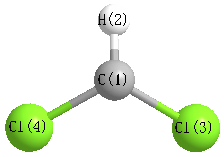 More geometry information
Calculated Bond Angles
| atom1 |
atom2 |
atom3 |
angle |
|
atom1 |
atom2 |
atom3 |
angle |
| Cl3 |
C1 |
H2 |
119.889 |
|
Cl3 |
C1 |
Cl4 |
120.222 |
| Cl4 |
C1 |
H2 |
119.889 |
|
Electronic energy levels
Charges, Dipole, Quadrupole and Polarizability
Jump to
S1C1
Energy calculated at CCD/aug-cc-pVTZ
| | hartrees |
|---|
| Energy at 0K | -958.014503 |
| Energy at 298.15K | -958.015356 |
| HF Energy | -957.450926 |
| Nuclear repulsion energy | 125.921641 |
The energy at 298.15K was derived from the energy at 0K
and an integrated heat capacity that used the calculated vibrational frequencies.
Vibrational Frequencies calculated at CCD/aug-cc-pVTZ
| Mode Number |
Symmetry |
Frequency
(cm-1) |
Scaled Frequency
(cm-1) |
IR Intensities
(km mol-1) |
Raman Act
(Å4/u) |
Dep P |
Dep U |
|---|
| 1 |
A' |
3259 |
3119 |
0.68 |
|
|
|
| 2 |
A' |
777 |
743 |
12.42 |
|
|
|
| 3 |
A' |
530 |
508 |
17.75 |
|
|
|
| 4 |
A' |
308 |
295 |
0.43 |
|
|
|
| 5 |
A" |
1268 |
1214 |
46.11 |
|
|
|
| 6 |
A" |
922 |
882 |
139.71 |
|
|
|
Unscaled Zero Point Vibrational Energy (zpe) 3531.8 cm
-1
Scaled (by 0.957) Zero Point Vibrational Energy (zpe) 3380.0 cm
-1
See section
III.C.1 List or set vibrational scaling factors
to change the scale factors used here.
See section
III.C.2
Calculate a vibrational scaling factor for a given set of molecules
to determine the least squares best scaling factor.
Geometric Data calculated at CCD/aug-cc-pVTZ
Point Group is Cs
Cartesians (Å)
| Atom |
x (Å) |
y (Å) |
z (Å) |
|---|
| C1 |
0.012 |
0.700 |
0.000 |
| H2 |
-0.488 |
1.653 |
0.000 |
| Cl3 |
0.012 |
-0.172 |
1.466 |
| Cl4 |
0.012 |
-0.172 |
-1.466 |
Atom - Atom Distances (Å)
| |
C1 |
H2 |
Cl3 |
Cl4 |
| C1 | | 1.0769 | 1.7056 | 1.7056 |
H2 | 1.0769 | | 2.3941 | 2.3941 | Cl3 | 1.7056 | 2.3941 | | 2.9317 | Cl4 | 1.7056 | 2.3941 | 2.9317 | |
More geometry information
Calculated Bond Angles
| atom1 |
atom2 |
atom3 |
angle |
|
atom1 |
atom2 |
atom3 |
angle |
| Cl3 |
C1 |
H2 |
116.916 |
|
Cl3 |
C1 |
Cl4 |
118.507 |
| Cl4 |
C1 |
H2 |
116.916 |
|
Electronic energy levels
Charges, Dipole, Quadrupole and Polarizability
