Jump to
S1C2
Energy calculated at MP2/aug-cc-pVTZ
| | hartrees |
|---|
| Energy at 0K | -148.529646 |
| Energy at 298.15K | -148.531928 |
| HF Energy | -147.966805 |
| Nuclear repulsion energy | 58.972054 |
The energy at 298.15K was derived from the energy at 0K
and an integrated heat capacity that used the calculated vibrational frequencies.
Vibrational Frequencies calculated at MP2/aug-cc-pVTZ
| Mode Number |
Symmetry |
Frequency
(cm-1) |
Scaled Frequency
(cm-1) |
IR Intensities
(km mol-1) |
Raman Act
(Å4/u) |
Dep P |
Dep U |
|---|
| 1 |
A' |
3569 |
3401 |
46.45 |
|
|
|
| 2 |
A' |
2247 |
2141 |
70.16 |
|
|
|
| 3 |
A' |
1639 |
1561 |
36.66 |
|
|
|
| 4 |
A' |
1070 |
1019 |
9.83 |
|
|
|
| 5 |
A' |
649 |
619 |
194.20 |
|
|
|
| 6 |
A' |
469 |
447 |
17.92 |
|
|
|
| 7 |
A" |
3672 |
3499 |
72.06 |
|
|
|
| 8 |
A" |
1206 |
1149 |
0.06 |
|
|
|
| 9 |
A" |
397 |
378 |
0.43 |
|
|
|
Unscaled Zero Point Vibrational Energy (zpe) 7459.2 cm
-1
Scaled (by 0.9529) Zero Point Vibrational Energy (zpe) 7107.8 cm
-1
See section
III.C.1 List or set vibrational scaling factors
to change the scale factors used here.
See section
III.C.2
Calculate a vibrational scaling factor for a given set of molecules
to determine the least squares best scaling factor.
Geometric Data calculated at MP2/aug-cc-pVTZ
Point Group is Cs
Cartesians (Å)
| Atom |
x (Å) |
y (Å) |
z (Å) |
|---|
| C1 |
0.000 |
0.219 |
0.000 |
| N2 |
-0.010 |
1.385 |
0.000 |
| N3 |
0.084 |
-1.125 |
0.000 |
| H4 |
-0.259 |
-1.568 |
0.839 |
| H5 |
-0.259 |
-1.568 |
-0.839 |
Atom - Atom Distances (Å)
| |
C1 |
N2 |
N3 |
H4 |
H5 |
| C1 | | 1.1663 | 1.3471 | 1.9911 | 1.9911 |
N2 | 1.1663 | | 2.5125 | 3.0801 | 3.0801 | N3 | 1.3471 | 2.5125 | | 1.0089 | 1.0089 | H4 | 1.9911 | 3.0801 | 1.0089 | | 1.6785 | H5 | 1.9911 | 3.0801 | 1.0089 | 1.6785 | |
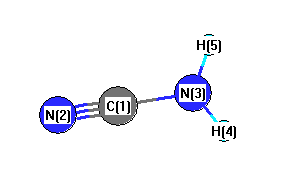 More geometry information
Calculated Bond Angles
| atom1 |
atom2 |
atom3 |
angle |
|
atom1 |
atom2 |
atom3 |
angle |
| C1 |
N3 |
H4 |
114.606 |
|
C1 |
N3 |
H5 |
114.606 |
| N2 |
C1 |
N3 |
176.919 |
|
H4 |
N3 |
H5 |
112.579 |
Electronic energy levels
Charges, Dipole, Quadrupole and Polarizability
Jump to
S1C1
Energy calculated at MP2/aug-cc-pVTZ
| | hartrees |
|---|
| Energy at 0K | -148.527572 |
| Energy at 298.15K | |
| HF Energy | -147.965751 |
| Nuclear repulsion energy | 59.176124 |
The energy at 298.15K was derived from the energy at 0K
and an integrated heat capacity that used the calculated vibrational frequencies.
Vibrational Frequencies calculated at MP2/aug-cc-pVTZ
| Mode Number |
Symmetry |
Frequency
(cm-1) |
Scaled Frequency
(cm-1) |
IR Intensities
(km mol-1) |
Raman Act
(Å4/u) |
Dep P |
Dep U |
|---|
| 1 |
A1 |
3653 |
3480 |
83.41 |
|
|
|
| 2 |
A1 |
2274 |
2167 |
113.29 |
|
|
|
| 3 |
A1 |
1622 |
1546 |
43.27 |
|
|
|
| 4 |
A1 |
1105 |
1053 |
16.87 |
|
|
|
| 5 |
B1 |
495 |
471 |
0.09 |
|
|
|
| 6 |
B1 |
488i |
465i |
238.52 |
|
|
|
| 7 |
B2 |
3783 |
3605 |
112.00 |
|
|
|
| 8 |
B2 |
1129 |
1075 |
1.60 |
|
|
|
| 9 |
B2 |
398 |
379 |
0.00 |
|
|
|
Unscaled Zero Point Vibrational Energy (zpe) 6985.1 cm
-1
Scaled (by 0.9529) Zero Point Vibrational Energy (zpe) 6656.1 cm
-1
See section
III.C.1 List or set vibrational scaling factors
to change the scale factors used here.
See section
III.C.2
Calculate a vibrational scaling factor for a given set of molecules
to determine the least squares best scaling factor.
Geometric Data calculated at MP2/aug-cc-pVTZ
Point Group is C2v
Cartesians (Å)
| Atom |
x (Å) |
y (Å) |
z (Å) |
|---|
| C1 |
0.000 |
0.000 |
0.218 |
| N2 |
0.000 |
0.000 |
1.391 |
| N3 |
0.000 |
0.000 |
-1.115 |
| H4 |
0.000 |
0.865 |
-1.619 |
| H5 |
0.000 |
-0.865 |
-1.619 |
Atom - Atom Distances (Å)
| |
C1 |
N2 |
N3 |
H4 |
H5 |
| C1 | | 1.1729 | 1.3323 | 2.0306 | 2.0306 |
N2 | 1.1729 | | 2.5052 | 3.1318 | 3.1318 | N3 | 1.3323 | 2.5052 | | 1.0017 | 1.0017 | H4 | 2.0306 | 3.1318 | 1.0017 | | 1.7305 | H5 | 2.0306 | 3.1318 | 1.0017 | 1.7305 | |
More geometry information
Calculated Bond Angles
| atom1 |
atom2 |
atom3 |
angle |
|
atom1 |
atom2 |
atom3 |
angle |
| C1 |
N3 |
H4 |
120.258 |
|
C1 |
N3 |
H5 |
120.258 |
| N2 |
C1 |
N3 |
180.000 |
|
H4 |
N3 |
H5 |
119.484 |
Electronic energy levels
Charges, Dipole, Quadrupole and Polarizability
