Jump to
S1C2
Energy calculated at B2PLYP=FULL/aug-cc-pVTZ
| | hartrees |
|---|
| Energy at 0K | -168.544777 |
| Energy at 298.15K | |
| HF Energy | -168.323346 |
| Nuclear repulsion energy | 60.454994 |
The energy at 298.15K was derived from the energy at 0K
and an integrated heat capacity that used the calculated vibrational frequencies.
Vibrational Frequencies calculated at B2PLYP=FULL/aug-cc-pVTZ
| Mode Number |
Symmetry |
Frequency
(cm-1) |
Scaled Frequency
(cm-1) |
IR Intensities
(km mol-1) |
Raman Act
(Å4/u) |
Dep P |
Dep U |
|---|
| 1 |
Σ |
3517 |
3374 |
265.72 |
36.66 |
0.21 |
0.35 |
| 2 |
Σ |
2279 |
2186 |
445.66 |
33.25 |
0.03 |
0.07 |
| 3 |
Σ |
1279 |
1227 |
104.68 |
33.86 |
0.20 |
0.33 |
| 4 |
Π |
557 |
535 |
3.71 |
0.04 |
0.75 |
0.86 |
| 4 |
Π |
557 |
535 |
3.71 |
0.04 |
0.75 |
0.86 |
| 5 |
Π |
74i |
71i |
70.23 |
4.93 |
0.75 |
0.86 |
| 5 |
Π |
74i |
71i |
70.23 |
4.93 |
0.75 |
0.86 |
Unscaled Zero Point Vibrational Energy (zpe) 4020.6 cm
-1
Scaled (by 0.9594) Zero Point Vibrational Energy (zpe) 3857.3 cm
-1
See section
III.C.1 List or set vibrational scaling factors
to change the scale factors used here.
See section
III.C.2
Calculate a vibrational scaling factor for a given set of molecules
to determine the least squares best scaling factor.
Geometric Data calculated at B2PLYP=FULL/aug-cc-pVTZ
Point Group is C∞v
Cartesians (Å)
| Atom |
x (Å) |
y (Å) |
z (Å) |
|---|
| O1 |
0.000 |
0.000 |
1.182 |
| N2 |
0.000 |
0.000 |
-0.019 |
| C3 |
0.000 |
0.000 |
-1.181 |
| H4 |
0.000 |
0.000 |
-2.238 |
Atom - Atom Distances (Å)
| |
O1 |
N2 |
C3 |
H4 |
| O1 | | 1.2013 | 2.3633 | 3.4199 |
N2 | 1.2013 | | 1.1620 | 2.2185 | C3 | 2.3633 | 1.1620 | | 1.0566 | H4 | 3.4199 | 2.2185 | 1.0566 | |
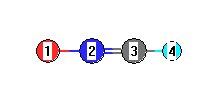 More geometry information
Calculated Bond Angles
| atom1 |
atom2 |
atom3 |
angle |
|
atom1 |
atom2 |
atom3 |
angle |
| O1 |
N2 |
C3 |
180.000 |
|
N2 |
C3 |
H4 |
180.000 |
Electronic energy levels
Charges, Dipole, Quadrupole and Polarizability
Jump to
S1C1
Energy calculated at B2PLYP=FULL/aug-cc-pVTZ
| | hartrees |
|---|
| Energy at 0K | -168.544779 |
| Energy at 298.15K | -168.545135 |
| HF Energy | -168.323147 |
| Nuclear repulsion energy | 60.452766 |
The energy at 298.15K was derived from the energy at 0K
and an integrated heat capacity that used the calculated vibrational frequencies.
Vibrational Frequencies calculated at B2PLYP=FULL/aug-cc-pVTZ
| Mode Number |
Symmetry |
Frequency
(cm-1) |
Scaled Frequency
(cm-1) |
IR Intensities
(km mol-1) |
Raman Act
(Å4/u) |
Dep P |
Dep U |
|---|
| 1 |
A' |
3512 |
3370 |
258.67 |
|
|
|
| 2 |
A' |
2276 |
2183 |
447.59 |
|
|
|
| 3 |
A' |
1280 |
1228 |
101.88 |
|
|
|
| 4 |
A' |
557 |
535 |
4.02 |
|
|
|
| 5 |
A' |
115 |
110 |
80.12 |
|
|
|
| 6 |
A" |
557 |
535 |
3.78 |
|
|
|
Unscaled Zero Point Vibrational Energy (zpe) 4148.1 cm
-1
Scaled (by 0.9594) Zero Point Vibrational Energy (zpe) 3979.7 cm
-1
See section
III.C.1 List or set vibrational scaling factors
to change the scale factors used here.
See section
III.C.2
Calculate a vibrational scaling factor for a given set of molecules
to determine the least squares best scaling factor.
Geometric Data calculated at B2PLYP=FULL/aug-cc-pVTZ
Point Group is Cs
Cartesians (Å)
| Atom |
x (Å) |
y (Å) |
z (Å) |
|---|
| O1 |
-0.379 |
-1.120 |
0.000 |
| N2 |
0.000 |
0.020 |
0.000 |
| C3 |
0.400 |
1.112 |
0.000 |
| H4 |
0.629 |
2.144 |
0.000 |
Atom - Atom Distances (Å)
| |
O1 |
N2 |
C3 |
H4 |
| O1 | | 1.2010 | 2.3635 | 3.4153 |
N2 | 1.2010 | | 1.1627 | 2.2147 | C3 | 2.3635 | 1.1627 | | 1.0569 | H4 | 3.4153 | 2.2147 | 1.0569 | |
More geometry information
Calculated Bond Angles
| atom1 |
atom2 |
atom3 |
angle |
|
atom1 |
atom2 |
atom3 |
angle |
| O1 |
N2 |
C3 |
178.253 |
|
N2 |
C3 |
H4 |
172.385 |
Electronic energy levels
Charges, Dipole, Quadrupole and Polarizability
