Jump to
S1C2
Energy calculated at MP2=FULL/aug-cc-pVTZ
| | hartrees |
|---|
| Energy at 0K | -151.696746 |
| Energy at 298.15K | |
| HF Energy | -151.142615 |
| Nuclear repulsion energy | 52.886401 |
The energy at 298.15K was derived from the energy at 0K
and an integrated heat capacity that used the calculated vibrational frequencies.
Vibrational Frequencies calculated at MP2=FULL/aug-cc-pVTZ
| Mode Number |
Symmetry |
Frequency
(cm-1) |
Scaled Frequency
(cm-1) |
IR Intensities
(km mol-1) |
Raman Act
(Å4/u) |
Dep P |
Dep U |
|---|
| 1 |
Σ |
3518 |
3347 |
228.68 |
31.33 |
0.21 |
0.34 |
| 2 |
Σ |
2449 |
2330 |
1616.04 |
205.41 |
0.13 |
0.23 |
| 3 |
Σ |
1374 |
1307 |
26.08 |
8.32 |
0.04 |
0.08 |
| 4 |
Π |
612 |
582 |
0.01 |
0.83 |
0.75 |
0.86 |
| 4 |
Π |
597 |
568 |
16.18 |
4.86 |
0.75 |
0.86 |
| 5 |
Π |
468 |
445 |
19.98 |
0.05 |
0.75 |
0.86 |
| 5 |
Π |
434i |
413i |
136.88 |
9.41 |
0.75 |
0.86 |
Unscaled Zero Point Vibrational Energy (zpe) 4291.5 cm
-1
Scaled (by 0.9514) Zero Point Vibrational Energy (zpe) 4082.9 cm
-1
See section
III.C.1 List or set vibrational scaling factors
to change the scale factors used here.
See section
III.C.2
Calculate a vibrational scaling factor for a given set of molecules
to determine the least squares best scaling factor.
Geometric Data calculated at MP2=FULL/aug-cc-pVTZ
Point Group is C∞v
Cartesians (Å)
| Atom |
x (Å) |
y (Å) |
z (Å) |
|---|
| C1 |
0.000 |
0.000 |
0.029 |
| C2 |
0.000 |
0.000 |
-1.238 |
| O3 |
0.000 |
0.000 |
1.194 |
| H4 |
0.000 |
0.000 |
-2.292 |
Atom - Atom Distances (Å)
| |
C1 |
C2 |
O3 |
H4 |
| C1 | | 1.2671 | 1.1646 | 2.3205 |
C2 | 1.2671 | | 2.4318 | 1.0534 | O3 | 1.1646 | 2.4318 | | 3.4852 | H4 | 2.3205 | 1.0534 | 3.4852 | |
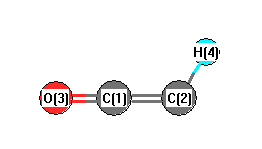 More geometry information
Calculated Bond Angles
| atom1 |
atom2 |
atom3 |
angle |
|
atom1 |
atom2 |
atom3 |
angle |
| C1 |
C2 |
H4 |
180.000 |
|
C2 |
C1 |
O3 |
180.000 |
Electronic energy levels
Charges, Dipole, Quadrupole and Polarizability
Jump to
S1C1
Energy calculated at MP2=FULL/aug-cc-pVTZ
| | hartrees |
|---|
| Energy at 0K | -151.701750 |
| Energy at 298.15K | |
| HF Energy | -151.141911 |
| Nuclear repulsion energy | 52.510412 |
The energy at 298.15K was derived from the energy at 0K
and an integrated heat capacity that used the calculated vibrational frequencies.
Vibrational Frequencies calculated at MP2=FULL/aug-cc-pVTZ
| Mode Number |
Symmetry |
Frequency
(cm-1) |
Scaled Frequency
(cm-1) |
IR Intensities
(km mol-1) |
Raman Act
(Å4/u) |
Dep P |
Dep U |
|---|
| 1 |
A' |
3367 |
3203 |
50.96 |
73.01 |
0.23 |
0.38 |
| 2 |
A' |
2359 |
2244 |
1159.10 |
619.13 |
0.10 |
0.19 |
| 3 |
A' |
1249 |
1189 |
1.31 |
52.01 |
0.54 |
0.70 |
| 4 |
A' |
662 |
630 |
200.87 |
31.21 |
0.10 |
0.18 |
| 5 |
A' |
585 |
556 |
32.84 |
47.05 |
0.19 |
0.32 |
| 6 |
A" |
534 |
508 |
4.17 |
26.52 |
0.75 |
0.86 |
Unscaled Zero Point Vibrational Energy (zpe) 4377.8 cm
-1
Scaled (by 0.9514) Zero Point Vibrational Energy (zpe) 4165.0 cm
-1
See section
III.C.1 List or set vibrational scaling factors
to change the scale factors used here.
See section
III.C.2
Calculate a vibrational scaling factor for a given set of molecules
to determine the least squares best scaling factor.
Geometric Data calculated at MP2=FULL/aug-cc-pVTZ
Point Group is Cs
Cartesians (Å)
| Atom |
x (Å) |
y (Å) |
z (Å) |
|---|
| C1 |
0.000 |
0.052 |
0.000 |
| C2 |
0.997 |
-0.799 |
0.000 |
| O3 |
-1.003 |
0.634 |
0.000 |
| H4 |
2.043 |
-0.583 |
0.000 |
Atom - Atom Distances (Å)
| |
C1 |
C2 |
O3 |
H4 |
| C1 | | 1.3105 | 1.1598 | 2.1394 |
C2 | 1.3105 | | 2.4602 | 1.0679 | O3 | 1.1598 | 2.4602 | | 3.2802 | H4 | 2.1394 | 1.0679 | 3.2802 | |
More geometry information
Calculated Bond Angles
| atom1 |
atom2 |
atom3 |
angle |
|
atom1 |
atom2 |
atom3 |
angle |
| C1 |
C2 |
H4 |
127.887 |
|
C2 |
C1 |
O3 |
169.658 |
Electronic energy levels
Charges, Dipole, Quadrupole and Polarizability
