Jump to
S1C2
Energy calculated at MP2/aug-cc-pVTZ
| | hartrees |
|---|
| Energy at 0K | -151.647425 |
| Energy at 298.15K | |
| HF Energy | -151.142101 |
| Nuclear repulsion energy | 52.696849 |
The energy at 298.15K was derived from the energy at 0K
and an integrated heat capacity that used the calculated vibrational frequencies.
Vibrational Frequencies calculated at MP2/aug-cc-pVTZ
| Mode Number |
Symmetry |
Frequency
(cm-1) |
Scaled Frequency
(cm-1) |
IR Intensities
(km mol-1) |
Raman Act
(Å4/u) |
Dep P |
Dep U |
|---|
| 1 |
Σ |
3507 |
3342 |
228.19 |
34.68 |
0.21 |
0.35 |
| 2 |
Σ |
2449 |
2334 |
1710.45 |
192.43 |
0.13 |
0.22 |
| 3 |
Σ |
1372 |
1308 |
25.96 |
8.17 |
0.06 |
0.12 |
| 4 |
Π |
607 |
578 |
0.06 |
0.79 |
0.75 |
0.86 |
| 4 |
Π |
584 |
557 |
11.53 |
4.93 |
0.75 |
0.86 |
| 5 |
Π |
428 |
408 |
25.08 |
0.24 |
0.75 |
0.86 |
| 5 |
Π |
491i |
467i |
137.76 |
9.36 |
0.75 |
0.86 |
Unscaled Zero Point Vibrational Energy (zpe) 4228.5 cm
-1
Scaled (by 0.9529) Zero Point Vibrational Energy (zpe) 4029.3 cm
-1
See section
III.C.1 List or set vibrational scaling factors
to change the scale factors used here.
See section
III.C.2
Calculate a vibrational scaling factor for a given set of molecules
to determine the least squares best scaling factor.
Geometric Data calculated at MP2/aug-cc-pVTZ
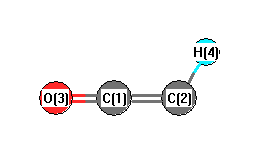
Point Group is C∞v
Cartesians (Å)
| Atom |
x (Å) |
y (Å) |
z (Å) |
|---|
| C1 |
0.000 |
0.000 |
0.029 |
| C2 |
0.000 |
0.000 |
-1.243 |
| O3 |
0.000 |
0.000 |
1.198 |
| H4 |
0.000 |
0.000 |
-2.302 |
Atom - Atom Distances (Å)
| |
C1 |
C2 |
O3 |
H4 |
| C1 | | 1.2718 | 1.1685 | 2.3308 |
C2 | 1.2718 | | 2.4402 | 1.0590 | O3 | 1.1685 | 2.4402 | | 3.4993 | H4 | 2.3308 | 1.0590 | 3.4993 | |
 More geometry information
Calculated Bond Angles
| atom1 |
atom2 |
atom3 |
angle |
|
atom1 |
atom2 |
atom3 |
angle |
| C1 |
C2 |
H4 |
180.000 |
|
C2 |
C1 |
O3 |
180.000 |
Electronic energy levels
Charges, Dipole, Quadrupole and Polarizability
Jump to
S1C1
Energy calculated at MP2/aug-cc-pVTZ
| | hartrees |
|---|
| Energy at 0K | -151.653346 |
| Energy at 298.15K | |
| HF Energy | -151.141020 |
| Nuclear repulsion energy | 52.276281 |
The energy at 298.15K was derived from the energy at 0K
and an integrated heat capacity that used the calculated vibrational frequencies.
Vibrational Frequencies calculated at MP2/aug-cc-pVTZ
| Mode Number |
Symmetry |
Frequency
(cm-1) |
Scaled Frequency
(cm-1) |
IR Intensities
(km mol-1) |
Raman Act
(Å4/u) |
Dep P |
Dep U |
|---|
| 1 |
A' |
3328 |
3171 |
46.57 |
79.28 |
0.21 |
0.35 |
| 2 |
A' |
2348 |
2237 |
1177.58 |
748.80 |
0.11 |
0.20 |
| 3 |
A' |
1233 |
1175 |
1.28 |
84.38 |
0.50 |
0.66 |
| 4 |
A' |
681 |
649 |
195.29 |
52.73 |
0.13 |
0.24 |
| 5 |
A' |
588 |
560 |
23.06 |
70.61 |
0.22 |
0.37 |
| 6 |
A" |
529 |
504 |
3.98 |
28.14 |
0.75 |
0.86 |
Unscaled Zero Point Vibrational Energy (zpe) 4352.7 cm
-1
Scaled (by 0.9529) Zero Point Vibrational Energy (zpe) 4147.7 cm
-1
See section
III.C.1 List or set vibrational scaling factors
to change the scale factors used here.
See section
III.C.2
Calculate a vibrational scaling factor for a given set of molecules
to determine the least squares best scaling factor.
Geometric Data calculated at MP2/aug-cc-pVTZ
Point Group is Cs
Cartesians (Å)
| Atom |
x (Å) |
y (Å) |
z (Å) |
|---|
| C1 |
0.000 |
0.053 |
0.000 |
| C2 |
1.008 |
-0.797 |
0.000 |
| O3 |
-1.013 |
0.626 |
0.000 |
| H4 |
2.054 |
-0.551 |
0.000 |
Atom - Atom Distances (Å)
| |
C1 |
C2 |
O3 |
H4 |
| C1 | | 1.3187 | 1.1637 | 2.1413 |
C2 | 1.3187 | | 2.4717 | 1.0748 | O3 | 1.1637 | 2.4717 | | 3.2853 | H4 | 2.1413 | 1.0748 | 3.2853 | |
More geometry information
Calculated Bond Angles
| atom1 |
atom2 |
atom3 |
angle |
|
atom1 |
atom2 |
atom3 |
angle |
| C1 |
C2 |
H4 |
126.623 |
|
C2 |
C1 |
O3 |
169.358 |
Electronic energy levels
Charges, Dipole, Quadrupole and Polarizability
