Jump to
S1C2
Energy calculated at CCD/aug-cc-pVTZ
| | hartrees |
|---|
| Energy at 0K | -151.652697 |
| Energy at 298.15K | |
| HF Energy | -151.142687 |
| Nuclear repulsion energy | 52.829140 |
The energy at 298.15K was derived from the energy at 0K
and an integrated heat capacity that used the calculated vibrational frequencies.
Vibrational Frequencies calculated at CCD/aug-cc-pVTZ
| Mode Number |
Symmetry |
Frequency
(cm-1) |
Scaled Frequency
(cm-1) |
IR Intensities
(km mol-1) |
Raman Act
(Å4/u) |
Dep P |
Dep U |
|---|
| 1 |
Σ |
3490 |
3340 |
165.00 |
|
|
|
| 2 |
Σ |
2275 |
2177 |
865.07 |
|
|
|
| 3 |
Σ |
1375 |
1316 |
32.53 |
|
|
|
| 4 |
Π |
599 |
573 |
0.15 |
|
|
|
| 4 |
Π |
563 |
538 |
8.91 |
|
|
|
| 5 |
Π |
428 |
410 |
25.68 |
|
|
|
| 5 |
Π |
400i |
383i |
126.00 |
|
|
|
Unscaled Zero Point Vibrational Energy (zpe) 4164.4 cm
-1
Scaled (by 0.957) Zero Point Vibrational Energy (zpe) 3985.3 cm
-1
See section
III.C.1 List or set vibrational scaling factors
to change the scale factors used here.
See section
III.C.2
Calculate a vibrational scaling factor for a given set of molecules
to determine the least squares best scaling factor.
Geometric Data calculated at CCD/aug-cc-pVTZ
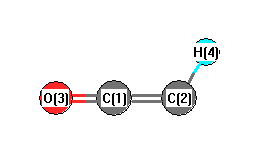
Point Group is C∞v
Cartesians (Å)
| Atom |
x (Å) |
y (Å) |
z (Å) |
|---|
| C1 |
0.000 |
0.000 |
0.026 |
| C2 |
0.000 |
0.000 |
-1.237 |
| O3 |
0.000 |
0.000 |
1.195 |
| H4 |
0.000 |
0.000 |
-2.296 |
Atom - Atom Distances (Å)
| |
C1 |
C2 |
O3 |
H4 |
| C1 | | 1.2623 | 1.1696 | 2.3220 |
C2 | 1.2623 | | 2.4319 | 1.0597 | O3 | 1.1696 | 2.4319 | | 3.4916 | H4 | 2.3220 | 1.0597 | 3.4916 | |
 More geometry information
Calculated Bond Angles
| atom1 |
atom2 |
atom3 |
angle |
|
atom1 |
atom2 |
atom3 |
angle |
| C1 |
C2 |
H4 |
180.000 |
|
C2 |
C1 |
O3 |
180.000 |
Electronic energy levels
Charges, Dipole, Quadrupole and Polarizability
Jump to
S1C1
Energy calculated at CCD/aug-cc-pVTZ
| | hartrees |
|---|
| Energy at 0K | -151.655975 |
| Energy at 298.15K | |
| HF Energy | -151.142377 |
| Nuclear repulsion energy | 52.589963 |
The energy at 298.15K was derived from the energy at 0K
and an integrated heat capacity that used the calculated vibrational frequencies.
Vibrational Frequencies calculated at CCD/aug-cc-pVTZ
| Mode Number |
Symmetry |
Frequency
(cm-1) |
Scaled Frequency
(cm-1) |
IR Intensities
(km mol-1) |
Raman Act
(Å4/u) |
Dep P |
Dep U |
|---|
| 1 |
A' |
3347 |
3203 |
47.53 |
|
|
|
| 2 |
A' |
2228 |
2133 |
812.48 |
|
|
|
| 3 |
A' |
1275 |
1220 |
0.86 |
|
|
|
| 4 |
A' |
613 |
587 |
47.54 |
|
|
|
| 5 |
A' |
524 |
501 |
241.15 |
|
|
|
| 6 |
A" |
526 |
504 |
4.82 |
|
|
|
Unscaled Zero Point Vibrational Energy (zpe) 4256.9 cm
-1
Scaled (by 0.957) Zero Point Vibrational Energy (zpe) 4073.9 cm
-1
See section
III.C.1 List or set vibrational scaling factors
to change the scale factors used here.
See section
III.C.2
Calculate a vibrational scaling factor for a given set of molecules
to determine the least squares best scaling factor.
Geometric Data calculated at CCD/aug-cc-pVTZ
Point Group is Cs
Cartesians (Å)
| Atom |
x (Å) |
y (Å) |
z (Å) |
|---|
| C1 |
0.000 |
0.051 |
0.000 |
| C2 |
0.987 |
-0.801 |
0.000 |
| O3 |
-0.996 |
0.643 |
0.000 |
| H4 |
2.048 |
-0.645 |
0.000 |
Atom - Atom Distances (Å)
| |
C1 |
C2 |
O3 |
H4 |
| C1 | | 1.3040 | 1.1589 | 2.1630 |
C2 | 1.3040 | | 2.4534 | 1.0724 | O3 | 1.1589 | 2.4534 | | 3.3055 | H4 | 2.1630 | 1.0724 | 3.3055 | |
More geometry information
Calculated Bond Angles
| atom1 |
atom2 |
atom3 |
angle |
|
atom1 |
atom2 |
atom3 |
angle |
| C1 |
C2 |
H4 |
130.818 |
|
C2 |
C1 |
O3 |
169.915 |
Electronic energy levels
Charges, Dipole, Quadrupole and Polarizability
