Jump to
S1C2
Energy calculated at ROHF/aug-cc-pVTZ
| | hartrees |
|---|
| Energy at 0K | -151.134700 |
| Energy at 298.15K | |
| HF Energy | -151.134700 |
| Nuclear repulsion energy | 53.514920 |
The energy at 298.15K was derived from the energy at 0K
and an integrated heat capacity that used the calculated vibrational frequencies.
Vibrational Frequencies calculated at ROHF/aug-cc-pVTZ
| Mode Number |
Symmetry |
Frequency
(cm-1) |
Scaled Frequency
(cm-1) |
IR Intensities
(km mol-1) |
Raman Act
(Å4/u) |
Dep P |
Dep U |
|---|
| 1 |
Σ |
3614 |
3614 |
196.14 |
|
|
|
| 2 |
Σ |
2340 |
2340 |
887.40 |
|
|
|
| 3 |
Σ |
1413 |
1413 |
16.80 |
|
|
|
| 4 |
Π |
657 |
657 |
0.67 |
|
|
|
| 4 |
Π |
610 |
610 |
13.61 |
|
|
|
| 5 |
Π |
263 |
263 |
51.28 |
|
|
|
| 5 |
Π |
303i |
303i |
160.57 |
|
|
|
Unscaled Zero Point Vibrational Energy (zpe) 4297.0 cm
-1
Scaled (by 1) Zero Point Vibrational Energy (zpe) 4297.0 cm
-1
See section
III.C.1 List or set vibrational scaling factors
to change the scale factors used here.
See section
III.C.2
Calculate a vibrational scaling factor for a given set of molecules
to determine the least squares best scaling factor.
Geometric Data calculated at ROHF/aug-cc-pVTZ
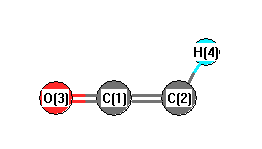
Point Group is C∞v
Cartesians (Å)
| Atom |
x (Å) |
y (Å) |
z (Å) |
|---|
| C1 |
0.000 |
0.000 |
0.031 |
| C2 |
0.000 |
0.000 |
-1.224 |
| O3 |
0.000 |
0.000 |
1.179 |
| H4 |
0.000 |
0.000 |
-2.275 |
Atom - Atom Distances (Å)
| |
C1 |
C2 |
O3 |
H4 |
| C1 | | 1.2551 | 1.1472 | 2.3064 |
C2 | 1.2551 | | 2.4023 | 1.0513 | O3 | 1.1472 | 2.4023 | | 3.4536 | H4 | 2.3064 | 1.0513 | 3.4536 | |
 More geometry information
Calculated Bond Angles
| atom1 |
atom2 |
atom3 |
angle |
|
atom1 |
atom2 |
atom3 |
angle |
| C1 |
C2 |
H4 |
180.000 |
|
C2 |
C1 |
O3 |
180.000 |
Electronic energy levels
Charges, Dipole, Quadrupole and Polarizability
Charges from optimized geometry at ROHF/aug-cc-pVTZ
Charges (e)
| Number |
Element |
Mulliken |
CHELPG |
AIM |
ESP |
| 1 |
C |
0.528 |
|
|
|
| 2 |
C |
-0.662 |
|
|
|
| 3 |
O |
-0.430 |
|
|
|
| 4 |
H |
0.564 |
|
|
|
Electric dipole moments
Electric dipole components in Debye
(What's a Debye? See section
VII.A.3)
| |
x |
y |
z |
Total |
| |
0.000 |
0.000 |
-2.451 |
2.451 |
| CHELPG |
|
|
|
|
| AIM |
|
|
|
|
| ESP |
|
|
|
|
Electric Quadrupole moment
Quadrupole components in D Å
| Primitive |
|---|
| | x | y | z |
|---|
| x |
-16.275 |
0.000 |
0.000 |
| y |
0.000 |
-18.112 |
0.000 |
| z |
0.000 |
0.000 |
-15.476 |
|
| Traceless |
|---|
| | x | y | z |
|---|
| x |
0.518 |
0.000 |
0.000 |
| y |
0.000 |
-2.236 |
0.000 |
| z |
0.000 |
0.000 |
1.718 |
|
| Polar |
|---|
| 3z2-r2 | 3.436 |
|---|
| x2-y2 | 1.837 |
|---|
| xy | 0.000 |
|---|
| xz | 0.000 |
|---|
| yz | 0.000 |
|---|
|
Polarizabilities
Components of the polarizability tensor.
Units are
Å
3 (Angstrom cubed)
Change units.
| |
x |
y |
z |
| x |
0.000 |
0.000 |
0.000 |
| y |
0.000 |
0.000 |
0.000 |
| z |
0.000 |
0.000 |
0.000 |
<r2> (average value of r
2) Å
2
| <r2> |
35.661 |
| (<r2>)1/2 |
5.972 |
Jump to
S1C1
Energy calculated at ROHF/aug-cc-pVTZ
| | hartrees |
|---|
| Energy at 0K | -151.136766 |
| Energy at 298.15K | |
| HF Energy | -151.136766 |
| Nuclear repulsion energy | 53.299272 |
The energy at 298.15K was derived from the energy at 0K
and an integrated heat capacity that used the calculated vibrational frequencies.
Vibrational Frequencies calculated at ROHF/aug-cc-pVTZ
| Mode Number |
Symmetry |
Frequency
(cm-1) |
Scaled Frequency
(cm-1) |
IR Intensities
(km mol-1) |
Raman Act
(Å4/u) |
Dep P |
Dep U |
|---|
| 1 |
A' |
3467 |
3467 |
60.66 |
|
|
|
| 2 |
A' |
2316 |
2316 |
973.20 |
|
|
|
| 3 |
A' |
1312 |
1312 |
0.10 |
|
|
|
| 4 |
A' |
672 |
672 |
55.58 |
|
|
|
| 5 |
A' |
449 |
449 |
370.15 |
|
|
|
| 6 |
A" |
588 |
588 |
19.46 |
|
|
|
Unscaled Zero Point Vibrational Energy (zpe) 4402.2 cm
-1
Scaled (by 1) Zero Point Vibrational Energy (zpe) 4402.2 cm
-1
See section
III.C.1 List or set vibrational scaling factors
to change the scale factors used here.
See section
III.C.2
Calculate a vibrational scaling factor for a given set of molecules
to determine the least squares best scaling factor.
Geometric Data calculated at ROHF/aug-cc-pVTZ
Point Group is Cs
Cartesians (Å)
| Atom |
x (Å) |
y (Å) |
z (Å) |
|---|
| C1 |
0.000 |
0.047 |
0.000 |
| C2 |
0.705 |
-1.044 |
0.000 |
| O3 |
-0.748 |
0.898 |
0.000 |
| H4 |
1.756 |
-1.204 |
0.000 |
Atom - Atom Distances (Å)
| |
C1 |
C2 |
O3 |
H4 |
| C1 | | 1.2986 | 1.1337 | 2.1561 |
C2 | 1.2986 | | 2.4257 | 1.0635 | O3 | 1.1337 | 2.4257 | | 3.2699 | H4 | 2.1561 | 1.0635 | 3.2699 | |
More geometry information
Calculated Bond Angles
| atom1 |
atom2 |
atom3 |
angle |
|
atom1 |
atom2 |
atom3 |
angle |
| C1 |
C2 |
H4 |
131.526 |
|
C2 |
C1 |
O3 |
171.576 |
Electronic energy levels
Charges, Dipole, Quadrupole and Polarizability
Charges from optimized geometry at ROHF/aug-cc-pVTZ
Charges (e)
| Number |
Element |
Mulliken |
CHELPG |
AIM |
ESP |
| 1 |
C |
0.403 |
|
|
|
| 2 |
C |
-0.633 |
|
|
|
| 3 |
O |
-0.275 |
|
|
|
| 4 |
H |
0.505 |
|
|
|
Electric dipole moments
Electric dipole components in Debye
(What's a Debye? See section
VII.A.3)
| |
x |
y |
z |
Total |
| |
1.730 |
0.002 |
0.000 |
1.730 |
| CHELPG |
|
|
|
|
| AIM |
|
|
|
|
| ESP |
|
|
|
|
Electric Quadrupole moment
Quadrupole components in D Å
| Primitive |
|---|
| | x | y | z |
|---|
| x |
-15.363 |
-0.280 |
0.001 |
| y |
-0.280 |
-20.390 |
-0.003 |
| z |
0.001 |
-0.003 |
-16.491 |
|
| Traceless |
|---|
| | x | y | z |
|---|
| x |
3.077 |
-0.280 |
0.001 |
| y |
-0.280 |
-4.463 |
-0.003 |
| z |
0.001 |
-0.003 |
1.386 |
|
| Polar |
|---|
| 3z2-r2 | 2.772 |
|---|
| x2-y2 | 5.027 |
|---|
| xy | -0.280 |
|---|
| xz | 0.001 |
|---|
| yz | -0.003 |
|---|
|
Polarizabilities
Components of the polarizability tensor.
Units are
Å
3 (Angstrom cubed)
Change units.
| |
x |
y |
z |
| x |
0.000 |
0.000 |
0.000 |
| y |
0.000 |
0.000 |
0.000 |
| z |
0.000 |
0.000 |
0.000 |
<r2> (average value of r
2) Å
2
| <r2> |
35.880 |
| (<r2>)1/2 |
5.990 |
