Jump to
S1C2
Energy calculated at CCSD(T)/aug-cc-pVTZ
| | hartrees |
|---|
| Energy at 0K | -277.953563 |
| Energy at 298.15K | |
| HF Energy | -277.038846 |
| Nuclear repulsion energy | 125.539150 |
The energy at 298.15K was derived from the energy at 0K
and an integrated heat capacity that used the calculated vibrational frequencies.
Vibrational Frequencies calculated at CCSD(T)/aug-cc-pVTZ
| Mode Number |
Symmetry |
Frequency
(cm-1) |
Scaled Frequency
(cm-1) |
IR Intensities
(km mol-1) |
Raman Act
(Å4/u) |
Dep P |
Dep U |
|---|
| 1 |
Ag |
3066 |
2974 |
|
|
|
|
| 2 |
Ag |
1529 |
1483 |
|
|
|
|
| 3 |
Ag |
1453 |
1409 |
|
|
|
|
| 4 |
Ag |
1101 |
1068 |
|
|
|
|
| 5 |
Ag |
1069 |
1037 |
|
|
|
|
| 6 |
Ag |
457 |
443 |
|
|
|
|
| 7 |
Au |
3139 |
3045 |
|
|
|
|
| 8 |
Au |
1238 |
1201 |
|
|
|
|
| 9 |
Au |
813 |
789 |
|
|
|
|
| 10 |
Au |
114 |
111 |
|
|
|
|
| 11 |
Bg |
3114 |
3021 |
|
|
|
|
| 12 |
Bg |
1305 |
1266 |
|
|
|
|
| 13 |
Bg |
1180 |
1145 |
|
|
|
|
| 14 |
Bu |
3071 |
2979 |
|
|
|
|
| 15 |
Bu |
1536 |
1490 |
|
|
|
|
| 16 |
Bu |
1364 |
1323 |
|
|
|
|
| 17 |
Bu |
1079 |
1047 |
|
|
|
|
| 18 |
Bu |
275 |
267 |
|
|
|
|
Unscaled Zero Point Vibrational Energy (zpe) 13452.1 cm
-1
Scaled (by 0.9699) Zero Point Vibrational Energy (zpe) 13047.2 cm
-1
See section
III.C.1 List or set vibrational scaling factors
to change the scale factors used here.
See section
III.C.2
Calculate a vibrational scaling factor for a given set of molecules
to determine the least squares best scaling factor.
Geometric Data calculated at CCSD(T)/aug-cc-pVTZ
Point Group is C2h
Cartesians (Å)
| Atom |
x (Å) |
y (Å) |
z (Å) |
|---|
| C1 |
0.427 |
0.627 |
0.000 |
| C2 |
-0.427 |
-0.627 |
0.000 |
| F3 |
-0.427 |
1.724 |
0.000 |
| F4 |
0.427 |
-1.724 |
0.000 |
| H5 |
1.053 |
0.673 |
0.893 |
| H6 |
1.053 |
0.673 |
-0.893 |
| H7 |
-1.053 |
-0.673 |
0.893 |
| H8 |
-1.053 |
-0.673 |
-0.893 |
Atom - Atom Distances (Å)
| |
C1 |
C2 |
F3 |
F4 |
H5 |
H6 |
H7 |
H8 |
| C1 | | 1.5173 | 1.3906 | 2.3514 | 1.0915 | 1.0915 | 2.1628 | 2.1628 |
C2 | 1.5173 | | 2.3514 | 1.3906 | 2.1628 | 2.1628 | 1.0915 | 1.0915 | F3 | 1.3906 | 2.3514 | | 3.5529 | 2.0232 | 2.0232 | 2.6336 | 2.6336 | F4 | 2.3514 | 1.3906 | 3.5529 | | 2.6336 | 2.6336 | 2.0232 | 2.0232 | H5 | 1.0915 | 2.1628 | 2.0232 | 2.6336 | | 1.7864 | 2.4989 | 3.0717 | H6 | 1.0915 | 2.1628 | 2.0232 | 2.6336 | 1.7864 | | 3.0717 | 2.4989 | H7 | 2.1628 | 1.0915 | 2.6336 | 2.0232 | 2.4989 | 3.0717 | | 1.7864 | H8 | 2.1628 | 1.0915 | 2.6336 | 2.0232 | 3.0717 | 2.4989 | 1.7864 | |
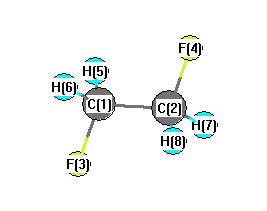 More geometry information
Calculated Bond Angles
| atom1 |
atom2 |
atom3 |
angle |
|
atom1 |
atom2 |
atom3 |
angle |
| C1 |
C2 |
F4 |
107.837 |
|
C1 |
C2 |
H7 |
110.942 |
| C1 |
C2 |
H8 |
110.942 |
|
C2 |
C1 |
F3 |
107.837 |
| C2 |
C1 |
H5 |
110.942 |
|
C2 |
C1 |
H6 |
110.942 |
| F3 |
C1 |
H5 |
108.600 |
|
F3 |
C1 |
H6 |
108.600 |
| F4 |
C2 |
H7 |
108.600 |
|
F4 |
C2 |
H8 |
108.600 |
| H5 |
C1 |
H6 |
109.838 |
|
H7 |
C2 |
H8 |
109.838 |
Electronic energy levels
Charges, Dipole, Quadrupole and Polarizability
Jump to
S1C1
Energy calculated at CCSD(T)/aug-cc-pVTZ
| | hartrees |
|---|
| Energy at 0K | -277.954754 |
| Energy at 298.15K | |
| HF Energy | -277.039459 |
| Nuclear repulsion energy | 127.688720 |
The energy at 298.15K was derived from the energy at 0K
and an integrated heat capacity that used the calculated vibrational frequencies.
Vibrational Frequencies calculated at CCSD(T)/aug-cc-pVTZ
| Mode Number |
Symmetry |
Frequency
(cm-1) |
Scaled Frequency
(cm-1) |
IR Intensities
(km mol-1) |
Raman Act
(Å4/u) |
Dep P |
Dep U |
|---|
| 1 |
A |
3108 |
3014 |
|
|
|
|
| 2 |
A |
3058 |
2966 |
|
|
|
|
| 3 |
A |
1503 |
1458 |
|
|
|
|
| 4 |
A |
1446 |
1403 |
|
|
|
|
| 5 |
A |
1306 |
1267 |
|
|
|
|
| 6 |
A |
1137 |
1103 |
|
|
|
|
| 7 |
A |
1129 |
1095 |
|
|
|
|
| 8 |
A |
879 |
852 |
|
|
|
|
| 9 |
A |
323 |
314 |
|
|
|
|
| 10 |
A |
150 |
145 |
|
|
|
|
| 11 |
B |
3120 |
3026 |
|
|
|
|
| 12 |
B |
3049 |
2957 |
|
|
|
|
| 13 |
B |
1503 |
1457 |
|
|
|
|
| 14 |
B |
1408 |
1366 |
|
|
|
|
| 15 |
B |
1265 |
1227 |
|
|
|
|
| 16 |
B |
1097 |
1064 |
|
|
|
|
| 17 |
B |
911 |
883 |
|
|
|
|
| 18 |
B |
497 |
482 |
|
|
|
|
Unscaled Zero Point Vibrational Energy (zpe) 13443.8 cm
-1
Scaled (by 0.9699) Zero Point Vibrational Energy (zpe) 13039.2 cm
-1
See section
III.C.1 List or set vibrational scaling factors
to change the scale factors used here.
See section
III.C.2
Calculate a vibrational scaling factor for a given set of molecules
to determine the least squares best scaling factor.
Geometric Data calculated at CCSD(T)/aug-cc-pVTZ
Point Group is C2
Cartesians (Å)
| Atom |
x (Å) |
y (Å) |
z (Å) |
|---|
| C1 |
0.268 |
0.704 |
0.514 |
| C2 |
-0.268 |
-0.704 |
0.514 |
| F3 |
-0.268 |
1.421 |
-0.548 |
| F4 |
0.268 |
-1.421 |
-0.548 |
| H5 |
-0.017 |
1.207 |
1.442 |
| H6 |
1.355 |
0.702 |
0.407 |
| H7 |
0.017 |
-1.207 |
1.442 |
| H8 |
-1.355 |
-0.702 |
0.407 |
Atom - Atom Distances (Å)
| |
C1 |
C2 |
F3 |
F4 |
H5 |
H6 |
H7 |
H8 |
| C1 | | 1.5054 | 1.3884 | 2.3747 | 1.0939 | 1.0922 | 2.1389 | 2.1491 |
C2 | 1.5054 | | 2.3747 | 1.3884 | 2.1389 | 2.1491 | 1.0939 | 1.0922 | F3 | 1.3884 | 2.3747 | | 2.8910 | 2.0175 | 2.0148 | 3.3084 | 2.5691 | F4 | 2.3747 | 1.3884 | 2.8910 | | 3.3084 | 2.5691 | 2.0175 | 2.0148 | H5 | 1.0939 | 2.1389 | 2.0175 | 3.3084 | | 1.7906 | 2.4139 | 2.5507 | H6 | 1.0922 | 2.1491 | 2.0148 | 2.5691 | 1.7906 | | 2.5507 | 3.0515 | H7 | 2.1389 | 1.0939 | 3.3084 | 2.0175 | 2.4139 | 2.5507 | | 1.7906 | H8 | 2.1491 | 1.0922 | 2.5691 | 2.0148 | 2.5507 | 3.0515 | 1.7906 | |
More geometry information
Calculated Bond Angles
| atom1 |
atom2 |
atom3 |
angle |
|
atom1 |
atom2 |
atom3 |
angle |
| C1 |
C2 |
F4 |
110.224 |
|
C1 |
C2 |
H7 |
109.736 |
| C1 |
C2 |
H8 |
110.649 |
|
C2 |
C1 |
F3 |
110.224 |
| C2 |
C1 |
H5 |
109.736 |
|
C2 |
C1 |
H6 |
110.649 |
| F3 |
C1 |
H5 |
108.151 |
|
F3 |
C1 |
H6 |
108.038 |
| F4 |
C2 |
H7 |
108.151 |
|
F4 |
C2 |
H8 |
108.038 |
| H5 |
C1 |
H6 |
109.991 |
|
H7 |
C2 |
H8 |
109.991 |
Electronic energy levels
Charges, Dipole, Quadrupole and Polarizability
