Jump to
S1C2
Energy calculated at CCSD(T)=FULL/aug-cc-pVTZ
| | hartrees |
|---|
| Energy at 0K | -189.566413 |
| Energy at 298.15K | -189.569137 |
| HF Energy | -188.844497 |
| Nuclear repulsion energy | 70.300221 |
The energy at 298.15K was derived from the energy at 0K
and an integrated heat capacity that used the calculated vibrational frequencies.
Vibrational Frequencies calculated at CCSD(T)=FULL/aug-cc-pVTZ
| Mode Number |
Symmetry |
Frequency
(cm-1) |
Scaled Frequency
(cm-1) |
IR Intensities
(km mol-1) |
Raman Act
(Å4/u) |
Dep P |
Dep U |
|---|
| 1 |
A' |
3767 |
3631 |
|
|
|
|
| 2 |
A' |
3099 |
2987 |
|
|
|
|
| 3 |
A' |
1818 |
1752 |
|
|
|
|
| 4 |
A' |
1414 |
1363 |
|
|
|
|
| 5 |
A' |
1317 |
1270 |
|
|
|
|
| 6 |
A' |
1140 |
1099 |
|
|
|
|
| 7 |
A' |
633 |
610 |
|
|
|
|
| 8 |
A" |
1070 |
1031 |
|
|
|
|
| 9 |
A" |
673 |
649 |
|
|
|
|
Unscaled Zero Point Vibrational Energy (zpe) 7466.2 cm
-1
Scaled (by 0.9637) Zero Point Vibrational Energy (zpe) 7195.2 cm
-1
See section
III.C.1 List or set vibrational scaling factors
to change the scale factors used here.
See section
III.C.2
Calculate a vibrational scaling factor for a given set of molecules
to determine the least squares best scaling factor.
Geometric Data calculated at CCSD(T)=FULL/aug-cc-pVTZ
Point Group is Cs
Cartesians (Å)
| Atom |
x (Å) |
y (Å) |
z (Å) |
|---|
| C1 |
0.000 |
0.421 |
0.000 |
| O2 |
-1.030 |
-0.441 |
0.000 |
| O3 |
1.159 |
0.111 |
0.000 |
| H4 |
-0.376 |
1.444 |
0.000 |
| H5 |
-0.652 |
-1.330 |
0.000 |
Atom - Atom Distances (Å)
| |
C1 |
O2 |
O3 |
H4 |
H5 |
| C1 | | 1.3431 | 1.1996 | 1.0900 | 1.8688 |
O2 | 1.3431 | | 2.2573 | 1.9949 | 0.9672 | O3 | 1.1996 | 2.2573 | | 2.0334 | 2.3138 | H4 | 1.0900 | 1.9949 | 2.0334 | | 2.7882 | H5 | 1.8688 | 0.9672 | 2.3138 | 2.7882 | |
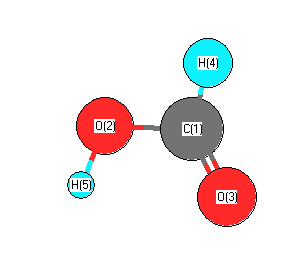 More geometry information
Calculated Bond Angles
| atom1 |
atom2 |
atom3 |
angle |
|
atom1 |
atom2 |
atom3 |
angle |
| C1 |
O2 |
H5 |
106.849 |
|
O2 |
C1 |
O3 |
125.091 |
| O2 |
C1 |
H4 |
109.715 |
|
O3 |
C1 |
H4 |
125.194 |
Electronic energy levels
Charges, Dipole, Quadrupole and Polarizability
Jump to
S1C1
Energy calculated at CCSD(T)=FULL/aug-cc-pVTZ
| | hartrees |
|---|
| Energy at 0K | -189.559608 |
| Energy at 298.15K | |
| HF Energy | -188.836916 |
| Nuclear repulsion energy | 70.072518 |
The energy at 298.15K was derived from the energy at 0K
and an integrated heat capacity that used the calculated vibrational frequencies.
Vibrational Frequencies calculated at CCSD(T)=FULL/aug-cc-pVTZ
| Mode Number |
Symmetry |
Frequency
(cm-1) |
Scaled Frequency
(cm-1) |
IR Intensities
(km mol-1) |
Raman Act
(Å4/u) |
Dep P |
Dep U |
|---|
| 1 |
A' |
3829 |
3690 |
|
|
|
|
| 2 |
A' |
3017 |
2908 |
|
|
|
|
| 3 |
A' |
1859 |
1792 |
|
|
|
|
| 4 |
A' |
1420 |
1368 |
|
|
|
|
| 5 |
A' |
1291 |
1244 |
|
|
|
|
| 6 |
A' |
1120 |
1079 |
|
|
|
|
| 7 |
A' |
657 |
633 |
|
|
|
|
| 8 |
A" |
1042 |
1004 |
|
|
|
|
| 9 |
A" |
515 |
497 |
|
|
|
|
Unscaled Zero Point Vibrational Energy (zpe) 7375.1 cm
-1
Scaled (by 0.9637) Zero Point Vibrational Energy (zpe) 7107.4 cm
-1
See section
III.C.1 List or set vibrational scaling factors
to change the scale factors used here.
See section
III.C.2
Calculate a vibrational scaling factor for a given set of molecules
to determine the least squares best scaling factor.
Geometric Data calculated at CCSD(T)=FULL/aug-cc-pVTZ
Point Group is Cs
Cartesians (Å)
| Atom |
x (Å) |
y (Å) |
z (Å) |
|---|
| C1 |
0.000 |
0.385 |
0.000 |
| O2 |
-0.897 |
-0.624 |
0.000 |
| O3 |
1.178 |
0.195 |
0.000 |
| H4 |
-0.460 |
1.380 |
0.000 |
| H5 |
-1.786 |
-0.256 |
0.000 |
Atom - Atom Distances (Å)
| |
C1 |
O2 |
O3 |
H4 |
H5 |
| C1 | | 1.3504 | 1.1931 | 1.0961 | 1.8973 |
O2 | 1.3504 | | 2.2309 | 2.0514 | 0.9623 | O3 | 1.1931 | 2.2309 | | 2.0214 | 2.9978 | H4 | 1.0961 | 2.0514 | 2.0214 | | 2.1055 | H5 | 1.8973 | 0.9623 | 2.9978 | 2.1055 | |
More geometry information
Calculated Bond Angles
| atom1 |
atom2 |
atom3 |
angle |
|
atom1 |
atom2 |
atom3 |
angle |
| C1 |
O2 |
H5 |
109.095 |
|
O2 |
C1 |
O3 |
122.469 |
| O2 |
C1 |
H4 |
113.559 |
|
O3 |
C1 |
H4 |
123.972 |
Electronic energy levels
Charges, Dipole, Quadrupole and Polarizability
