Jump to
S1C2
Energy calculated at QCISD(T)=FULL/aug-cc-pVTZ
| | hartrees |
|---|
| Energy at 0K | -189.567517 |
| Energy at 298.15K | -189.570236 |
| HF Energy | -188.844367 |
| Nuclear repulsion energy | 70.263185 |
The energy at 298.15K was derived from the energy at 0K
and an integrated heat capacity that used the calculated vibrational frequencies.
Vibrational Frequencies calculated at QCISD(T)=FULL/aug-cc-pVTZ
| Mode Number |
Symmetry |
Frequency
(cm-1) |
Scaled Frequency
(cm-1) |
IR Intensities
(km mol-1) |
Raman Act
(Å4/u) |
Dep P |
Dep U |
|---|
| 1 |
A' |
3762 |
3762 |
|
|
|
|
| 2 |
A' |
3097 |
3097 |
|
|
|
|
| 3 |
A' |
1812 |
1812 |
|
|
|
|
| 4 |
A' |
1410 |
1410 |
|
|
|
|
| 5 |
A' |
1313 |
1313 |
|
|
|
|
| 6 |
A' |
1136 |
1136 |
|
|
|
|
| 7 |
A' |
630 |
630 |
|
|
|
|
| 8 |
A" |
1066 |
1066 |
|
|
|
|
| 9 |
A" |
670 |
670 |
|
|
|
|
Unscaled Zero Point Vibrational Energy (zpe) 7447.8 cm
-1
Scaled (by 1) Zero Point Vibrational Energy (zpe) 7447.8 cm
-1
See section
III.C.1 List or set vibrational scaling factors
to change the scale factors used here.
See section
III.C.2
Calculate a vibrational scaling factor for a given set of molecules
to determine the least squares best scaling factor.
Geometric Data calculated at QCISD(T)=FULL/aug-cc-pVTZ
Point Group is Cs
Cartesians (Å)
| Atom |
x (Å) |
y (Å) |
z (Å) |
|---|
| C1 |
0.000 |
0.421 |
0.000 |
| O2 |
-1.031 |
-0.441 |
0.000 |
| O3 |
1.159 |
0.111 |
0.000 |
| H4 |
-0.377 |
1.444 |
0.000 |
| H5 |
-0.651 |
-1.331 |
0.000 |
Atom - Atom Distances (Å)
| |
C1 |
O2 |
O3 |
H4 |
H5 |
| C1 | | 1.3441 | 1.2003 | 1.0901 | 1.8691 |
O2 | 1.3441 | | 2.2587 | 1.9955 | 0.9674 | O3 | 1.2003 | 2.2587 | | 2.0343 | 2.3141 | H4 | 1.0901 | 1.9955 | 2.0343 | | 2.7885 | H5 | 1.8691 | 0.9674 | 2.3141 | 2.7885 | |
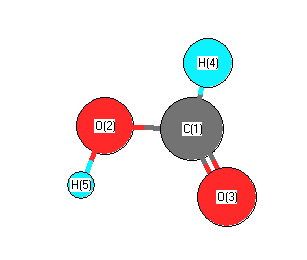 More geometry information
Calculated Bond Angles
| atom1 |
atom2 |
atom3 |
angle |
|
atom1 |
atom2 |
atom3 |
angle |
| C1 |
O2 |
H5 |
106.790 |
|
O2 |
C1 |
O3 |
125.083 |
| O2 |
C1 |
H4 |
109.691 |
|
O3 |
C1 |
H4 |
125.227 |
Electronic energy levels
Charges, Dipole, Quadrupole and Polarizability
Jump to
S1C1
Energy calculated at QCISD(T)=FULL/aug-cc-pVTZ
| | hartrees |
|---|
| Energy at 0K | -189.560739 |
| Energy at 298.15K | |
| HF Energy | -188.836822 |
| Nuclear repulsion energy | 70.049366 |
The energy at 298.15K was derived from the energy at 0K
and an integrated heat capacity that used the calculated vibrational frequencies.
Vibrational Frequencies calculated at QCISD(T)=FULL/aug-cc-pVTZ
| Mode Number |
Symmetry |
Frequency
(cm-1) |
Scaled Frequency
(cm-1) |
IR Intensities
(km mol-1) |
Raman Act
(Å4/u) |
Dep P |
Dep U |
|---|
| 1 |
A' |
3825 |
3825 |
|
|
|
|
| 2 |
A' |
3016 |
3016 |
|
|
|
|
| 3 |
A' |
1851 |
1851 |
|
|
|
|
| 4 |
A' |
1419 |
1419 |
|
|
|
|
| 5 |
A' |
1289 |
1289 |
|
|
|
|
| 6 |
A' |
1119 |
1119 |
|
|
|
|
| 7 |
A' |
657 |
657 |
|
|
|
|
| 8 |
A" |
1042 |
1042 |
|
|
|
|
| 9 |
A" |
523 |
523 |
|
|
|
|
Unscaled Zero Point Vibrational Energy (zpe) 7370.4 cm
-1
Scaled (by 1) Zero Point Vibrational Energy (zpe) 7370.4 cm
-1
See section
III.C.1 List or set vibrational scaling factors
to change the scale factors used here.
See section
III.C.2
Calculate a vibrational scaling factor for a given set of molecules
to determine the least squares best scaling factor.
Geometric Data calculated at QCISD(T)=FULL/aug-cc-pVTZ
Point Group is Cs
Cartesians (Å)
| Atom |
x (Å) |
y (Å) |
z (Å) |
|---|
| C1 |
0.000 |
0.385 |
0.000 |
| O2 |
-0.898 |
-0.624 |
0.000 |
| O3 |
1.178 |
0.195 |
0.000 |
| H4 |
-0.461 |
1.380 |
0.000 |
| H5 |
-1.786 |
-0.254 |
0.000 |
Atom - Atom Distances (Å)
| |
C1 |
O2 |
O3 |
H4 |
H5 |
| C1 | | 1.3508 | 1.1936 | 1.0963 | 1.8967 |
O2 | 1.3508 | | 2.2315 | 2.0514 | 0.9626 | O3 | 1.1936 | 2.2315 | | 2.0227 | 2.9978 | H4 | 1.0963 | 2.0514 | 2.0227 | | 2.1036 | H5 | 1.8967 | 0.9626 | 2.9978 | 2.1036 | |
More geometry information
Calculated Bond Angles
| atom1 |
atom2 |
atom3 |
angle |
|
atom1 |
atom2 |
atom3 |
angle |
| C1 |
O2 |
H5 |
108.988 |
|
O2 |
C1 |
O3 |
122.446 |
| O2 |
C1 |
H4 |
113.520 |
|
O3 |
C1 |
H4 |
124.033 |
Electronic energy levels
Charges, Dipole, Quadrupole and Polarizability
