Jump to
S2C1
Energy calculated at MP2=FULL/6-31G(2df,p)
| | hartrees |
|---|
| Energy at 0K | -150.937076 |
| Energy at 298.15K | -150.935599 |
| HF Energy | -150.480165 |
| Nuclear repulsion energy | 45.939012 |
The energy at 298.15K was derived from the energy at 0K
and an integrated heat capacity that used the calculated vibrational frequencies.
Vibrational Frequencies calculated at MP2=FULL/6-31G(2df,p)
| Mode Number |
Symmetry |
Frequency
(cm-1) |
Scaled Frequency
(cm-1) |
IR Intensities
(km mol-1) |
Raman Act
(Å4/u) |
Dep P |
Dep U |
|---|
| 1 |
Σ |
2117 |
1990 |
319.76 |
|
|
|
| 2 |
Σ |
1099 |
1033 |
10.35 |
|
|
|
| 3 |
Π |
460 |
433 |
46.90 |
|
|
|
| 3 |
Π |
460 |
433 |
46.90 |
|
|
|
Unscaled Zero Point Vibrational Energy (zpe) 2068.4 cm
-1
Scaled (by 0.9399) Zero Point Vibrational Energy (zpe) 1944.0 cm
-1
See section
III.C.1 List or set vibrational scaling factors
to change the scale factors used here.
See section
III.C.2
Calculate a vibrational scaling factor for a given set of molecules
to determine the least squares best scaling factor.
Geometric Data calculated at MP2=FULL/6-31G(2df,p)
Point Group is C∞v
Cartesians (Å)
| Atom |
x (Å) |
y (Å) |
z (Å) |
|---|
| C1 |
0.000 |
0.000 |
-1.419 |
| C2 |
0.000 |
0.000 |
-0.054 |
| O3 |
0.000 |
0.000 |
1.105 |
Atom - Atom Distances (Å)
| |
C1 |
C2 |
O3 |
| C1 | | 1.3657 | 2.5241 |
C2 | 1.3657 | | 1.1585 | O3 | 2.5241 | 1.1585 | |
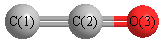 More geometry information
Calculated Bond Angles
| atom1 |
atom2 |
atom3 |
angle |
|
atom1 |
atom2 |
atom3 |
angle |
| C1 |
C2 |
O3 |
180.000 |
|
Electronic energy levels
Charges, Dipole, Quadrupole and Polarizability
Jump to
S1C1
Energy calculated at MP2=FULL/6-31G(2df,p)
| | hartrees |
|---|
| Energy at 0K | -150.901255 |
| Energy at 298.15K | -150.899727 |
| HF Energy | -150.417358 |
| Nuclear repulsion energy | 45.673813 |
The energy at 298.15K was derived from the energy at 0K
and an integrated heat capacity that used the calculated vibrational frequencies.
Vibrational Frequencies calculated at MP2=FULL/6-31G(2df,p)
| Mode Number |
Symmetry |
Frequency
(cm-1) |
Scaled Frequency
(cm-1) |
IR Intensities
(km mol-1) |
Raman Act
(Å4/u) |
Dep P |
Dep U |
|---|
| 1 |
Σ |
2034 |
1912 |
39.84 |
|
|
|
| 2 |
Σ |
1111 |
1044 |
27.31 |
|
|
|
| 3 |
Π |
513 |
482 |
4.83 |
|
|
|
| 3 |
Π |
361 |
339 |
57.09 |
|
|
|
Unscaled Zero Point Vibrational Energy (zpe) 2009.8 cm
-1
Scaled (by 0.9399) Zero Point Vibrational Energy (zpe) 1889.0 cm
-1
See section
III.C.1 List or set vibrational scaling factors
to change the scale factors used here.
See section
III.C.2
Calculate a vibrational scaling factor for a given set of molecules
to determine the least squares best scaling factor.
Geometric Data calculated at MP2=FULL/6-31G(2df,p)
Point Group is C∞v
Cartesians (Å)
| Atom |
x (Å) |
y (Å) |
z (Å) |
|---|
| C1 |
0.000 |
0.000 |
-1.421 |
| C2 |
0.000 |
0.000 |
-0.062 |
| O3 |
0.000 |
0.000 |
1.112 |
Atom - Atom Distances (Å)
| |
C1 |
C2 |
O3 |
| C1 | | 1.3586 | 2.5332 |
C2 | 1.3586 | | 1.1746 | O3 | 2.5332 | 1.1746 | |
More geometry information
Calculated Bond Angles
| atom1 |
atom2 |
atom3 |
angle |
|
atom1 |
atom2 |
atom3 |
angle |
| C1 |
C2 |
O3 |
180.000 |
|
Electronic energy levels
Charges, Dipole, Quadrupole and Polarizability
