Jump to
S2C1
Energy calculated at HSEh1PBE/6-31G(2df,p)
| | hartrees |
|---|
| Energy at 0K | -151.113899 |
| Energy at 298.15K | -151.112311 |
| HF Energy | -151.113899 |
| Nuclear repulsion energy | 45.975861 |
The energy at 298.15K was derived from the energy at 0K
and an integrated heat capacity that used the calculated vibrational frequencies.
Vibrational Frequencies calculated at HSEh1PBE/6-31G(2df,p)
| Mode Number |
Symmetry |
Frequency
(cm-1) |
Scaled Frequency
(cm-1) |
IR Intensities
(km mol-1) |
Raman Act
(Å4/u) |
Dep P |
Dep U |
|---|
| 1 |
Σ |
2091 |
2003 |
137.71 |
|
|
|
| 2 |
Σ |
1121 |
1074 |
16.68 |
|
|
|
| 3 |
Π |
398 |
381 |
44.50 |
|
|
|
| 3 |
Π |
398 |
381 |
44.50 |
|
|
|
Unscaled Zero Point Vibrational Energy (zpe) 2003.7 cm
-1
Scaled (by 0.9577) Zero Point Vibrational Energy (zpe) 1918.9 cm
-1
See section
III.C.1 List or set vibrational scaling factors
to change the scale factors used here.
See section
III.C.2
Calculate a vibrational scaling factor for a given set of molecules
to determine the least squares best scaling factor.
Geometric Data calculated at HSEh1PBE/6-31G(2df,p)
Point Group is C∞v
Cartesians (Å)
| Atom |
x (Å) |
y (Å) |
z (Å) |
|---|
| C1 |
0.000 |
0.000 |
-1.416 |
| C2 |
0.000 |
0.000 |
-0.056 |
| O3 |
0.000 |
0.000 |
1.104 |
Atom - Atom Distances (Å)
| |
C1 |
C2 |
O3 |
| C1 | | 1.3606 | 2.5206 |
C2 | 1.3606 | | 1.1600 | O3 | 2.5206 | 1.1600 | |
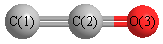 More geometry information
Calculated Bond Angles
| atom1 |
atom2 |
atom3 |
angle |
|
atom1 |
atom2 |
atom3 |
angle |
| C1 |
C2 |
O3 |
180.000 |
|
Electronic energy levels
Charges, Dipole, Quadrupole and Polarizability
Charges from optimized geometry at HSEh1PBE/6-31G(2df,p)
Charges (e)
| Number |
Element |
Mulliken |
CHELPG |
AIM |
ESP |
| 1 |
C |
-0.247 |
|
|
|
| 2 |
C |
0.387 |
|
|
|
| 3 |
O |
-0.140 |
|
|
|
Electric dipole moments
Electric dipole components in Debye
(What's a Debye? See section
VII.A.3)
| |
x |
y |
z |
Total |
| |
0.000 |
0.000 |
1.373 |
1.373 |
| CHELPG |
|
|
|
|
| AIM |
|
|
|
|
| ESP |
|
|
|
|
Electric Quadrupole moment
Quadrupole components in D Å
| Primitive |
|---|
| | x | y | z |
|---|
| x |
-15.403 |
0.000 |
0.000 |
| y |
0.000 |
-15.403 |
0.000 |
| z |
0.000 |
0.000 |
-21.694 |
|
| Traceless |
|---|
| | x | y | z |
|---|
| x |
3.145 |
0.000 |
0.000 |
| y |
0.000 |
3.145 |
0.000 |
| z |
0.000 |
0.000 |
-6.291 |
|
| Polar |
|---|
| 3z2-r2 | -12.581 |
|---|
| x2-y2 | 0.000 |
|---|
| xy | 0.000 |
|---|
| xz | 0.000 |
|---|
| yz | 0.000 |
|---|
|
Polarizabilities
Components of the polarizability tensor.
Units are
Å
3 (Angstrom cubed)
Change units.
| |
x |
y |
z |
| x |
2.269 |
0.000 |
0.000 |
| y |
0.000 |
2.269 |
0.000 |
| z |
0.000 |
0.000 |
5.045 |
<r2> (average value of r
2) Å
2
| <r2> |
32.740 |
| (<r2>)1/2 |
5.722 |
Jump to
S1C1
Energy calculated at HSEh1PBE/6-31G(2df,p)
| | hartrees |
|---|
| Energy at 0K | -151.067192 |
| Energy at 298.15K | -151.065627 |
| HF Energy | -151.067192 |
| Nuclear repulsion energy | 45.862385 |
The energy at 298.15K was derived from the energy at 0K
and an integrated heat capacity that used the calculated vibrational frequencies.
Vibrational Frequencies calculated at HSEh1PBE/6-31G(2df,p)
| Mode Number |
Symmetry |
Frequency
(cm-1) |
Scaled Frequency
(cm-1) |
IR Intensities
(km mol-1) |
Raman Act
(Å4/u) |
Dep P |
Dep U |
|---|
| 1 |
Σ |
2092 |
2003 |
86.36 |
|
|
|
| 2 |
Σ |
1134 |
1086 |
32.99 |
|
|
|
| 3 |
Π |
507 |
485 |
6.32 |
|
|
|
| 3 |
Π |
329 |
315 |
63.17 |
|
|
|
Unscaled Zero Point Vibrational Energy (zpe) 2030.7 cm
-1
Scaled (by 0.9577) Zero Point Vibrational Energy (zpe) 1944.8 cm
-1
See section
III.C.1 List or set vibrational scaling factors
to change the scale factors used here.
See section
III.C.2
Calculate a vibrational scaling factor for a given set of molecules
to determine the least squares best scaling factor.
Geometric Data calculated at HSEh1PBE/6-31G(2df,p)
Point Group is C∞v
Cartesians (Å)
| Atom |
x (Å) |
y (Å) |
z (Å) |
|---|
| C1 |
0.000 |
0.000 |
-1.418 |
| C2 |
0.000 |
0.000 |
-0.059 |
| O3 |
0.000 |
0.000 |
1.107 |
Atom - Atom Distances (Å)
| |
C1 |
C2 |
O3 |
| C1 | | 1.3586 | 2.5248 |
C2 | 1.3586 | | 1.1662 | O3 | 2.5248 | 1.1662 | |
More geometry information
Calculated Bond Angles
| atom1 |
atom2 |
atom3 |
angle |
|
atom1 |
atom2 |
atom3 |
angle |
| C1 |
C2 |
O3 |
180.000 |
|
Electronic energy levels
Charges, Dipole, Quadrupole and Polarizability
Charges from optimized geometry at HSEh1PBE/6-31G(2df,p)
Charges (e)
| Number |
Element |
Mulliken |
CHELPG |
AIM |
ESP |
| 1 |
C |
-0.230 |
|
|
|
| 2 |
C |
0.381 |
|
|
|
| 3 |
O |
-0.150 |
|
|
|
Electric dipole moments
Electric dipole components in Debye
(What's a Debye? See section
VII.A.3)
| |
x |
y |
z |
Total |
| |
0.000 |
0.000 |
1.128 |
1.128 |
| CHELPG |
|
|
|
|
| AIM |
|
|
|
|
| ESP |
|
|
|
|
Electric Quadrupole moment
Quadrupole components in D Å
| Primitive |
|---|
| | x | y | z |
|---|
| x |
-13.875 |
0.000 |
0.000 |
| y |
0.000 |
-17.058 |
0.000 |
| z |
0.000 |
0.000 |
-21.442 |
|
| Traceless |
|---|
| | x | y | z |
|---|
| x |
5.375 |
0.000 |
0.000 |
| y |
0.000 |
0.600 |
0.000 |
| z |
0.000 |
0.000 |
-5.975 |
|
| Polar |
|---|
| 3z2-r2 | -11.950 |
|---|
| x2-y2 | 3.183 |
|---|
| xy | 0.000 |
|---|
| xz | 0.000 |
|---|
| yz | 0.000 |
|---|
|
Polarizabilities
Components of the polarizability tensor.
Units are
Å
3 (Angstrom cubed)
Change units.
| |
x |
y |
z |
| x |
2.218 |
0.000 |
0.000 |
| y |
0.000 |
1.967 |
0.000 |
| z |
0.000 |
0.000 |
4.940 |
<r2> (average value of r
2) Å
2
| <r2> |
32.791 |
| (<r2>)1/2 |
5.726 |
