Jump to
S2C1
Energy calculated at PBEPBE/6-31G(2df,p)
| | hartrees |
|---|
| Energy at 0K | -151.102657 |
| Energy at 298.15K | -151.100915 |
| HF Energy | -151.102657 |
| Nuclear repulsion energy | 45.396265 |
The energy at 298.15K was derived from the energy at 0K
and an integrated heat capacity that used the calculated vibrational frequencies.
Vibrational Frequencies calculated at PBEPBE/6-31G(2df,p)
| Mode Number |
Symmetry |
Frequency
(cm-1) |
Scaled Frequency
(cm-1) |
IR Intensities
(km mol-1) |
Raman Act
(Å4/u) |
Dep P |
Dep U |
|---|
| 1 |
Σ |
1985 |
1965 |
78.24 |
|
|
|
| 2 |
Σ |
1068 |
1057 |
22.90 |
|
|
|
| 3 |
Π |
329 |
325 |
36.65 |
|
|
|
| 3 |
Π |
329 |
325 |
36.65 |
|
|
|
Unscaled Zero Point Vibrational Energy (zpe) 1855.2 cm
-1
Scaled (by 0.9897) Zero Point Vibrational Energy (zpe) 1836.1 cm
-1
See section
III.C.1 List or set vibrational scaling factors
to change the scale factors used here.
See section
III.C.2
Calculate a vibrational scaling factor for a given set of molecules
to determine the least squares best scaling factor.
Geometric Data calculated at PBEPBE/6-31G(2df,p)
Point Group is C∞v
Cartesians (Å)
| Atom |
x (Å) |
y (Å) |
z (Å) |
|---|
| C1 |
0.000 |
0.000 |
-1.433 |
| C2 |
0.000 |
0.000 |
-0.059 |
| O3 |
0.000 |
0.000 |
1.119 |
Atom - Atom Distances (Å)
| |
C1 |
C2 |
O3 |
| C1 | | 1.3741 | 2.5513 |
C2 | 1.3741 | | 1.1772 | O3 | 2.5513 | 1.1772 | |
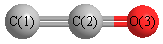 More geometry information
Calculated Bond Angles
| atom1 |
atom2 |
atom3 |
angle |
|
atom1 |
atom2 |
atom3 |
angle |
| C1 |
C2 |
O3 |
180.000 |
|
Electronic energy levels
Charges, Dipole, Quadrupole and Polarizability
Charges from optimized geometry at PBEPBE/6-31G(2df,p)
Charges (e)
| Number |
Element |
Mulliken |
CHELPG |
AIM |
ESP |
| 1 |
C |
-0.255 |
|
|
|
| 2 |
C |
0.365 |
|
|
|
| 3 |
O |
-0.110 |
|
|
|
Electric dipole moments
Electric dipole components in Debye
(What's a Debye? See section
VII.A.3)
| |
x |
y |
z |
Total |
| |
0.000 |
0.000 |
1.381 |
1.381 |
| CHELPG |
|
|
|
|
| AIM |
|
|
|
|
| ESP |
|
|
|
|
Electric Quadrupole moment
Quadrupole components in D Å
| Primitive |
|---|
| | x | y | z |
|---|
| x |
-15.439 |
0.000 |
0.000 |
| y |
0.000 |
-15.439 |
0.000 |
| z |
0.000 |
0.000 |
-21.434 |
|
| Traceless |
|---|
| | x | y | z |
|---|
| x |
2.998 |
0.000 |
0.000 |
| y |
0.000 |
2.998 |
0.000 |
| z |
0.000 |
0.000 |
-5.995 |
|
| Polar |
|---|
| 3z2-r2 | -11.991 |
|---|
| x2-y2 | 0.000 |
|---|
| xy | 0.000 |
|---|
| xz | 0.000 |
|---|
| yz | 0.000 |
|---|
|
Polarizabilities
Components of the polarizability tensor.
Units are
Å
3 (Angstrom cubed)
Change units.
| |
x |
y |
z |
| x |
2.257 |
0.000 |
0.000 |
| y |
0.000 |
2.257 |
0.000 |
| z |
0.000 |
0.000 |
5.142 |
<r2> (average value of r
2) Å
2
| <r2> |
33.238 |
| (<r2>)1/2 |
5.765 |
Jump to
S1C1
Energy calculated at PBEPBE/6-31G(2df,p)
| | hartrees |
|---|
| Energy at 0K | -151.059107 |
| Energy at 298.15K | -151.057360 |
| HF Energy | -151.059107 |
| Nuclear repulsion energy | 45.278039 |
The energy at 298.15K was derived from the energy at 0K
and an integrated heat capacity that used the calculated vibrational frequencies.
Vibrational Frequencies calculated at PBEPBE/6-31G(2df,p)
| Mode Number |
Symmetry |
Frequency
(cm-1) |
Scaled Frequency
(cm-1) |
IR Intensities
(km mol-1) |
Raman Act
(Å4/u) |
Dep P |
Dep U |
|---|
| 1 |
Σ |
1979 |
1958 |
37.53 |
|
|
|
| 2 |
Σ |
1082 |
1071 |
37.69 |
|
|
|
| 3 |
Π |
472 |
467 |
3.55 |
|
|
|
| 3 |
Π |
214 |
212 |
56.27 |
|
|
|
Unscaled Zero Point Vibrational Energy (zpe) 1873.4 cm
-1
Scaled (by 0.9897) Zero Point Vibrational Energy (zpe) 1854.1 cm
-1
See section
III.C.1 List or set vibrational scaling factors
to change the scale factors used here.
See section
III.C.2
Calculate a vibrational scaling factor for a given set of molecules
to determine the least squares best scaling factor.
Geometric Data calculated at PBEPBE/6-31G(2df,p)
Point Group is C∞v
Cartesians (Å)
| Atom |
x (Å) |
y (Å) |
z (Å) |
|---|
| C1 |
0.000 |
0.000 |
-1.433 |
| C2 |
0.000 |
0.000 |
-0.063 |
| O3 |
0.000 |
0.000 |
1.122 |
Atom - Atom Distances (Å)
| |
C1 |
C2 |
O3 |
| C1 | | 1.3708 | 2.5555 |
C2 | 1.3708 | | 1.1847 | O3 | 2.5555 | 1.1847 | |
More geometry information
Calculated Bond Angles
| atom1 |
atom2 |
atom3 |
angle |
|
atom1 |
atom2 |
atom3 |
angle |
| C1 |
C2 |
O3 |
180.000 |
|
Electronic energy levels
Charges, Dipole, Quadrupole and Polarizability
Charges from optimized geometry at PBEPBE/6-31G(2df,p)
Charges (e)
| Number |
Element |
Mulliken |
CHELPG |
AIM |
ESP |
| 1 |
C |
-0.241 |
|
|
|
| 2 |
C |
0.359 |
|
|
|
| 3 |
O |
-0.119 |
|
|
|
Electric dipole moments
Electric dipole components in Debye
(What's a Debye? See section
VII.A.3)
| |
x |
y |
z |
Total |
| |
0.000 |
0.000 |
1.195 |
1.195 |
| CHELPG |
|
|
|
|
| AIM |
|
|
|
|
| ESP |
|
|
|
|
Electric Quadrupole moment
Quadrupole components in D Å
| Primitive |
|---|
| | x | y | z |
|---|
| x |
-13.941 |
0.000 |
0.000 |
| y |
0.000 |
-17.057 |
0.000 |
| z |
0.000 |
0.000 |
-21.204 |
|
| Traceless |
|---|
| | x | y | z |
|---|
| x |
5.189 |
0.000 |
0.000 |
| y |
0.000 |
0.516 |
0.000 |
| z |
0.000 |
0.000 |
-5.705 |
|
| Polar |
|---|
| 3z2-r2 | -11.409 |
|---|
| x2-y2 | 3.116 |
|---|
| xy | 0.000 |
|---|
| xz | 0.000 |
|---|
| yz | 0.000 |
|---|
|
Polarizabilities
Components of the polarizability tensor.
Units are
Å
3 (Angstrom cubed)
Change units.
| |
x |
y |
z |
| x |
2.257 |
0.000 |
0.000 |
| y |
0.000 |
2.257 |
0.000 |
| z |
0.000 |
0.000 |
5.142 |
<r2> (average value of r
2) Å
2
| <r2> |
33.292 |
| (<r2>)1/2 |
5.770 |
