Jump to
S1C2
Energy calculated at QCISD/6-31G(2df,p)
| | hartrees |
|---|
| Energy at 0K | -166.175929 |
| Energy at 298.15K | |
| HF Energy | -165.666296 |
| Nuclear repulsion energy | 49.081455 |
The energy at 298.15K was derived from the energy at 0K
and an integrated heat capacity that used the calculated vibrational frequencies.
Vibrational Frequencies calculated at QCISD/6-31G(2df,p)
| Mode Number |
Symmetry |
Frequency
(cm-1) |
Scaled Frequency
(cm-1) |
IR Intensities
(km mol-1) |
Raman Act
(Å4/u) |
Dep P |
Dep U |
|---|
| 1 |
A1 |
4060 |
3846 |
56.80 |
|
|
|
| 2 |
A1 |
756 |
716 |
9.98 |
|
|
|
| 3 |
A1 |
595 |
563 |
146.29 |
|
|
|
| 4 |
A1 |
292 |
277 |
11.17 |
|
|
|
| 5 |
A2 |
235i |
222i |
0.00 |
|
|
|
| 6 |
B1 |
340 |
322 |
62.69 |
|
|
|
| 7 |
B2 |
4058 |
3844 |
153.03 |
|
|
|
| 8 |
B2 |
1567 |
1485 |
320.68 |
|
|
|
| 9 |
B2 |
479 |
454 |
302.03 |
|
|
|
Unscaled Zero Point Vibrational Energy (zpe) 5956.0 cm
-1
Scaled (by 0.9474) Zero Point Vibrational Energy (zpe) 5642.7 cm
-1
See section
III.C.1 List or set vibrational scaling factors
to change the scale factors used here.
See section
III.C.2
Calculate a vibrational scaling factor for a given set of molecules
to determine the least squares best scaling factor.
Geometric Data calculated at QCISD/6-31G(2df,p)
Point Group is C2v
Cartesians (Å)
| Atom |
x (Å) |
y (Å) |
z (Å) |
|---|
| Be1 |
0.000 |
0.000 |
0.005 |
| O2 |
0.000 |
1.423 |
0.079 |
| O3 |
0.000 |
-1.423 |
0.079 |
| H4 |
0.000 |
2.043 |
-0.640 |
| H5 |
0.000 |
-2.043 |
-0.640 |
Atom - Atom Distances (Å)
| |
Be1 |
O2 |
O3 |
H4 |
H5 |
| Be1 | | 1.4249 | 1.4249 | 2.1427 | 2.1427 |
O2 | 1.4249 | | 2.8460 | 0.9496 | 3.5401 | O3 | 1.4249 | 2.8460 | | 3.5401 | 0.9496 | H4 | 2.1427 | 0.9496 | 3.5401 | | 4.0866 | H5 | 2.1427 | 3.5401 | 0.9496 | 4.0866 | |
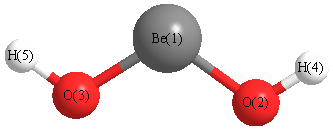 More geometry information
Calculated Bond Angles
| atom1 |
atom2 |
atom3 |
angle |
|
atom1 |
atom2 |
atom3 |
angle |
| Be1 |
O2 |
H4 |
127.818 |
|
Be1 |
O3 |
H5 |
127.818 |
| O2 |
Be1 |
O3 |
174.067 |
|
Electronic energy levels
Charges, Dipole, Quadrupole and Polarizability
Jump to
S1C1
Energy calculated at QCISD/6-31G(2df,p)
| | hartrees |
|---|
| Energy at 0K | -166.176985 |
| Energy at 298.15K | -166.178504 |
| HF Energy | -165.667003 |
| Nuclear repulsion energy | 49.053638 |
The energy at 298.15K was derived from the energy at 0K
and an integrated heat capacity that used the calculated vibrational frequencies.
Vibrational Frequencies calculated at QCISD/6-31G(2df,p)
| Mode Number |
Symmetry |
Frequency
(cm-1) |
Scaled Frequency
(cm-1) |
IR Intensities
(km mol-1) |
Raman Act
(Å4/u) |
Dep P |
Dep U |
|---|
| 1 |
A |
4041 |
3829 |
28.00 |
|
|
|
| 2 |
A |
750 |
711 |
3.33 |
|
|
|
| 3 |
A |
592 |
561 |
71.29 |
|
|
|
| 4 |
A |
309 |
292 |
45.85 |
|
|
|
| 5 |
A |
230 |
218 |
121.47 |
|
|
|
| 6 |
B |
4040 |
3827 |
166.75 |
|
|
|
| 7 |
B |
1566 |
1484 |
312.96 |
|
|
|
| 8 |
B |
587 |
557 |
343.06 |
|
|
|
| 9 |
B |
301 |
285 |
78.54 |
|
|
|
Unscaled Zero Point Vibrational Energy (zpe) 6207.7 cm
-1
Scaled (by 0.9474) Zero Point Vibrational Energy (zpe) 5881.2 cm
-1
See section
III.C.1 List or set vibrational scaling factors
to change the scale factors used here.
See section
III.C.2
Calculate a vibrational scaling factor for a given set of molecules
to determine the least squares best scaling factor.
Geometric Data calculated at QCISD/6-31G(2df,p)
Point Group is C2
Cartesians (Å)
| Atom |
x (Å) |
y (Å) |
z (Å) |
|---|
| Be1 |
0.000 |
0.000 |
-0.013 |
| O2 |
0.000 |
1.426 |
-0.054 |
| O3 |
0.000 |
-1.426 |
-0.054 |
| H4 |
0.569 |
1.992 |
0.456 |
| H5 |
-0.569 |
-1.992 |
0.456 |
Atom - Atom Distances (Å)
| |
Be1 |
O2 |
O3 |
H4 |
H5 |
| Be1 | | 1.4268 | 1.4268 | 2.1241 | 2.1241 |
O2 | 1.4268 | | 2.8523 | 0.9508 | 3.5025 | O3 | 1.4268 | 2.8523 | | 3.5025 | 0.9508 | H4 | 2.1241 | 0.9508 | 3.5025 | | 4.1433 | H5 | 2.1241 | 3.5025 | 0.9508 | 4.1433 | |
More geometry information
Calculated Bond Angles
| atom1 |
atom2 |
atom3 |
angle |
|
atom1 |
atom2 |
atom3 |
angle |
| Be1 |
O2 |
H4 |
125.404 |
|
Be1 |
O3 |
H5 |
125.404 |
| O2 |
Be1 |
O3 |
176.695 |
|
Electronic energy levels
Charges, Dipole, Quadrupole and Polarizability
