Jump to
S2C1
Energy calculated at CCD/6-31G(2df,p)
| | hartrees |
|---|
| Energy at 0K | -147.150105 |
| Energy at 298.15K | -147.149950 |
| HF Energy | -146.726220 |
| Nuclear repulsion energy | 47.078897 |
The energy at 298.15K was derived from the energy at 0K
and an integrated heat capacity that used the calculated vibrational frequencies.
Vibrational Frequencies calculated at CCD/6-31G(2df,p)
| Mode Number |
Symmetry |
Frequency
(cm-1) |
Scaled Frequency
(cm-1) |
IR Intensities
(km mol-1) |
Raman Act
(Å4/u) |
Dep P |
Dep U |
|---|
| 1 |
Σg |
1340 |
1269 |
0.00 |
|
|
|
| 2 |
Σu |
1195 |
1132 |
524.98 |
|
|
|
| 3 |
Πu |
508 |
481 |
21.98 |
|
|
|
| 3 |
Πu |
508 |
481 |
21.98 |
|
|
|
Unscaled Zero Point Vibrational Energy (zpe) 1775.7 cm
-1
Scaled (by 0.9472) Zero Point Vibrational Energy (zpe) 1682.0 cm
-1
See section
III.C.1 List or set vibrational scaling factors
to change the scale factors used here.
See section
III.C.2
Calculate a vibrational scaling factor for a given set of molecules
to determine the least squares best scaling factor.
Geometric Data calculated at CCD/6-31G(2df,p)
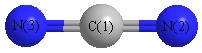
Point Group is D∞h
Cartesians (Å)
| Atom |
x (Å) |
y (Å) |
z (Å) |
|---|
| C1 |
0.000 |
0.000 |
0.000 |
| N2 |
0.000 |
0.000 |
1.220 |
| N3 |
0.000 |
0.000 |
-1.220 |
Atom - Atom Distances (Å)
| |
C1 |
N2 |
N3 |
| C1 | | 1.2196 | 1.2196 |
N2 | 1.2196 | | 2.4391 | N3 | 1.2196 | 2.4391 | |
 More geometry information
Calculated Bond Angles
| atom1 |
atom2 |
atom3 |
angle |
|
atom1 |
atom2 |
atom3 |
angle |
| N2 |
C1 |
N3 |
180.000 |
|
Electronic energy levels
Charges, Dipole, Quadrupole and Polarizability
Jump to
S1C1
Energy calculated at CCD/6-31G(2df,p)
| | hartrees |
|---|
| Energy at 0K | -147.104559 |
| Energy at 298.15K | -147.104360 |
| HF Energy | -146.625631 |
| Nuclear repulsion energy | 47.024023 |
The energy at 298.15K was derived from the energy at 0K
and an integrated heat capacity that used the calculated vibrational frequencies.
Vibrational Frequencies calculated at CCD/6-31G(2df,p)
| Mode Number |
Symmetry |
Frequency
(cm-1) |
Scaled Frequency
(cm-1) |
IR Intensities
(km mol-1) |
Raman Act
(Å4/u) |
Dep P |
Dep U |
|---|
| 1 |
Σg |
1344 |
1273 |
0.00 |
|
|
|
| 2 |
Σu |
1685 |
1596 |
249.12 |
|
|
|
| 3 |
Πu |
592 |
560 |
12.15 |
|
|
|
| 3 |
Πu |
370 |
351 |
32.28 |
|
|
|
Unscaled Zero Point Vibrational Energy (zpe) 1995.7 cm
-1
Scaled (by 0.9472) Zero Point Vibrational Energy (zpe) 1890.3 cm
-1
See section
III.C.1 List or set vibrational scaling factors
to change the scale factors used here.
See section
III.C.2
Calculate a vibrational scaling factor for a given set of molecules
to determine the least squares best scaling factor.
Geometric Data calculated at CCD/6-31G(2df,p)
Point Group is D∞h
Cartesians (Å)
| Atom |
x (Å) |
y (Å) |
z (Å) |
|---|
| C1 |
0.000 |
0.000 |
0.000 |
| N2 |
0.000 |
0.000 |
1.221 |
| N3 |
0.000 |
0.000 |
-1.221 |
Atom - Atom Distances (Å)
| |
C1 |
N2 |
N3 |
| C1 | | 1.2210 | 1.2210 |
N2 | 1.2210 | | 2.4420 | N3 | 1.2210 | 2.4420 | |
More geometry information
Calculated Bond Angles
| atom1 |
atom2 |
atom3 |
angle |
|
atom1 |
atom2 |
atom3 |
angle |
| N2 |
C1 |
N3 |
180.000 |
|
Electronic energy levels
Charges, Dipole, Quadrupole and Polarizability
