Jump to
S1C2
Energy calculated at PBE1PBE/6-31G(2df,p)
| | hartrees |
|---|
| Energy at 0K | -188.907007 |
| Energy at 298.15K | -188.908115 |
| HF Energy | -188.907007 |
| Nuclear repulsion energy | 63.441983 |
The energy at 298.15K was derived from the energy at 0K
and an integrated heat capacity that used the calculated vibrational frequencies.
Vibrational Frequencies calculated at PBE1PBE/6-31G(2df,p)
| Mode Number |
Symmetry |
Frequency
(cm-1) |
Scaled Frequency
(cm-1) |
IR Intensities
(km mol-1) |
Raman Act
(Å4/u) |
Dep P |
Dep U |
|---|
| 1 |
A' |
3662 |
3505 |
22.39 |
|
|
|
| 2 |
A' |
1921 |
1838 |
287.46 |
|
|
|
| 3 |
A' |
1320 |
1263 |
0.04 |
|
|
|
| 4 |
A' |
1113 |
1065 |
148.56 |
|
|
|
| 5 |
A' |
602 |
576 |
33.79 |
|
|
|
| 6 |
A" |
613 |
587 |
106.27 |
|
|
|
Unscaled Zero Point Vibrational Energy (zpe) 4615.2 cm
-1
Scaled (by 0.957) Zero Point Vibrational Energy (zpe) 4416.8 cm
-1
See section
III.C.1 List or set vibrational scaling factors
to change the scale factors used here.
See section
III.C.2
Calculate a vibrational scaling factor for a given set of molecules
to determine the least squares best scaling factor.
Geometric Data calculated at PBE1PBE/6-31G(2df,p)
Point Group is Cs
Cartesians (Å)
| Atom |
x (Å) |
y (Å) |
z (Å) |
|---|
| C1 |
0.000 |
0.439 |
0.000 |
| O2 |
-1.058 |
-0.348 |
0.000 |
| O3 |
1.153 |
0.178 |
0.000 |
| H4 |
-0.758 |
-1.274 |
0.000 |
Atom - Atom Distances (Å)
| |
C1 |
O2 |
O3 |
H4 |
| C1 | | 1.3191 | 1.1825 | 1.8732 |
O2 | 1.3191 | | 2.2733 | 0.9735 | O3 | 1.1825 | 2.2733 | | 2.3998 | H4 | 1.8732 | 0.9735 | 2.3998 | |
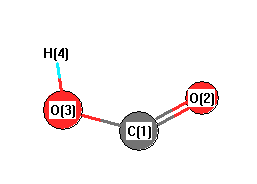 More geometry information
Calculated Bond Angles
| atom1 |
atom2 |
atom3 |
angle |
|
atom1 |
atom2 |
atom3 |
angle |
| C1 |
O2 |
H4 |
108.641 |
|
O2 |
C1 |
O3 |
130.590 |
Electronic energy levels
Charges, Dipole, Quadrupole and Polarizability
Charges from optimized geometry at PBE1PBE/6-31G(2df,p)
Charges (e)
| Number |
Element |
Mulliken |
CHELPG |
AIM |
ESP |
| 1 |
C |
0.193 |
|
|
|
| 2 |
O |
-0.314 |
|
|
|
| 3 |
O |
-0.205 |
|
|
|
| 4 |
H |
0.326 |
|
|
|
Electric dipole moments
Electric dipole components in Debye
(What's a Debye? See section
VII.A.3)
| |
x |
y |
z |
Total |
| |
-1.047 |
-1.668 |
0.000 |
1.969 |
| CHELPG |
|
|
|
|
| AIM |
|
|
|
|
| ESP |
|
|
|
|
Electric Quadrupole moment
Quadrupole components in D Å
| Primitive |
|---|
| | x | y | z |
|---|
| x |
-19.378 |
0.666 |
0.000 |
| y |
0.666 |
-13.497 |
0.000 |
| z |
0.000 |
0.000 |
-15.752 |
|
| Traceless |
|---|
| | x | y | z |
|---|
| x |
-4.753 |
0.666 |
0.000 |
| y |
0.666 |
4.068 |
0.000 |
| z |
0.000 |
0.000 |
0.685 |
|
| Polar |
|---|
| 3z2-r2 | 1.370 |
|---|
| x2-y2 | -5.881 |
|---|
| xy | 0.666 |
|---|
| xz | 0.000 |
|---|
| yz | 0.000 |
|---|
|
Polarizabilities
Components of the polarizability tensor.
Units are
Å
3 (Angstrom cubed)
Change units.
| |
x |
y |
z |
| x |
3.163 |
0.244 |
0.000 |
| y |
0.244 |
2.637 |
0.000 |
| z |
0.000 |
0.000 |
1.712 |
<r2> (average value of r
2) Å
2
| <r2> |
34.302 |
| (<r2>)1/2 |
5.857 |
Jump to
S1C1
Energy calculated at PBE1PBE/6-31G(2df,p)
| | hartrees |
|---|
| Energy at 0K | -188.908941 |
| Energy at 298.15K | -188.910028 |
| HF Energy | -188.908941 |
| Nuclear repulsion energy | 63.181912 |
The energy at 298.15K was derived from the energy at 0K
and an integrated heat capacity that used the calculated vibrational frequencies.
Vibrational Frequencies calculated at PBE1PBE/6-31G(2df,p)
| Mode Number |
Symmetry |
Frequency
(cm-1) |
Scaled Frequency
(cm-1) |
IR Intensities
(km mol-1) |
Raman Act
(Å4/u) |
Dep P |
Dep U |
|---|
| 1 |
A' |
3867 |
3700 |
117.27 |
|
|
|
| 2 |
A' |
1953 |
1869 |
203.34 |
|
|
|
| 3 |
A' |
1258 |
1204 |
263.84 |
|
|
|
| 4 |
A' |
1135 |
1086 |
33.59 |
|
|
|
| 5 |
A' |
625 |
598 |
3.49 |
|
|
|
| 6 |
A" |
559 |
535 |
84.84 |
|
|
|
Unscaled Zero Point Vibrational Energy (zpe) 4697.9 cm
-1
Scaled (by 0.957) Zero Point Vibrational Energy (zpe) 4495.9 cm
-1
See section
III.C.1 List or set vibrational scaling factors
to change the scale factors used here.
See section
III.C.2
Calculate a vibrational scaling factor for a given set of molecules
to determine the least squares best scaling factor.
Geometric Data calculated at PBE1PBE/6-31G(2df,p)
Point Group is Cs
Cartesians (Å)
| Atom |
x (Å) |
y (Å) |
z (Å) |
|---|
| C1 |
0.000 |
0.408 |
0.000 |
| O2 |
-0.942 |
-0.537 |
0.000 |
| O3 |
1.167 |
0.244 |
0.000 |
| H4 |
-1.800 |
-0.102 |
0.000 |
Atom - Atom Distances (Å)
| |
C1 |
O2 |
O3 |
H4 |
| C1 | | 1.3338 | 1.1780 | 1.8713 |
O2 | 1.3338 | | 2.2481 | 0.9627 | O3 | 1.1780 | 2.2481 | | 2.9872 | H4 | 1.8713 | 0.9627 | 2.9872 | |
More geometry information
Calculated Bond Angles
| atom1 |
atom2 |
atom3 |
angle |
|
atom1 |
atom2 |
atom3 |
angle |
| C1 |
O2 |
H4 |
108.056 |
|
O2 |
C1 |
O3 |
126.905 |
Electronic energy levels
Charges, Dipole, Quadrupole and Polarizability
Charges from optimized geometry at PBE1PBE/6-31G(2df,p)
Charges (e)
| Number |
Element |
Mulliken |
CHELPG |
AIM |
ESP |
| 1 |
C |
0.145 |
|
|
|
| 2 |
O |
-0.312 |
|
|
|
| 3 |
O |
-0.178 |
|
|
|
| 4 |
H |
0.344 |
|
|
|
Electric dipole moments
Electric dipole components in Debye
(What's a Debye? See section
VII.A.3)
| |
x |
y |
z |
Total |
| |
-2.980 |
0.318 |
0.000 |
2.997 |
| CHELPG |
|
|
|
|
| AIM |
|
|
|
|
| ESP |
|
|
|
|
Electric Quadrupole moment
Quadrupole components in D Å
| Primitive |
|---|
| | x | y | z |
|---|
| x |
-13.419 |
-1.009 |
0.000 |
| y |
-1.009 |
-17.257 |
0.000 |
| z |
0.000 |
0.000 |
-15.795 |
|
| Traceless |
|---|
| | x | y | z |
|---|
| x |
3.107 |
-1.009 |
0.000 |
| y |
-1.009 |
-2.651 |
0.000 |
| z |
0.000 |
0.000 |
-0.456 |
|
| Polar |
|---|
| 3z2-r2 | -0.913 |
|---|
| x2-y2 | 3.839 |
|---|
| xy | -1.009 |
|---|
| xz | 0.000 |
|---|
| yz | 0.000 |
|---|
|
Polarizabilities
Components of the polarizability tensor.
Units are
Å
3 (Angstrom cubed)
Change units.
| |
x |
y |
z |
| x |
3.624 |
0.185 |
0.000 |
| y |
0.185 |
2.135 |
0.000 |
| z |
0.000 |
0.000 |
1.729 |
<r2> (average value of r
2) Å
2
| <r2> |
34.686 |
| (<r2>)1/2 |
5.890 |
