Jump to
S1C2
Energy calculated at B2PLYP/6-31G(2df,p)
| | hartrees |
|---|
| Energy at 0K | -188.973834 |
| Energy at 298.15K | -188.974928 |
| HF Energy | -188.787970 |
| Nuclear repulsion energy | 63.114138 |
The energy at 298.15K was derived from the energy at 0K
and an integrated heat capacity that used the calculated vibrational frequencies.
Vibrational Frequencies calculated at B2PLYP/6-31G(2df,p)
| Mode Number |
Symmetry |
Frequency
(cm-1) |
Scaled Frequency
(cm-1) |
IR Intensities
(km mol-1) |
Raman Act
(Å4/u) |
Dep P |
Dep U |
|---|
| 1 |
A' |
3649 |
3484 |
25.98 |
|
|
|
| 2 |
A' |
1865 |
1781 |
251.44 |
|
|
|
| 3 |
A' |
1316 |
1257 |
0.35 |
|
|
|
| 4 |
A' |
1084 |
1035 |
156.23 |
|
|
|
| 5 |
A' |
597 |
570 |
31.64 |
|
|
|
| 6 |
A" |
601 |
574 |
105.66 |
|
|
|
Unscaled Zero Point Vibrational Energy (zpe) 4555.4 cm
-1
Scaled (by 0.955) Zero Point Vibrational Energy (zpe) 4350.4 cm
-1
See section
III.C.1 List or set vibrational scaling factors
to change the scale factors used here.
See section
III.C.2
Calculate a vibrational scaling factor for a given set of molecules
to determine the least squares best scaling factor.
Geometric Data calculated at B2PLYP/6-31G(2df,p)
Point Group is Cs
Cartesians (Å)
| Atom |
x (Å) |
y (Å) |
z (Å) |
|---|
| C1 |
0.000 |
0.443 |
0.000 |
| O2 |
-1.064 |
-0.353 |
0.000 |
| O3 |
1.158 |
0.180 |
0.000 |
| H4 |
-0.755 |
-1.277 |
0.000 |
Atom - Atom Distances (Å)
| |
C1 |
O2 |
O3 |
H4 |
| C1 | | 1.3288 | 1.1879 | 1.8787 |
O2 | 1.3288 | | 2.2853 | 0.9741 | O3 | 1.1879 | 2.2853 | | 2.4052 | H4 | 1.8787 | 0.9741 | 2.4052 | |
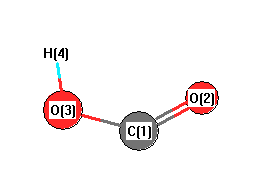 More geometry information
Calculated Bond Angles
| atom1 |
atom2 |
atom3 |
angle |
|
atom1 |
atom2 |
atom3 |
angle |
| C1 |
O2 |
H4 |
108.343 |
|
O2 |
C1 |
O3 |
130.390 |
Electronic energy levels
Charges, Dipole, Quadrupole and Polarizability
Charges from optimized geometry at B2PLYP/6-31G(2df,p)
Charges (e)
| Number |
Element |
Mulliken |
CHELPG |
AIM |
ESP |
| 1 |
C |
0.181 |
|
|
|
| 2 |
O |
-0.316 |
|
|
|
| 3 |
O |
-0.189 |
|
|
|
| 4 |
H |
0.324 |
|
|
|
Electric dipole moments
Electric dipole components in Debye
(What's a Debye? See section
VII.A.3)
| |
x |
y |
z |
Total |
| |
-0.941 |
-1.654 |
0.000 |
1.903 |
| CHELPG |
|
|
|
|
| AIM |
|
|
|
|
| ESP |
|
|
|
|
Electric Quadrupole moment
Quadrupole components in D Å
| Primitive |
|---|
| | x | y | z |
|---|
| x |
-19.509 |
0.634 |
0.000 |
| y |
0.634 |
-13.613 |
0.000 |
| z |
0.000 |
0.000 |
-15.848 |
|
| Traceless |
|---|
| | x | y | z |
|---|
| x |
-4.779 |
0.634 |
0.000 |
| y |
0.634 |
4.066 |
0.000 |
| z |
0.000 |
0.000 |
0.713 |
|
| Polar |
|---|
| 3z2-r2 | 1.426 |
|---|
| x2-y2 | -5.896 |
|---|
| xy | 0.634 |
|---|
| xz | 0.000 |
|---|
| yz | 0.000 |
|---|
|
Polarizabilities
Components of the polarizability tensor.
Units are
Å
3 (Angstrom cubed)
Change units.
| |
x |
y |
z |
| x |
3.212 |
0.254 |
0.000 |
| y |
0.254 |
2.604 |
0.000 |
| z |
0.000 |
0.000 |
1.697 |
<r2> (average value of r
2) Å
2
| <r2> |
34.620 |
| (<r2>)1/2 |
5.884 |
Jump to
S1C1
Energy calculated at B2PLYP/6-31G(2df,p)
| | hartrees |
|---|
| Energy at 0K | -188.976080 |
| Energy at 298.15K | -188.977152 |
| HF Energy | -188.789549 |
| Nuclear repulsion energy | 62.836287 |
The energy at 298.15K was derived from the energy at 0K
and an integrated heat capacity that used the calculated vibrational frequencies.
Vibrational Frequencies calculated at B2PLYP/6-31G(2df,p)
| Mode Number |
Symmetry |
Frequency
(cm-1) |
Scaled Frequency
(cm-1) |
IR Intensities
(km mol-1) |
Raman Act
(Å4/u) |
Dep P |
Dep U |
|---|
| 1 |
A' |
3831 |
3659 |
115.53 |
|
|
|
| 2 |
A' |
1899 |
1813 |
171.26 |
|
|
|
| 3 |
A' |
1255 |
1199 |
237.68 |
|
|
|
| 4 |
A' |
1098 |
1049 |
58.39 |
|
|
|
| 5 |
A' |
616 |
588 |
4.09 |
|
|
|
| 6 |
A" |
553 |
528 |
85.66 |
|
|
|
Unscaled Zero Point Vibrational Energy (zpe) 4625.9 cm
-1
Scaled (by 0.955) Zero Point Vibrational Energy (zpe) 4417.8 cm
-1
See section
III.C.1 List or set vibrational scaling factors
to change the scale factors used here.
See section
III.C.2
Calculate a vibrational scaling factor for a given set of molecules
to determine the least squares best scaling factor.
Geometric Data calculated at B2PLYP/6-31G(2df,p)
Point Group is Cs
Cartesians (Å)
| Atom |
x (Å) |
y (Å) |
z (Å) |
|---|
| C1 |
0.000 |
0.412 |
0.000 |
| O2 |
-0.946 |
-0.543 |
0.000 |
| O3 |
1.172 |
0.247 |
0.000 |
| H4 |
-1.805 |
-0.105 |
0.000 |
Atom - Atom Distances (Å)
| |
C1 |
O2 |
O3 |
H4 |
| C1 | | 1.3443 | 1.1832 | 1.8776 |
O2 | 1.3443 | | 2.2607 | 0.9641 | O3 | 1.1832 | 2.2607 | | 2.9976 | H4 | 1.8776 | 0.9641 | 2.9976 | |
More geometry information
Calculated Bond Angles
| atom1 |
atom2 |
atom3 |
angle |
|
atom1 |
atom2 |
atom3 |
angle |
| C1 |
O2 |
H4 |
107.710 |
|
O2 |
C1 |
O3 |
126.748 |
Electronic energy levels
Charges, Dipole, Quadrupole and Polarizability
Charges from optimized geometry at B2PLYP/6-31G(2df,p)
Charges (e)
| Number |
Element |
Mulliken |
CHELPG |
AIM |
ESP |
| 1 |
C |
0.138 |
|
|
|
| 2 |
O |
-0.316 |
|
|
|
| 3 |
O |
-0.163 |
|
|
|
| 4 |
H |
0.341 |
|
|
|
Electric dipole moments
Electric dipole components in Debye
(What's a Debye? See section
VII.A.3)
| |
x |
y |
z |
Total |
| |
-2.884 |
0.352 |
0.000 |
2.906 |
| CHELPG |
|
|
|
|
| AIM |
|
|
|
|
| ESP |
|
|
|
|
Electric Quadrupole moment
Quadrupole components in D Å
| Primitive |
|---|
| | x | y | z |
|---|
| x |
-13.526 |
-1.031 |
0.000 |
| y |
-1.031 |
-17.385 |
0.000 |
| z |
0.000 |
0.000 |
-15.890 |
|
| Traceless |
|---|
| | x | y | z |
|---|
| x |
3.111 |
-1.031 |
0.000 |
| y |
-1.031 |
-2.677 |
0.000 |
| z |
0.000 |
0.000 |
-0.434 |
|
| Polar |
|---|
| 3z2-r2 | -0.868 |
|---|
| x2-y2 | 3.859 |
|---|
| xy | -1.031 |
|---|
| xz | 0.000 |
|---|
| yz | 0.000 |
|---|
|
Polarizabilities
Components of the polarizability tensor.
Units are
Å
3 (Angstrom cubed)
Change units.
| |
x |
y |
z |
| x |
3.684 |
0.219 |
0.000 |
| y |
0.219 |
2.128 |
0.000 |
| z |
0.000 |
0.000 |
1.713 |
<r2> (average value of r
2) Å
2
| <r2> |
35.027 |
| (<r2>)1/2 |
5.918 |
