Jump to
S1C2
S2C1
S2C2
Energy calculated at QCISD/6-31G(2df,p)
| | hartrees |
|---|
| Energy at 0K | -131.119769 |
| Energy at 298.15K | -131.119176 |
| HF Energy | -130.691853 |
| Nuclear repulsion energy | 47.188790 |
The energy at 298.15K was derived from the energy at 0K
and an integrated heat capacity that used the calculated vibrational frequencies.
Vibrational Frequencies calculated at QCISD/6-31G(2df,p)
| Mode Number |
Symmetry |
Frequency
(cm-1) |
Scaled Frequency
(cm-1) |
IR Intensities
(km mol-1) |
Raman Act
(Å4/u) |
Dep P |
Dep U |
|---|
| 1 |
A' |
3394 |
3215 |
29.27 |
|
|
|
| 2 |
A' |
1839 |
1742 |
43.04 |
|
|
|
| 3 |
A' |
1174 |
1112 |
11.15 |
|
|
|
| 4 |
A' |
590 |
559 |
30.12 |
|
|
|
| 5 |
A' |
403 |
382 |
5.20 |
|
|
|
| 6 |
A" |
448 |
425 |
1.87 |
|
|
|
Unscaled Zero Point Vibrational Energy (zpe) 3924.3 cm
-1
Scaled (by 0.9474) Zero Point Vibrational Energy (zpe) 3717.9 cm
-1
See section
III.C.1 List or set vibrational scaling factors
to change the scale factors used here.
See section
III.C.2
Calculate a vibrational scaling factor for a given set of molecules
to determine the least squares best scaling factor.
Geometric Data calculated at QCISD/6-31G(2df,p)
Point Group is Cs
Cartesians (Å)
| Atom |
x (Å) |
y (Å) |
z (Å) |
|---|
| C1 |
0.055 |
-1.234 |
0.000 |
| C2 |
0.000 |
0.092 |
0.000 |
| N3 |
-0.147 |
1.278 |
0.000 |
| H4 |
0.699 |
-2.090 |
0.000 |
Atom - Atom Distances (Å)
| |
C1 |
C2 |
N3 |
H4 |
| C1 | | 1.3270 | 2.5200 | 1.0713 |
C2 | 1.3270 | | 1.1951 | 2.2914 | N3 | 2.5200 | 1.1951 | | 3.4728 | H4 | 1.0713 | 2.2914 | 3.4728 | |
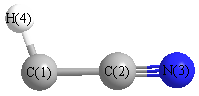 More geometry information
Calculated Bond Angles
| atom1 |
atom2 |
atom3 |
angle |
|
atom1 |
atom2 |
atom3 |
angle |
| C1 |
C2 |
N3 |
175.313 |
|
C2 |
C1 |
H4 |
145.448 |
Electronic energy levels
Charges, Dipole, Quadrupole and Polarizability
Jump to
S1C1
S2C1
S2C2
Energy calculated at QCISD/6-31G(2df,p)
| | hartrees |
|---|
| Energy at 0K | -131.118140 |
| Energy at 298.15K | |
| HF Energy | -130.689891 |
| Nuclear repulsion energy | 47.326813 |
The energy at 298.15K was derived from the energy at 0K
and an integrated heat capacity that used the calculated vibrational frequencies.
Vibrational Frequencies calculated at QCISD/6-31G(2df,p)
| Mode Number |
Symmetry |
Frequency
(cm-1) |
Scaled Frequency
(cm-1) |
IR Intensities
(km mol-1) |
Raman Act
(Å4/u) |
Dep P |
Dep U |
|---|
| 1 |
Σ |
3482 |
3299 |
74.15 |
|
|
|
| 2 |
Σ |
1698 |
1609 |
52.09 |
|
|
|
| 3 |
Σ |
1252 |
1186 |
6.17 |
|
|
|
| 4 |
Π |
445 |
421 |
0.16 |
|
|
|
| 4 |
Π |
445 |
421 |
0.16 |
|
|
|
| 5 |
Π |
401i |
379i |
48.86 |
|
|
|
| 5 |
Π |
401i |
379i |
48.86 |
|
|
|
Unscaled Zero Point Vibrational Energy (zpe) 3260.2 cm
-1
Scaled (by 0.9474) Zero Point Vibrational Energy (zpe) 3088.7 cm
-1
See section
III.C.1 List or set vibrational scaling factors
to change the scale factors used here.
See section
III.C.2
Calculate a vibrational scaling factor for a given set of molecules
to determine the least squares best scaling factor.
Geometric Data calculated at QCISD/6-31G(2df,p)
Point Group is C∞v
Cartesians (Å)
| Atom |
x (Å) |
y (Å) |
z (Å) |
|---|
| C1 |
0.000 |
0.000 |
-1.212 |
| C2 |
0.000 |
0.000 |
0.083 |
| N3 |
0.000 |
0.000 |
1.293 |
| H4 |
0.000 |
0.000 |
-2.276 |
Atom - Atom Distances (Å)
| |
C1 |
C2 |
N3 |
H4 |
| C1 | | 1.2950 | 2.5046 | 1.0638 |
C2 | 1.2950 | | 1.2096 | 2.3588 | N3 | 2.5046 | 1.2096 | | 3.5684 | H4 | 1.0638 | 2.3588 | 3.5684 | |
More geometry information
Calculated Bond Angles
| atom1 |
atom2 |
atom3 |
angle |
|
atom1 |
atom2 |
atom3 |
angle |
| C1 |
C2 |
N3 |
180.000 |
|
C2 |
C1 |
H4 |
180.000 |
Electronic energy levels
Charges, Dipole, Quadrupole and Polarizability
Charges from optimized geometry at QCISD/6-31G(2df,p)
Charges (e)
| Number |
Element |
Mulliken |
CHELPG |
AIM |
ESP |
| 1 |
C |
-0.247 |
|
|
|
| 2 |
C |
0.180 |
|
|
|
| 3 |
N |
-0.206 |
|
|
|
| 4 |
H |
0.273 |
|
|
|
Electric dipole moments
Electric dipole components in Debye
(What's a Debye? See section
VII.A.3)
| |
x |
y |
z |
Total |
| |
0.000 |
0.000 |
-3.288 |
3.288 |
| CHELPG |
|
|
|
|
| AIM |
|
|
|
|
| ESP |
|
|
|
|
Electric Quadrupole moment
Quadrupole components in D Å
Polarizabilities
Components of the polarizability tensor.
Units are
Å
3 (Angstrom cubed)
Change units.
| |
x |
y |
z |
| x |
0.000 |
0.000 |
0.000 |
| y |
0.000 |
0.000 |
0.000 |
| z |
0.000 |
0.000 |
0.000 |
<r2> (average value of r
2) Å
2
| <r2> |
35.992 |
| (<r2>)1/2 |
5.999 |
Jump to
S1C1
S1C2
S2C2
Energy calculated at QCISD/6-31G(2df,p)
| | hartrees |
|---|
| Energy at 0K | -131.094997 |
| Energy at 298.15K | -131.094444 |
| HF Energy | -130.629525 |
| Nuclear repulsion energy | 46.768822 |
The energy at 298.15K was derived from the energy at 0K
and an integrated heat capacity that used the calculated vibrational frequencies.
Vibrational Frequencies calculated at QCISD/6-31G(2df,p)
| Mode Number |
Symmetry |
Frequency
(cm-1) |
Scaled Frequency
(cm-1) |
IR Intensities
(km mol-1) |
Raman Act
(Å4/u) |
Dep P |
Dep U |
|---|
| 1 |
A' |
3094 |
2931 |
11.15 |
|
|
|
| 2 |
A' |
2124 |
2013 |
42.24 |
|
|
|
| 3 |
A' |
1070 |
1014 |
72.02 |
|
|
|
| 4 |
A' |
979 |
928 |
0.63 |
|
|
|
| 5 |
A' |
444 |
420 |
19.15 |
|
|
|
| 6 |
A" |
320 |
303 |
12.93 |
|
|
|
Unscaled Zero Point Vibrational Energy (zpe) 4015.7 cm
-1
Scaled (by 0.9474) Zero Point Vibrational Energy (zpe) 3804.4 cm
-1
See section
III.C.1 List or set vibrational scaling factors
to change the scale factors used here.
See section
III.C.2
Calculate a vibrational scaling factor for a given set of molecules
to determine the least squares best scaling factor.
Geometric Data calculated at QCISD/6-31G(2df,p)
Point Group is Cs
Cartesians (Å)
| Atom |
x (Å) |
y (Å) |
z (Å) |
|---|
| C1 |
-0.053 |
-1.300 |
0.000 |
| C2 |
0.000 |
0.098 |
0.000 |
| N3 |
-0.095 |
1.271 |
0.000 |
| H4 |
0.980 |
-1.685 |
0.000 |
Atom - Atom Distances (Å)
| |
C1 |
C2 |
N3 |
H4 |
| C1 | | 1.3996 | 2.5714 | 1.1018 |
C2 | 1.3996 | | 1.1763 | 2.0346 | N3 | 2.5714 | 1.1763 | | 3.1449 | H4 | 1.1018 | 2.0346 | 3.1449 | |
More geometry information
Electronic energy levels
Charges, Dipole, Quadrupole and Polarizability
Jump to
S1C1
S1C2
S2C1
Energy calculated at QCISD/6-31G(2df,p)
| | hartrees |
|---|
| Energy at 0K | -131.094997 |
| Energy at 298.15K | -131.094444 |
| HF Energy | -130.629525 |
| Nuclear repulsion energy | 46.768822 |
The energy at 298.15K was derived from the energy at 0K
and an integrated heat capacity that used the calculated vibrational frequencies.
Vibrational Frequencies calculated at QCISD/6-31G(2df,p)
Geometric Data calculated at QCISD/6-31G(2df,p)
Point Group is Cs
Electronic energy levels
Charges, Dipole, Quadrupole and Polarizability
