Jump to
S1C2
S2C1
S2C2
Energy calculated at PBE1PBE/6-31G(2df,p)
| | hartrees |
|---|
| Energy at 0K | -131.271362 |
| Energy at 298.15K | -131.270642 |
| HF Energy | -131.271362 |
| Nuclear repulsion energy | 47.439019 |
The energy at 298.15K was derived from the energy at 0K
and an integrated heat capacity that used the calculated vibrational frequencies.
Vibrational Frequencies calculated at PBE1PBE/6-31G(2df,p)
| Mode Number |
Symmetry |
Frequency
(cm-1) |
Scaled Frequency
(cm-1) |
IR Intensities
(km mol-1) |
Raman Act
(Å4/u) |
Dep P |
Dep U |
|---|
| 1 |
A' |
3423 |
3276 |
44.81 |
|
|
|
| 2 |
A' |
1803 |
1726 |
44.20 |
|
|
|
| 3 |
A' |
1249 |
1195 |
8.09 |
|
|
|
| 4 |
A' |
466 |
446 |
10.79 |
|
|
|
| 5 |
A' |
352 |
337 |
35.98 |
|
|
|
| 6 |
A" |
457 |
438 |
1.51 |
|
|
|
Unscaled Zero Point Vibrational Energy (zpe) 3875.3 cm
-1
Scaled (by 0.957) Zero Point Vibrational Energy (zpe) 3708.6 cm
-1
See section
III.C.1 List or set vibrational scaling factors
to change the scale factors used here.
See section
III.C.2
Calculate a vibrational scaling factor for a given set of molecules
to determine the least squares best scaling factor.
Geometric Data calculated at PBE1PBE/6-31G(2df,p)
Point Group is Cs
Cartesians (Å)
| Atom |
x (Å) |
y (Å) |
z (Å) |
|---|
| C1 |
0.081 |
-1.214 |
0.000 |
| C2 |
0.000 |
0.086 |
0.000 |
| N3 |
-0.155 |
1.275 |
0.000 |
| H4 |
0.596 |
-2.152 |
0.000 |
Atom - Atom Distances (Å)
| |
C1 |
C2 |
N3 |
H4 |
| C1 | | 1.3026 | 2.5007 | 1.0692 |
C2 | 1.3026 | | 1.1994 | 2.3153 | N3 | 2.5007 | 1.1994 | | 3.5080 | H4 | 1.0692 | 2.3153 | 3.5080 | |
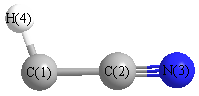 More geometry information
Calculated Bond Angles
| atom1 |
atom2 |
atom3 |
angle |
|
atom1 |
atom2 |
atom3 |
angle |
| C1 |
C2 |
N3 |
176.162 |
|
C2 |
C1 |
H4 |
154.801 |
Electronic energy levels
Charges, Dipole, Quadrupole and Polarizability
Jump to
S1C1
S2C1
S2C2
Energy calculated at PBE1PBE/6-31G(2df,p)
| | hartrees |
|---|
| Energy at 0K | -131.270982 |
| Energy at 298.15K | |
| HF Energy | -131.270982 |
| Nuclear repulsion energy | 47.492455 |
The energy at 298.15K was derived from the energy at 0K
and an integrated heat capacity that used the calculated vibrational frequencies.
Vibrational Frequencies calculated at PBE1PBE/6-31G(2df,p)
| Mode Number |
Symmetry |
Frequency
(cm-1) |
Scaled Frequency
(cm-1) |
IR Intensities
(km mol-1) |
Raman Act
(Å4/u) |
Dep P |
Dep U |
|---|
| 1 |
Σ |
3479 |
3329 |
72.03 |
|
|
|
| 2 |
Σ |
1749 |
1674 |
47.96 |
|
|
|
| 3 |
Σ |
1283 |
1228 |
5.42 |
|
|
|
| 4 |
Π |
458 |
439 |
0.58 |
|
|
|
| 4 |
Π |
458 |
439 |
0.58 |
|
|
|
| 5 |
Π |
256i |
245i |
46.39 |
|
|
|
| 5 |
Π |
256i |
245i |
46.39 |
|
|
|
Unscaled Zero Point Vibrational Energy (zpe) 3457.7 cm
-1
Scaled (by 0.957) Zero Point Vibrational Energy (zpe) 3309.0 cm
-1
See section
III.C.1 List or set vibrational scaling factors
to change the scale factors used here.
See section
III.C.2
Calculate a vibrational scaling factor for a given set of molecules
to determine the least squares best scaling factor.
Geometric Data calculated at PBE1PBE/6-31G(2df,p)
Point Group is C∞v
Cartesians (Å)
| Atom |
x (Å) |
y (Å) |
z (Å) |
|---|
| C1 |
0.000 |
0.000 |
-1.206 |
| C2 |
0.000 |
0.000 |
0.081 |
| N3 |
0.000 |
0.000 |
1.288 |
| H4 |
0.000 |
0.000 |
-2.271 |
Atom - Atom Distances (Å)
| |
C1 |
C2 |
N3 |
H4 |
| C1 | | 1.2875 | 2.4944 | 1.0650 |
C2 | 1.2875 | | 1.2070 | 2.3525 | N3 | 2.4944 | 1.2070 | | 3.5595 | H4 | 1.0650 | 2.3525 | 3.5595 | |
More geometry information
Calculated Bond Angles
| atom1 |
atom2 |
atom3 |
angle |
|
atom1 |
atom2 |
atom3 |
angle |
| C1 |
C2 |
N3 |
180.000 |
|
C2 |
C1 |
H4 |
180.000 |
Electronic energy levels
Charges, Dipole, Quadrupole and Polarizability
Charges from optimized geometry at PBE1PBE/6-31G(2df,p)
Charges (e)
| Number |
Element |
Mulliken |
CHELPG |
AIM |
ESP |
| 1 |
C |
-0.224 |
|
|
|
| 2 |
C |
0.303 |
|
|
|
| 3 |
N |
-0.338 |
|
|
|
| 4 |
H |
0.259 |
|
|
|
Electric dipole moments
Electric dipole components in Debye
(What's a Debye? See section
VII.A.3)
| |
x |
y |
z |
Total |
| |
0.000 |
0.000 |
-3.262 |
3.262 |
| CHELPG |
|
|
|
|
| AIM |
|
|
|
|
| ESP |
|
|
|
|
Electric Quadrupole moment
Quadrupole components in D Å
| Primitive |
|---|
| | x | y | z |
|---|
| x |
-16.866 |
0.000 |
0.000 |
| y |
0.000 |
-16.866 |
0.000 |
| z |
0.000 |
0.000 |
-14.969 |
|
| Traceless |
|---|
| | x | y | z |
|---|
| x |
-0.949 |
0.000 |
0.000 |
| y |
0.000 |
-0.949 |
0.000 |
| z |
0.000 |
0.000 |
1.897 |
|
| Polar |
|---|
| 3z2-r2 | 3.794 |
|---|
| x2-y2 | 0.000 |
|---|
| xy | 0.000 |
|---|
| xz | 0.000 |
|---|
| yz | 0.000 |
|---|
|
Polarizabilities
Components of the polarizability tensor.
Units are
Å
3 (Angstrom cubed)
Change units.
| |
x |
y |
z |
| x |
2.033 |
0.000 |
0.000 |
| y |
0.000 |
2.033 |
0.000 |
| z |
0.000 |
0.000 |
6.186 |
<r2> (average value of r
2) Å
2
| <r2> |
35.684 |
| (<r2>)1/2 |
5.974 |
Jump to
S1C1
S1C2
S2C2
Energy calculated at PBE1PBE/6-31G(2df,p)
| | hartrees |
|---|
| Energy at 0K | -131.239349 |
| Energy at 298.15K | -131.238819 |
| HF Energy | -131.239349 |
| Nuclear repulsion energy | 47.096772 |
The energy at 298.15K was derived from the energy at 0K
and an integrated heat capacity that used the calculated vibrational frequencies.
Vibrational Frequencies calculated at PBE1PBE/6-31G(2df,p)
| Mode Number |
Symmetry |
Frequency
(cm-1) |
Scaled Frequency
(cm-1) |
IR Intensities
(km mol-1) |
Raman Act
(Å4/u) |
Dep P |
Dep U |
|---|
| 1 |
A' |
3090 |
2957 |
6.89 |
|
|
|
| 2 |
A' |
2126 |
2035 |
23.57 |
|
|
|
| 3 |
A' |
1100 |
1053 |
37.47 |
|
|
|
| 4 |
A' |
943 |
902 |
44.76 |
|
|
|
| 5 |
A' |
466 |
446 |
24.29 |
|
|
|
| 6 |
A" |
326 |
312 |
12.91 |
|
|
|
Unscaled Zero Point Vibrational Energy (zpe) 4025.4 cm
-1
Scaled (by 0.957) Zero Point Vibrational Energy (zpe) 3852.3 cm
-1
See section
III.C.1 List or set vibrational scaling factors
to change the scale factors used here.
See section
III.C.2
Calculate a vibrational scaling factor for a given set of molecules
to determine the least squares best scaling factor.
Geometric Data calculated at PBE1PBE/6-31G(2df,p)
Point Group is Cs
Cartesians (Å)
| Atom |
x (Å) |
y (Å) |
z (Å) |
|---|
| C1 |
0.036 |
-1.281 |
0.000 |
| C2 |
0.000 |
0.091 |
0.000 |
| N3 |
-0.184 |
1.254 |
0.000 |
| H4 |
1.076 |
-1.644 |
0.000 |
Atom - Atom Distances (Å)
| |
C1 |
C2 |
N3 |
H4 |
| C1 | | 1.3721 | 2.5445 | 1.1020 |
C2 | 1.3721 | | 1.1778 | 2.0420 | N3 | 2.5445 | 1.1778 | | 3.1610 | H4 | 1.1020 | 2.0420 | 3.1610 | |
More geometry information
Electronic energy levels
Charges, Dipole, Quadrupole and Polarizability
Charges from optimized geometry at PBE1PBE/6-31G(2df,p)
Charges (e)
| Number |
Element |
Mulliken |
CHELPG |
AIM |
ESP |
| 1 |
C |
-0.252 |
|
|
|
| 2 |
C |
0.325 |
|
|
|
| 3 |
N |
-0.285 |
|
|
|
| 4 |
H |
0.212 |
|
|
|
Electric dipole moments
Electric dipole components in Debye
(What's a Debye? See section
VII.A.3)
| |
x |
y |
z |
Total |
| |
1.623 |
-1.428 |
0.000 |
2.161 |
| CHELPG |
|
|
|
|
| AIM |
|
|
|
|
| ESP |
|
|
|
|
Electric Quadrupole moment
Quadrupole components in D Å
| Primitive |
|---|
| | x | y | z |
|---|
| x |
-16.695 |
-2.360 |
0.000 |
| y |
-2.360 |
-20.406 |
0.000 |
| z |
0.000 |
0.000 |
-15.608 |
|
| Traceless |
|---|
| | x | y | z |
|---|
| x |
1.311 |
-2.360 |
0.000 |
| y |
-2.360 |
-4.254 |
0.000 |
| z |
0.000 |
0.000 |
2.943 |
|
| Polar |
|---|
| 3z2-r2 | 5.885 |
|---|
| x2-y2 | 3.710 |
|---|
| xy | -2.360 |
|---|
| xz | 0.000 |
|---|
| yz | 0.000 |
|---|
|
Polarizabilities
Components of the polarizability tensor.
Units are
Å
3 (Angstrom cubed)
Change units.
| |
x |
y |
z |
| x |
2.612 |
-0.609 |
0.000 |
| y |
-0.609 |
6.172 |
0.000 |
| z |
0.000 |
0.000 |
2.463 |
<r2> (average value of r
2) Å
2
| <r2> |
35.984 |
| (<r2>)1/2 |
5.999 |
Jump to
S1C1
S1C2
S2C1
Energy calculated at PBE1PBE/6-31G(2df,p)
| | hartrees |
|---|
| Energy at 0K | -131.239349 |
| Energy at 298.15K | -131.238819 |
| HF Energy | -131.239349 |
| Nuclear repulsion energy | 47.096772 |
The energy at 298.15K was derived from the energy at 0K
and an integrated heat capacity that used the calculated vibrational frequencies.
Vibrational Frequencies calculated at PBE1PBE/6-31G(2df,p)
Geometric Data calculated at PBE1PBE/6-31G(2df,p)
Point Group is Cs
Electronic energy levels
Charges, Dipole, Quadrupole and Polarizability
