Jump to
S1C2
S2C1
S2C2
Energy calculated at CCD/6-31G(2df,p)
| | hartrees |
|---|
| Energy at 0K | -131.099301 |
| Energy at 298.15K | -131.098810 |
| HF Energy | -130.690872 |
| Nuclear repulsion energy | 47.629317 |
The energy at 298.15K was derived from the energy at 0K
and an integrated heat capacity that used the calculated vibrational frequencies.
Vibrational Frequencies calculated at CCD/6-31G(2df,p)
| Mode Number |
Symmetry |
Frequency
(cm-1) |
Scaled Frequency
(cm-1) |
IR Intensities
(km mol-1) |
Raman Act
(Å4/u) |
Dep P |
Dep U |
|---|
| 1 |
A' |
3397 |
3218 |
27.02 |
|
|
|
| 2 |
A' |
1948 |
1845 |
39.43 |
|
|
|
| 3 |
A' |
1145 |
1085 |
33.49 |
|
|
|
| 4 |
A' |
667 |
632 |
16.44 |
|
|
|
| 5 |
A' |
422 |
400 |
4.43 |
|
|
|
| 6 |
A" |
503 |
476 |
4.98 |
|
|
|
Unscaled Zero Point Vibrational Energy (zpe) 4041.1 cm
-1
Scaled (by 0.9472) Zero Point Vibrational Energy (zpe) 3827.7 cm
-1
See section
III.C.1 List or set vibrational scaling factors
to change the scale factors used here.
See section
III.C.2
Calculate a vibrational scaling factor for a given set of molecules
to determine the least squares best scaling factor.
Geometric Data calculated at CCD/6-31G(2df,p)
Point Group is Cs
Cartesians (Å)
| Atom |
x (Å) |
y (Å) |
z (Å) |
|---|
| C1 |
-0.090 |
-1.232 |
0.000 |
| C2 |
0.000 |
0.105 |
0.000 |
| N3 |
0.004 |
1.269 |
0.000 |
| H4 |
0.511 |
-2.120 |
0.000 |
Atom - Atom Distances (Å)
| |
C1 |
C2 |
N3 |
H4 |
| C1 | | 1.3403 | 2.5027 | 1.0716 |
C2 | 1.3403 | | 1.1637 | 2.2827 | N3 | 2.5027 | 1.1637 | | 3.4262 | H4 | 1.0716 | 2.2827 | 3.4262 | |
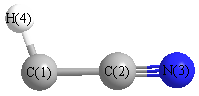 More geometry information
Calculated Bond Angles
| atom1 |
atom2 |
atom3 |
angle |
|
atom1 |
atom2 |
atom3 |
angle |
| C1 |
C2 |
N3 |
176.357 |
|
C2 |
C1 |
H4 |
142.088 |
Electronic energy levels
Charges, Dipole, Quadrupole and Polarizability
Jump to
S1C1
S2C1
S2C2
Energy calculated at CCD/6-31G(2df,p)
| | hartrees |
|---|
| Energy at 0K | -131.097305 |
| Energy at 298.15K | |
| HF Energy | -130.689468 |
| Nuclear repulsion energy | 47.792381 |
The energy at 298.15K was derived from the energy at 0K
and an integrated heat capacity that used the calculated vibrational frequencies.
Vibrational Frequencies calculated at CCD/6-31G(2df,p)
| Mode Number |
Symmetry |
Frequency
(cm-1) |
Scaled Frequency
(cm-1) |
IR Intensities
(km mol-1) |
Raman Act
(Å4/u) |
Dep P |
Dep U |
|---|
| 1 |
Σ |
3510 |
3324 |
77.33 |
|
|
|
| 2 |
Σ |
1603 |
1519 |
74.02 |
|
|
|
| 3 |
Σ |
1270 |
1203 |
39.18 |
|
|
|
| 4 |
Π |
492 |
466 |
0.56 |
|
|
|
| 4 |
Π |
492 |
466 |
0.56 |
|
|
|
| 5 |
Π |
374i |
354i |
51.09 |
|
|
|
| 5 |
Π |
374i |
354i |
51.09 |
|
|
|
Unscaled Zero Point Vibrational Energy (zpe) 3309.5 cm
-1
Scaled (by 0.9472) Zero Point Vibrational Energy (zpe) 3134.8 cm
-1
See section
III.C.1 List or set vibrational scaling factors
to change the scale factors used here.
See section
III.C.2
Calculate a vibrational scaling factor for a given set of molecules
to determine the least squares best scaling factor.
Geometric Data calculated at CCD/6-31G(2df,p)
Point Group is C∞v
Cartesians (Å)
| Atom |
x (Å) |
y (Å) |
z (Å) |
|---|
| C1 |
0.000 |
0.000 |
-1.202 |
| C2 |
0.000 |
0.000 |
0.089 |
| N3 |
0.000 |
0.000 |
1.278 |
| H4 |
0.000 |
0.000 |
-2.265 |
Atom - Atom Distances (Å)
| |
C1 |
C2 |
N3 |
H4 |
| C1 | | 1.2914 | 2.4802 | 1.0624 |
C2 | 1.2914 | | 1.1888 | 2.3538 | N3 | 2.4802 | 1.1888 | | 3.5425 | H4 | 1.0624 | 2.3538 | 3.5425 | |
More geometry information
Calculated Bond Angles
| atom1 |
atom2 |
atom3 |
angle |
|
atom1 |
atom2 |
atom3 |
angle |
| C1 |
C2 |
N3 |
180.000 |
|
C2 |
C1 |
H4 |
180.000 |
Electronic energy levels
Charges, Dipole, Quadrupole and Polarizability
Charges from optimized geometry at CCD/6-31G(2df,p)
Charges (e)
| Number |
Element |
Mulliken |
CHELPG |
AIM |
ESP |
| 1 |
C |
-0.255 |
|
|
|
| 2 |
C |
0.189 |
|
|
|
| 3 |
N |
-0.214 |
|
|
|
| 4 |
H |
0.279 |
|
|
|
Electric dipole moments
Electric dipole components in Debye
(What's a Debye? See section
VII.A.3)
| |
x |
y |
z |
Total |
| |
0.000 |
0.000 |
-3.487 |
3.487 |
| CHELPG |
|
|
|
|
| AIM |
|
|
|
|
| ESP |
|
|
|
|
Electric Quadrupole moment
Quadrupole components in D Å
Polarizabilities
Components of the polarizability tensor.
Units are
Å
3 (Angstrom cubed)
Change units.
| |
x |
y |
z |
| x |
0.000 |
0.000 |
0.000 |
| y |
0.000 |
0.000 |
0.000 |
| z |
0.000 |
0.000 |
0.000 |
<r2> (average value of r
2) Å
2
| <r2> |
35.528 |
| (<r2>)1/2 |
5.961 |
Jump to
S1C1
S1C2
S2C2
Energy calculated at CCD/6-31G(2df,p)
| | hartrees |
|---|
| Energy at 0K | -131.086980 |
| Energy at 298.15K | -131.086446 |
| HF Energy | -130.630552 |
| Nuclear repulsion energy | 46.830825 |
The energy at 298.15K was derived from the energy at 0K
and an integrated heat capacity that used the calculated vibrational frequencies.
Vibrational Frequencies calculated at CCD/6-31G(2df,p)
| Mode Number |
Symmetry |
Frequency
(cm-1) |
Scaled Frequency
(cm-1) |
IR Intensities
(km mol-1) |
Raman Act
(Å4/u) |
Dep P |
Dep U |
|---|
| 1 |
A' |
3096 |
2932 |
11.37 |
|
|
|
| 2 |
A' |
2265 |
2145 |
23.77 |
|
|
|
| 3 |
A' |
1086 |
1029 |
65.69 |
|
|
|
| 4 |
A' |
978 |
926 |
7.98 |
|
|
|
| 5 |
A' |
440 |
417 |
18.57 |
|
|
|
| 6 |
A" |
338 |
320 |
14.77 |
|
|
|
Unscaled Zero Point Vibrational Energy (zpe) 4101.2 cm
-1
Scaled (by 0.9472) Zero Point Vibrational Energy (zpe) 3884.7 cm
-1
See section
III.C.1 List or set vibrational scaling factors
to change the scale factors used here.
See section
III.C.2
Calculate a vibrational scaling factor for a given set of molecules
to determine the least squares best scaling factor.
Geometric Data calculated at CCD/6-31G(2df,p)
Point Group is Cs
Cartesians (Å)
| Atom |
x (Å) |
y (Å) |
z (Å) |
|---|
| C1 |
-0.104 |
-1.301 |
0.000 |
| C2 |
0.000 |
0.104 |
0.000 |
| N3 |
-0.042 |
1.270 |
0.000 |
| H4 |
0.920 |
-1.709 |
0.000 |
Atom - Atom Distances (Å)
| |
C1 |
C2 |
N3 |
H4 |
| C1 | | 1.4084 | 2.5720 | 1.1021 |
C2 | 1.4084 | | 1.1675 | 2.0327 | N3 | 2.5720 | 1.1675 | | 3.1309 | H4 | 1.1021 | 2.0327 | 3.1309 | |
More geometry information
Electronic energy levels
Charges, Dipole, Quadrupole and Polarizability
Jump to
S1C1
S1C2
S2C1
Energy calculated at CCD/6-31G(2df,p)
| | hartrees |
|---|
| Energy at 0K | -131.086980 |
| Energy at 298.15K | -131.086446 |
| HF Energy | -130.630552 |
| Nuclear repulsion energy | 46.830825 |
The energy at 298.15K was derived from the energy at 0K
and an integrated heat capacity that used the calculated vibrational frequencies.
Vibrational Frequencies calculated at CCD/6-31G(2df,p)
Geometric Data calculated at CCD/6-31G(2df,p)
Point Group is Cs
Electronic energy levels
Charges, Dipole, Quadrupole and Polarizability
