Jump to
S1C2
Energy calculated at MP2/6-31G(2df,p)
| | hartrees |
|---|
| Energy at 0K | -957.855596 |
| Energy at 298.15K | |
| HF Energy | -957.371435 |
| Nuclear repulsion energy | 126.479543 |
The energy at 298.15K was derived from the energy at 0K
and an integrated heat capacity that used the calculated vibrational frequencies.
Vibrational Frequencies calculated at MP2/6-31G(2df,p)
| Mode Number |
Symmetry |
Frequency
(cm-1) |
Scaled Frequency
(cm-1) |
IR Intensities
(km mol-1) |
Raman Act
(Å4/u) |
Dep P |
Dep U |
|---|
| 1 |
A1 |
3347 |
3161 |
2.09 |
|
|
|
| 2 |
A1 |
783 |
740 |
9.28 |
|
|
|
| 3 |
A1 |
317 |
300 |
0.48 |
|
|
|
| 4 |
B1 |
452i |
427i |
39.71 |
|
|
|
| 5 |
B2 |
1262 |
1192 |
56.46 |
|
|
|
| 6 |
B2 |
968 |
914 |
140.41 |
|
|
|
Unscaled Zero Point Vibrational Energy (zpe) 3112.6 cm
-1
Scaled (by 0.9445) Zero Point Vibrational Energy (zpe) 2939.8 cm
-1
See section
III.C.1 List or set vibrational scaling factors
to change the scale factors used here.
See section
III.C.2
Calculate a vibrational scaling factor for a given set of molecules
to determine the least squares best scaling factor.
Geometric Data calculated at MP2/6-31G(2df,p)
Point Group is C2v
Cartesians (Å)
| Atom |
x (Å) |
y (Å) |
z (Å) |
|---|
| C1 |
0.000 |
0.000 |
0.672 |
| H2 |
0.000 |
0.000 |
1.747 |
| Cl3 |
0.000 |
1.465 |
-0.170 |
| Cl4 |
0.000 |
-1.465 |
-0.170 |
Atom - Atom Distances (Å)
| |
C1 |
H2 |
Cl3 |
Cl4 |
| C1 | | 1.0751 | 1.6899 | 1.6899 |
H2 | 1.0751 | | 2.4130 | 2.4130 | Cl3 | 1.6899 | 2.4130 | | 2.9303 | Cl4 | 1.6899 | 2.4130 | 2.9303 | |
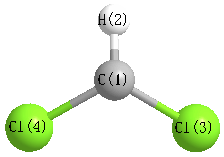 More geometry information
Calculated Bond Angles
| atom1 |
atom2 |
atom3 |
angle |
|
atom1 |
atom2 |
atom3 |
angle |
| Cl3 |
C1 |
H2 |
119.889 |
|
Cl3 |
C1 |
Cl4 |
120.223 |
| Cl4 |
C1 |
H2 |
119.889 |
|
Electronic energy levels
Charges, Dipole, Quadrupole and Polarizability
Jump to
S1C1
Energy calculated at MP2/6-31G(2df,p)
| | hartrees |
|---|
| Energy at 0K | -957.856968 |
| Energy at 298.15K | -957.857847 |
| HF Energy | -957.373110 |
| Nuclear repulsion energy | 126.208010 |
The energy at 298.15K was derived from the energy at 0K
and an integrated heat capacity that used the calculated vibrational frequencies.
Vibrational Frequencies calculated at MP2/6-31G(2df,p)
| Mode Number |
Symmetry |
Frequency
(cm-1) |
Scaled Frequency
(cm-1) |
IR Intensities
(km mol-1) |
Raman Act
(Å4/u) |
Dep P |
Dep U |
|---|
| 1 |
A' |
3292 |
3109 |
1.83 |
|
|
|
| 2 |
A' |
794 |
750 |
16.26 |
|
|
|
| 3 |
A' |
563 |
532 |
17.35 |
|
|
|
| 4 |
A' |
312 |
294 |
0.36 |
|
|
|
| 5 |
A" |
1266 |
1196 |
45.74 |
|
|
|
| 6 |
A" |
929 |
878 |
168.01 |
|
|
|
Unscaled Zero Point Vibrational Energy (zpe) 3578.0 cm
-1
Scaled (by 0.9445) Zero Point Vibrational Energy (zpe) 3379.4 cm
-1
See section
III.C.1 List or set vibrational scaling factors
to change the scale factors used here.
See section
III.C.2
Calculate a vibrational scaling factor for a given set of molecules
to determine the least squares best scaling factor.
Geometric Data calculated at MP2/6-31G(2df,p)
Point Group is Cs
Cartesians (Å)
| Atom |
x (Å) |
y (Å) |
z (Å) |
|---|
| C1 |
0.013 |
0.701 |
0.000 |
| H2 |
-0.520 |
1.640 |
0.000 |
| Cl3 |
0.013 |
-0.172 |
1.462 |
| Cl4 |
0.013 |
-0.172 |
-1.462 |
Atom - Atom Distances (Å)
| |
C1 |
H2 |
Cl3 |
Cl4 |
| C1 | | 1.0799 | 1.7023 | 1.7023 |
H2 | 1.0799 | | 2.3882 | 2.3882 | Cl3 | 1.7023 | 2.3882 | | 2.9231 | Cl4 | 1.7023 | 2.3882 | 2.9231 | |
More geometry information
Calculated Bond Angles
| atom1 |
atom2 |
atom3 |
angle |
|
atom1 |
atom2 |
atom3 |
angle |
| Cl3 |
C1 |
H2 |
116.480 |
|
Cl3 |
C1 |
Cl4 |
118.312 |
| Cl4 |
C1 |
H2 |
116.480 |
|
Electronic energy levels
Charges, Dipole, Quadrupole and Polarizability
