Jump to
S1C2
Energy calculated at QCISD/6-31G(2df,p)
| | hartrees |
|---|
| Energy at 0K | -957.899699 |
| Energy at 298.15K | |
| HF Energy | -957.371530 |
| Nuclear repulsion energy | 125.765990 |
The energy at 298.15K was derived from the energy at 0K
and an integrated heat capacity that used the calculated vibrational frequencies.
Vibrational Frequencies calculated at QCISD/6-31G(2df,p)
| Mode Number |
Symmetry |
Frequency
(cm-1) |
Scaled Frequency
(cm-1) |
IR Intensities
(km mol-1) |
Raman Act
(Å4/u) |
Dep P |
Dep U |
|---|
| 1 |
A1 |
3318 |
3143 |
0.99 |
|
|
|
| 2 |
A1 |
766 |
726 |
8.26 |
|
|
|
| 3 |
A1 |
312 |
295 |
0.56 |
|
|
|
| 4 |
B1 |
405i |
384i |
37.20 |
|
|
|
| 5 |
B2 |
1257 |
1191 |
56.21 |
|
|
|
| 6 |
B2 |
954 |
904 |
118.62 |
|
|
|
Unscaled Zero Point Vibrational Energy (zpe) 3100.6 cm
-1
Scaled (by 0.9474) Zero Point Vibrational Energy (zpe) 2937.5 cm
-1
See section
III.C.1 List or set vibrational scaling factors
to change the scale factors used here.
See section
III.C.2
Calculate a vibrational scaling factor for a given set of molecules
to determine the least squares best scaling factor.
Geometric Data calculated at QCISD/6-31G(2df,p)
Point Group is C2v
Cartesians (Å)
| Atom |
x (Å) |
y (Å) |
z (Å) |
|---|
| C1 |
0.000 |
0.000 |
0.675 |
| H2 |
0.000 |
0.000 |
1.751 |
| Cl3 |
0.000 |
1.474 |
-0.171 |
| Cl4 |
0.000 |
-1.474 |
-0.171 |
Atom - Atom Distances (Å)
| |
C1 |
H2 |
Cl3 |
Cl4 |
| C1 | | 1.0764 | 1.6994 | 1.6994 |
H2 | 1.0764 | | 2.4220 | 2.4220 | Cl3 | 1.6994 | 2.4220 | | 2.9487 | Cl4 | 1.6994 | 2.4220 | 2.9487 | |
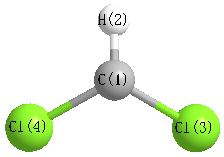 More geometry information
Calculated Bond Angles
| atom1 |
atom2 |
atom3 |
angle |
|
atom1 |
atom2 |
atom3 |
angle |
| Cl3 |
C1 |
H2 |
119.826 |
|
Cl3 |
C1 |
Cl4 |
120.349 |
| Cl4 |
C1 |
H2 |
119.826 |
|
Electronic energy levels
Charges, Dipole, Quadrupole and Polarizability
Jump to
S1C1
Energy calculated at QCISD/6-31G(2df,p)
| | hartrees |
|---|
| Energy at 0K | -957.900711 |
| Energy at 298.15K | -957.901547 |
| HF Energy | -957.373151 |
| Nuclear repulsion energy | 125.610167 |
The energy at 298.15K was derived from the energy at 0K
and an integrated heat capacity that used the calculated vibrational frequencies.
Vibrational Frequencies calculated at QCISD/6-31G(2df,p)
| Mode Number |
Symmetry |
Frequency
(cm-1) |
Scaled Frequency
(cm-1) |
IR Intensities
(km mol-1) |
Raman Act
(Å4/u) |
Dep P |
Dep U |
|---|
| 1 |
A' |
3278 |
3106 |
1.38 |
|
|
|
| 2 |
A' |
775 |
734 |
13.42 |
|
|
|
| 3 |
A' |
521 |
493 |
19.02 |
|
|
|
| 4 |
A' |
306 |
290 |
0.50 |
|
|
|
| 5 |
A" |
1262 |
1196 |
45.91 |
|
|
|
| 6 |
A" |
925 |
876 |
142.43 |
|
|
|
Unscaled Zero Point Vibrational Energy (zpe) 3533.2 cm
-1
Scaled (by 0.9474) Zero Point Vibrational Energy (zpe) 3347.4 cm
-1
See section
III.C.1 List or set vibrational scaling factors
to change the scale factors used here.
See section
III.C.2
Calculate a vibrational scaling factor for a given set of molecules
to determine the least squares best scaling factor.
Geometric Data calculated at QCISD/6-31G(2df,p)
Point Group is Cs
Cartesians (Å)
| Atom |
x (Å) |
y (Å) |
z (Å) |
|---|
| C1 |
0.012 |
0.700 |
0.000 |
| H2 |
-0.493 |
1.655 |
0.000 |
| Cl3 |
0.012 |
-0.172 |
1.470 |
| Cl4 |
0.012 |
-0.172 |
-1.470 |
Atom - Atom Distances (Å)
| |
C1 |
H2 |
Cl3 |
Cl4 |
| C1 | | 1.0800 | 1.7094 | 1.7094 |
H2 | 1.0800 | | 2.3987 | 2.3987 | Cl3 | 1.7094 | 2.3987 | | 2.9399 | Cl4 | 1.7094 | 2.3987 | 2.9399 | |
More geometry information
Calculated Bond Angles
| atom1 |
atom2 |
atom3 |
angle |
|
atom1 |
atom2 |
atom3 |
angle |
| Cl3 |
C1 |
H2 |
116.810 |
|
Cl3 |
C1 |
Cl4 |
118.614 |
| Cl4 |
C1 |
H2 |
116.810 |
|
Electronic energy levels
Charges, Dipole, Quadrupole and Polarizability
