Jump to
S1C2
Energy calculated at MP2=FULL/6-31G(2df,p)
| | hartrees |
|---|
| Energy at 0K | -151.594062 |
| Energy at 298.15K | |
| HF Energy | -151.100488 |
| Nuclear repulsion energy | 52.871524 |
The energy at 298.15K was derived from the energy at 0K
and an integrated heat capacity that used the calculated vibrational frequencies.
Vibrational Frequencies calculated at MP2=FULL/6-31G(2df,p)
| Mode Number |
Symmetry |
Frequency
(cm-1) |
Scaled Frequency
(cm-1) |
IR Intensities
(km mol-1) |
Raman Act
(Å4/u) |
Dep P |
Dep U |
|---|
| 1 |
Σ |
3570 |
3356 |
220.74 |
28.67 |
0.22 |
0.36 |
| 2 |
Σ |
2488 |
2338 |
1248.91 |
81.27 |
0.30 |
0.46 |
| 3 |
Σ |
1396 |
1312 |
30.89 |
1.54 |
0.00 |
0.01 |
| 4 |
Π |
637 |
598 |
1.15 |
2.57 |
0.75 |
0.86 |
| 4 |
Π |
619 |
582 |
18.93 |
5.64 |
0.75 |
0.86 |
| 5 |
Π |
454 |
427 |
26.44 |
0.01 |
0.75 |
0.86 |
| 5 |
Π |
498i |
468i |
149.68 |
5.37 |
0.75 |
0.86 |
Unscaled Zero Point Vibrational Energy (zpe) 4332.8 cm
-1
Scaled (by 0.9399) Zero Point Vibrational Energy (zpe) 4072.4 cm
-1
See section
III.C.1 List or set vibrational scaling factors
to change the scale factors used here.
See section
III.C.2
Calculate a vibrational scaling factor for a given set of molecules
to determine the least squares best scaling factor.
Geometric Data calculated at MP2=FULL/6-31G(2df,p)
Point Group is C∞v
Cartesians (Å)
| Atom |
x (Å) |
y (Å) |
z (Å) |
|---|
| C1 |
0.000 |
0.000 |
0.028 |
| C2 |
0.000 |
0.000 |
-1.237 |
| O3 |
0.000 |
0.000 |
1.194 |
| H4 |
0.000 |
0.000 |
-2.294 |
Atom - Atom Distances (Å)
| |
C1 |
C2 |
O3 |
H4 |
| C1 | | 1.2649 | 1.1663 | 2.3219 |
C2 | 1.2649 | | 2.4312 | 1.0570 | O3 | 1.1663 | 2.4312 | | 3.4882 | H4 | 2.3219 | 1.0570 | 3.4882 | |
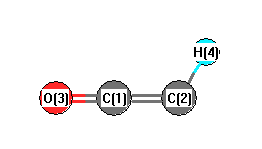 More geometry information
Calculated Bond Angles
| atom1 |
atom2 |
atom3 |
angle |
|
atom1 |
atom2 |
atom3 |
angle |
| C1 |
C2 |
H4 |
180.000 |
|
C2 |
C1 |
O3 |
180.000 |
Electronic energy levels
Charges, Dipole, Quadrupole and Polarizability
Jump to
S1C1
Energy calculated at MP2=FULL/6-31G(2df,p)
| | hartrees |
|---|
| Energy at 0K | -151.598920 |
| Energy at 298.15K | |
| HF Energy | -151.099512 |
| Nuclear repulsion energy | 52.483102 |
The energy at 298.15K was derived from the energy at 0K
and an integrated heat capacity that used the calculated vibrational frequencies.
Vibrational Frequencies calculated at MP2=FULL/6-31G(2df,p)
| Mode Number |
Symmetry |
Frequency
(cm-1) |
Scaled Frequency
(cm-1) |
IR Intensities
(km mol-1) |
Raman Act
(Å4/u) |
Dep P |
Dep U |
|---|
| 1 |
A' |
3396 |
3192 |
52.76 |
63.32 |
0.30 |
0.46 |
| 2 |
A' |
2399 |
2254 |
955.07 |
420.13 |
0.14 |
0.25 |
| 3 |
A' |
1268 |
1191 |
2.39 |
71.44 |
0.39 |
0.56 |
| 4 |
A' |
661 |
621 |
163.47 |
19.97 |
0.03 |
0.05 |
| 5 |
A' |
603 |
567 |
63.62 |
50.12 |
0.13 |
0.23 |
| 6 |
A" |
565 |
531 |
8.45 |
31.04 |
0.75 |
0.86 |
Unscaled Zero Point Vibrational Energy (zpe) 4445.7 cm
-1
Scaled (by 0.9399) Zero Point Vibrational Energy (zpe) 4178.5 cm
-1
See section
III.C.1 List or set vibrational scaling factors
to change the scale factors used here.
See section
III.C.2
Calculate a vibrational scaling factor for a given set of molecules
to determine the least squares best scaling factor.
Geometric Data calculated at MP2=FULL/6-31G(2df,p)
Point Group is Cs
Cartesians (Å)
| Atom |
x (Å) |
y (Å) |
z (Å) |
|---|
| C1 |
0.000 |
0.046 |
0.000 |
| C2 |
0.957 |
-0.845 |
0.000 |
| O3 |
-0.970 |
0.684 |
0.000 |
| H4 |
2.018 |
-0.686 |
0.000 |
Atom - Atom Distances (Å)
| |
C1 |
C2 |
O3 |
H4 |
| C1 | | 1.3081 | 1.1614 | 2.1470 |
C2 | 1.3081 | | 2.4608 | 1.0728 | O3 | 1.1614 | 2.4608 | | 3.2878 | H4 | 2.1470 | 1.0728 | 3.2878 | |
More geometry information
Calculated Bond Angles
| atom1 |
atom2 |
atom3 |
angle |
|
atom1 |
atom2 |
atom3 |
angle |
| C1 |
C2 |
H4 |
128.518 |
|
C2 |
C1 |
O3 |
170.377 |
Electronic energy levels
Charges, Dipole, Quadrupole and Polarizability
