Jump to
S1C2
Energy calculated at PBE1PBE/6-31G(2df,p)
| | hartrees |
|---|
| Energy at 0K | -151.761545 |
| Energy at 298.15K | |
| HF Energy | -151.761545 |
| Nuclear repulsion energy | 52.631632 |
The energy at 298.15K was derived from the energy at 0K
and an integrated heat capacity that used the calculated vibrational frequencies.
Vibrational Frequencies calculated at PBE1PBE/6-31G(2df,p)
| Mode Number |
Symmetry |
Frequency
(cm-1) |
Scaled Frequency
(cm-1) |
IR Intensities
(km mol-1) |
Raman Act
(Å4/u) |
Dep P |
Dep U |
|---|
| 1 |
Σ |
3507 |
3356 |
123.38 |
44.55 |
0.23 |
0.38 |
| 2 |
Σ |
2157 |
2065 |
194.36 |
3.44 |
0.46 |
0.63 |
| 3 |
Σ |
1332 |
1275 |
20.99 |
31.99 |
0.22 |
0.36 |
| 4 |
Π |
591 |
566 |
0.18 |
1.63 |
0.75 |
0.86 |
| 4 |
Π |
547 |
523 |
11.82 |
1.16 |
0.75 |
0.86 |
| 5 |
Π |
439 |
420 |
24.36 |
0.00 |
0.75 |
0.86 |
| 5 |
Π |
383i |
367i |
128.90 |
3.25 |
0.75 |
0.86 |
Unscaled Zero Point Vibrational Energy (zpe) 4095.2 cm
-1
Scaled (by 0.957) Zero Point Vibrational Energy (zpe) 3919.1 cm
-1
See section
III.C.1 List or set vibrational scaling factors
to change the scale factors used here.
See section
III.C.2
Calculate a vibrational scaling factor for a given set of molecules
to determine the least squares best scaling factor.
Geometric Data calculated at PBE1PBE/6-31G(2df,p)
Point Group is C∞v
Cartesians (Å)
| Atom |
x (Å) |
y (Å) |
z (Å) |
|---|
| C1 |
0.000 |
0.000 |
0.020 |
| C2 |
0.000 |
0.000 |
-1.238 |
| O3 |
0.000 |
0.000 |
1.201 |
| H4 |
0.000 |
0.000 |
-2.301 |
Atom - Atom Distances (Å)
| |
C1 |
C2 |
O3 |
H4 |
| C1 | | 1.2585 | 1.1806 | 2.3209 |
C2 | 1.2585 | | 2.4391 | 1.0624 | O3 | 1.1806 | 2.4391 | | 3.5015 | H4 | 2.3209 | 1.0624 | 3.5015 | |
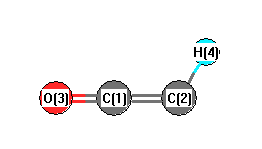 More geometry information
Calculated Bond Angles
| atom1 |
atom2 |
atom3 |
angle |
|
atom1 |
atom2 |
atom3 |
angle |
| C1 |
C2 |
H4 |
180.000 |
|
C2 |
C1 |
O3 |
180.000 |
Electronic energy levels
Charges, Dipole, Quadrupole and Polarizability
Charges from optimized geometry at PBE1PBE/6-31G(2df,p)
Charges (e)
| Number |
Element |
Mulliken |
CHELPG |
AIM |
ESP |
| 1 |
C |
0.431 |
|
|
|
| 2 |
C |
-0.442 |
|
|
|
| 3 |
O |
-0.245 |
|
|
|
| 4 |
H |
0.256 |
|
|
|
Electric dipole moments
Electric dipole components in Debye
(What's a Debye? See section
VII.A.3)
| |
x |
y |
z |
Total |
| |
0.000 |
0.000 |
-2.070 |
2.070 |
| CHELPG |
|
|
|
|
| AIM |
|
|
|
|
| ESP |
|
|
|
|
Electric Quadrupole moment
Quadrupole components in D Å
| Primitive |
|---|
| | x | y | z |
|---|
| x |
-17.352 |
0.000 |
0.000 |
| y |
0.000 |
-15.771 |
0.000 |
| z |
0.000 |
0.000 |
-14.141 |
|
| Traceless |
|---|
| | x | y | z |
|---|
| x |
-2.396 |
0.000 |
0.000 |
| y |
0.000 |
-0.025 |
0.000 |
| z |
0.000 |
0.000 |
2.421 |
|
| Polar |
|---|
| 3z2-r2 | 4.841 |
|---|
| x2-y2 | -1.581 |
|---|
| xy | 0.000 |
|---|
| xz | 0.000 |
|---|
| yz | 0.000 |
|---|
|
Polarizabilities
Components of the polarizability tensor.
Units are
Å
3 (Angstrom cubed)
Change units.
| |
x |
y |
z |
| x |
1.857 |
0.000 |
0.000 |
| y |
0.000 |
1.812 |
0.000 |
| z |
0.000 |
0.000 |
5.379 |
<r2> (average value of r
2) Å
2
| <r2> |
35.872 |
| (<r2>)1/2 |
5.989 |
Jump to
S1C1
Energy calculated at PBE1PBE/6-31G(2df,p)
| | hartrees |
|---|
| Energy at 0K | -151.763714 |
| Energy at 298.15K | |
| HF Energy | -151.763714 |
| Nuclear repulsion energy | 52.489337 |
The energy at 298.15K was derived from the energy at 0K
and an integrated heat capacity that used the calculated vibrational frequencies.
Vibrational Frequencies calculated at PBE1PBE/6-31G(2df,p)
| Mode Number |
Symmetry |
Frequency
(cm-1) |
Scaled Frequency
(cm-1) |
IR Intensities
(km mol-1) |
Raman Act
(Å4/u) |
Dep P |
Dep U |
|---|
| 1 |
A' |
3377 |
3232 |
46.12 |
70.84 |
0.30 |
0.46 |
| 2 |
A' |
2144 |
2052 |
281.63 |
4.13 |
0.26 |
0.41 |
| 3 |
A' |
1282 |
1227 |
5.96 |
28.13 |
0.26 |
0.41 |
| 4 |
A' |
582 |
557 |
11.70 |
3.61 |
0.74 |
0.85 |
| 5 |
A' |
470 |
450 |
225.02 |
4.23 |
0.18 |
0.30 |
| 6 |
A" |
522 |
499 |
5.30 |
0.72 |
0.75 |
0.86 |
Unscaled Zero Point Vibrational Energy (zpe) 4188.6 cm
-1
Scaled (by 0.957) Zero Point Vibrational Energy (zpe) 4008.5 cm
-1
See section
III.C.1 List or set vibrational scaling factors
to change the scale factors used here.
See section
III.C.2
Calculate a vibrational scaling factor for a given set of molecules
to determine the least squares best scaling factor.
Geometric Data calculated at PBE1PBE/6-31G(2df,p)
Point Group is Cs
Cartesians (Å)
| Atom |
x (Å) |
y (Å) |
z (Å) |
|---|
| C1 |
0.000 |
0.046 |
0.000 |
| C2 |
1.038 |
-0.722 |
0.000 |
| O3 |
-1.041 |
0.580 |
0.000 |
| H4 |
2.103 |
-0.585 |
0.000 |
Atom - Atom Distances (Å)
| |
C1 |
C2 |
O3 |
H4 |
| C1 | | 1.2907 | 1.1701 | 2.1951 |
C2 | 1.2907 | | 2.4527 | 1.0738 | O3 | 1.1701 | 2.4527 | | 3.3524 | H4 | 2.1951 | 1.0738 | 3.3524 | |
More geometry information
Calculated Bond Angles
| atom1 |
atom2 |
atom3 |
angle |
|
atom1 |
atom2 |
atom3 |
angle |
| C1 |
C2 |
H4 |
136.161 |
|
C2 |
C1 |
O3 |
170.670 |
Electronic energy levels
Charges, Dipole, Quadrupole and Polarizability
Charges from optimized geometry at PBE1PBE/6-31G(2df,p)
Charges (e)
| Number |
Element |
Mulliken |
CHELPG |
AIM |
ESP |
| 1 |
C |
0.435 |
|
|
|
| 2 |
C |
-0.442 |
|
|
|
| 3 |
O |
-0.213 |
|
|
|
| 4 |
H |
0.220 |
|
|
|
Electric dipole moments
Electric dipole components in Debye
(What's a Debye? See section
VII.A.3)
| |
x |
y |
z |
Total |
| |
1.568 |
0.325 |
0.000 |
1.601 |
| CHELPG |
|
|
|
|
| AIM |
|
|
|
|
| ESP |
|
|
|
|
Electric Quadrupole moment
Quadrupole components in D Å
| Primitive |
|---|
| | x | y | z |
|---|
| x |
-14.639 |
0.739 |
0.000 |
| y |
0.739 |
-18.575 |
0.000 |
| z |
0.000 |
0.000 |
-15.890 |
|
| Traceless |
|---|
| | x | y | z |
|---|
| x |
2.594 |
0.739 |
0.000 |
| y |
0.739 |
-3.310 |
0.000 |
| z |
0.000 |
0.000 |
0.717 |
|
| Polar |
|---|
| 3z2-r2 | 1.433 |
|---|
| x2-y2 | 3.936 |
|---|
| xy | 0.739 |
|---|
| xz | 0.000 |
|---|
| yz | 0.000 |
|---|
|
Polarizabilities
Components of the polarizability tensor.
Units are
Å
3 (Angstrom cubed)
Change units.
| |
x |
y |
z |
| x |
4.551 |
-1.577 |
0.000 |
| y |
-1.577 |
3.095 |
0.000 |
| z |
0.000 |
0.000 |
2.179 |
<r2> (average value of r
2) Å
2
| <r2> |
35.947 |
| (<r2>)1/2 |
5.996 |
