Jump to
S1C2
Energy calculated at B2PLYP/6-31G(2df,p)
| | hartrees |
|---|
| Energy at 0K | -151.813935 |
| Energy at 298.15K | |
| HF Energy | -151.654831 |
| Nuclear repulsion energy | 52.525087 |
The energy at 298.15K was derived from the energy at 0K
and an integrated heat capacity that used the calculated vibrational frequencies.
Vibrational Frequencies calculated at B2PLYP/6-31G(2df,p)
| Mode Number |
Symmetry |
Frequency
(cm-1) |
Scaled Frequency
(cm-1) |
IR Intensities
(km mol-1) |
Raman Act
(Å4/u) |
Dep P |
Dep U |
|---|
| 1 |
Σ |
3521 |
3362 |
130.08 |
40.57 |
0.23 |
0.38 |
| 2 |
Σ |
2167 |
2069 |
230.83 |
0.31 |
0.12 |
0.21 |
| 3 |
Σ |
1311 |
1252 |
22.78 |
25.78 |
0.21 |
0.35 |
| 4 |
Π |
584 |
557 |
0.07 |
1.62 |
0.75 |
0.86 |
| 4 |
Π |
544 |
519 |
10.38 |
1.48 |
0.75 |
0.86 |
| 5 |
Π |
435 |
415 |
25.71 |
0.01 |
0.75 |
0.86 |
| 5 |
Π |
447i |
427i |
127.94 |
3.57 |
0.75 |
0.86 |
Unscaled Zero Point Vibrational Energy (zpe) 4056.9 cm
-1
Scaled (by 0.955) Zero Point Vibrational Energy (zpe) 3874.4 cm
-1
See section
III.C.1 List or set vibrational scaling factors
to change the scale factors used here.
See section
III.C.2
Calculate a vibrational scaling factor for a given set of molecules
to determine the least squares best scaling factor.
Geometric Data calculated at B2PLYP/6-31G(2df,p)
Point Group is C∞v
Cartesians (Å)
| Atom |
x (Å) |
y (Å) |
z (Å) |
|---|
| C1 |
0.000 |
0.000 |
0.019 |
| C2 |
0.000 |
0.000 |
-1.241 |
| O3 |
0.000 |
0.000 |
1.204 |
| H4 |
0.000 |
0.000 |
-2.300 |
Atom - Atom Distances (Å)
| |
C1 |
C2 |
O3 |
H4 |
| C1 | | 1.2598 | 1.1848 | 2.3190 |
C2 | 1.2598 | | 2.4447 | 1.0591 | O3 | 1.1848 | 2.4447 | | 3.5038 | H4 | 2.3190 | 1.0591 | 3.5038 | |
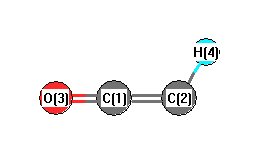 More geometry information
Calculated Bond Angles
| atom1 |
atom2 |
atom3 |
angle |
|
atom1 |
atom2 |
atom3 |
angle |
| C1 |
C2 |
H4 |
180.000 |
|
C2 |
C1 |
O3 |
180.000 |
Electronic energy levels
Charges, Dipole, Quadrupole and Polarizability
Charges from optimized geometry at B2PLYP/6-31G(2df,p)
Charges (e)
| Number |
Element |
Mulliken |
CHELPG |
AIM |
ESP |
| 1 |
C |
0.388 |
|
|
|
| 2 |
C |
-0.404 |
|
|
|
| 3 |
O |
-0.234 |
|
|
|
| 4 |
H |
0.249 |
|
|
|
Electric dipole moments
Electric dipole components in Debye
(What's a Debye? See section
VII.A.3)
| |
x |
y |
z |
Total |
| |
0.000 |
0.000 |
-2.105 |
2.105 |
| CHELPG |
|
|
|
|
| AIM |
|
|
|
|
| ESP |
|
|
|
|
Electric Quadrupole moment
Quadrupole components in D Å
| Primitive |
|---|
| | x | y | z |
|---|
| x |
-17.418 |
0.000 |
0.000 |
| y |
0.000 |
-15.833 |
0.000 |
| z |
0.000 |
0.000 |
-14.343 |
|
| Traceless |
|---|
| | x | y | z |
|---|
| x |
-2.330 |
0.000 |
0.000 |
| y |
0.000 |
0.048 |
0.000 |
| z |
0.000 |
0.000 |
2.282 |
|
| Polar |
|---|
| 3z2-r2 | 4.564 |
|---|
| x2-y2 | -1.585 |
|---|
| xy | 0.000 |
|---|
| xz | 0.000 |
|---|
| yz | 0.000 |
|---|
|
Polarizabilities
Components of the polarizability tensor.
Units are
Å
3 (Angstrom cubed)
Change units.
| |
x |
y |
z |
| x |
1.835 |
0.000 |
0.000 |
| y |
0.000 |
1.792 |
0.000 |
| z |
0.000 |
0.000 |
5.324 |
<r2> (average value of r
2) Å
2
| <r2> |
36.028 |
| (<r2>)1/2 |
6.002 |
Jump to
S1C1
Energy calculated at B2PLYP/6-31G(2df,p)
| | hartrees |
|---|
| Energy at 0K | -151.817066 |
| Energy at 298.15K | |
| HF Energy | -151.655898 |
| Nuclear repulsion energy | 52.319309 |
The energy at 298.15K was derived from the energy at 0K
and an integrated heat capacity that used the calculated vibrational frequencies.
Vibrational Frequencies calculated at B2PLYP/6-31G(2df,p)
| Mode Number |
Symmetry |
Frequency
(cm-1) |
Scaled Frequency
(cm-1) |
IR Intensities
(km mol-1) |
Raman Act
(Å4/u) |
Dep P |
Dep U |
|---|
| 1 |
A' |
3375 |
3223 |
39.39 |
72.70 |
0.30 |
0.47 |
| 2 |
A' |
2133 |
2037 |
299.55 |
0.09 |
0.75 |
0.86 |
| 3 |
A' |
1248 |
1192 |
6.57 |
26.82 |
0.27 |
0.42 |
| 4 |
A' |
580 |
554 |
41.60 |
4.70 |
0.52 |
0.68 |
| 5 |
A' |
521 |
497 |
200.18 |
4.42 |
0.10 |
0.18 |
| 6 |
A" |
521 |
497 |
4.19 |
0.59 |
0.75 |
0.86 |
Unscaled Zero Point Vibrational Energy (zpe) 4188.9 cm
-1
Scaled (by 0.955) Zero Point Vibrational Energy (zpe) 4000.4 cm
-1
See section
III.C.1 List or set vibrational scaling factors
to change the scale factors used here.
See section
III.C.2
Calculate a vibrational scaling factor for a given set of molecules
to determine the least squares best scaling factor.
Geometric Data calculated at B2PLYP/6-31G(2df,p)
Point Group is Cs
Cartesians (Å)
| Atom |
x (Å) |
y (Å) |
z (Å) |
|---|
| C1 |
0.000 |
0.050 |
0.000 |
| C2 |
1.084 |
-0.662 |
0.000 |
| O3 |
-1.079 |
0.512 |
0.000 |
| H4 |
2.129 |
-0.423 |
0.000 |
Atom - Atom Distances (Å)
| |
C1 |
C2 |
O3 |
H4 |
| C1 | | 1.2969 | 1.1744 | 2.1810 |
C2 | 1.2969 | | 2.4618 | 1.0721 | O3 | 1.1744 | 2.4618 | | 3.3420 | H4 | 2.1810 | 1.0721 | 3.3420 | |
More geometry information
Calculated Bond Angles
| atom1 |
atom2 |
atom3 |
angle |
|
atom1 |
atom2 |
atom3 |
angle |
| C1 |
C2 |
H4 |
133.805 |
|
C2 |
C1 |
O3 |
169.929 |
Electronic energy levels
Charges, Dipole, Quadrupole and Polarizability
Charges from optimized geometry at B2PLYP/6-31G(2df,p)
Charges (e)
| Number |
Element |
Mulliken |
CHELPG |
AIM |
ESP |
| 1 |
C |
0.406 |
|
|
|
| 2 |
C |
-0.414 |
|
|
|
| 3 |
O |
-0.197 |
|
|
|
| 4 |
H |
0.205 |
|
|
|
Electric dipole moments
Electric dipole components in Debye
(What's a Debye? See section
VII.A.3)
| |
x |
y |
z |
Total |
| |
1.492 |
0.476 |
0.000 |
1.566 |
| CHELPG |
|
|
|
|
| AIM |
|
|
|
|
| ESP |
|
|
|
|
Electric Quadrupole moment
Quadrupole components in D Å
| Primitive |
|---|
| | x | y | z |
|---|
| x |
-15.016 |
1.116 |
-0.004 |
| y |
1.116 |
-18.598 |
0.007 |
| z |
-0.004 |
0.007 |
-15.968 |
|
| Traceless |
|---|
| | x | y | z |
|---|
| x |
2.267 |
1.116 |
-0.004 |
| y |
1.116 |
-3.105 |
0.007 |
| z |
-0.004 |
0.007 |
0.839 |
|
| Polar |
|---|
| 3z2-r2 | 1.678 |
|---|
| x2-y2 | 3.581 |
|---|
| xy | 1.116 |
|---|
| xz | -0.004 |
|---|
| yz | 0.007 |
|---|
|
Polarizabilities
Components of the polarizability tensor.
Units are
Å
3 (Angstrom cubed)
Change units.
| |
x |
y |
z |
| x |
4.751 |
-1.483 |
0.001 |
| y |
-1.483 |
2.921 |
0.001 |
| z |
0.001 |
0.001 |
2.111 |
<r2> (average value of r
2) Å
2
| <r2> |
36.154 |
| (<r2>)1/2 |
6.013 |
