Jump to
S1C2
Energy calculated at CCD/6-31G(2df,p)
| | hartrees |
|---|
| Energy at 0K | -151.582340 |
| Energy at 298.15K | |
| HF Energy | -151.100613 |
| Nuclear repulsion energy | 52.850046 |
The energy at 298.15K was derived from the energy at 0K
and an integrated heat capacity that used the calculated vibrational frequencies.
Vibrational Frequencies calculated at CCD/6-31G(2df,p)
| Mode Number |
Symmetry |
Frequency
(cm-1) |
Scaled Frequency
(cm-1) |
IR Intensities
(km mol-1) |
Raman Act
(Å4/u) |
Dep P |
Dep U |
|---|
| 1 |
Σ |
3538 |
3351 |
166.87 |
|
|
|
| 2 |
Σ |
2319 |
2196 |
665.93 |
|
|
|
| 3 |
Σ |
1393 |
1319 |
34.69 |
|
|
|
| 4 |
Π |
616 |
584 |
0.67 |
|
|
|
| 4 |
Π |
583 |
553 |
14.75 |
|
|
|
| 5 |
Π |
448 |
424 |
28.21 |
|
|
|
| 5 |
Π |
420i |
398i |
139.20 |
|
|
|
Unscaled Zero Point Vibrational Energy (zpe) 4238.2 cm
-1
Scaled (by 0.9472) Zero Point Vibrational Energy (zpe) 4014.4 cm
-1
See section
III.C.1 List or set vibrational scaling factors
to change the scale factors used here.
See section
III.C.2
Calculate a vibrational scaling factor for a given set of molecules
to determine the least squares best scaling factor.
Geometric Data calculated at CCD/6-31G(2df,p)
Point Group is C∞v
Cartesians (Å)
| Atom |
x (Å) |
y (Å) |
z (Å) |
|---|
| C1 |
0.000 |
0.000 |
0.025 |
| C2 |
0.000 |
0.000 |
-1.235 |
| O3 |
0.000 |
0.000 |
1.195 |
| H4 |
0.000 |
0.000 |
-2.295 |
Atom - Atom Distances (Å)
| |
C1 |
C2 |
O3 |
H4 |
| C1 | | 1.2600 | 1.1704 | 2.3196 |
C2 | 1.2600 | | 2.4305 | 1.0596 | O3 | 1.1704 | 2.4305 | | 3.4901 | H4 | 2.3196 | 1.0596 | 3.4901 | |
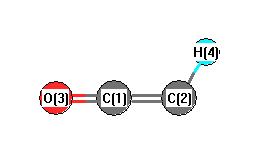 More geometry information
Calculated Bond Angles
| atom1 |
atom2 |
atom3 |
angle |
|
atom1 |
atom2 |
atom3 |
angle |
| C1 |
C2 |
H4 |
180.000 |
|
C2 |
C1 |
O3 |
180.000 |
Electronic energy levels
Charges, Dipole, Quadrupole and Polarizability
Jump to
S1C1
Energy calculated at CCD/6-31G(2df,p)
| | hartrees |
|---|
| Energy at 0K | -151.585169 |
| Energy at 298.15K | |
| HF Energy | -151.100116 |
| Nuclear repulsion energy | 52.614500 |
The energy at 298.15K was derived from the energy at 0K
and an integrated heat capacity that used the calculated vibrational frequencies.
Vibrational Frequencies calculated at CCD/6-31G(2df,p)
| Mode Number |
Symmetry |
Frequency
(cm-1) |
Scaled Frequency
(cm-1) |
IR Intensities
(km mol-1) |
Raman Act
(Å4/u) |
Dep P |
Dep U |
|---|
| 1 |
A' |
3396 |
3217 |
52.23 |
|
|
|
| 2 |
A' |
2273 |
2153 |
676.99 |
|
|
|
| 3 |
A' |
1300 |
1232 |
1.95 |
|
|
|
| 4 |
A' |
620 |
587 |
26.42 |
|
|
|
| 5 |
A' |
513 |
486 |
254.79 |
|
|
|
| 6 |
A" |
545 |
517 |
9.14 |
|
|
|
Unscaled Zero Point Vibrational Energy (zpe) 4323.6 cm
-1
Scaled (by 0.9472) Zero Point Vibrational Energy (zpe) 4095.3 cm
-1
See section
III.C.1 List or set vibrational scaling factors
to change the scale factors used here.
See section
III.C.2
Calculate a vibrational scaling factor for a given set of molecules
to determine the least squares best scaling factor.
Geometric Data calculated at CCD/6-31G(2df,p)
Point Group is Cs
Cartesians (Å)
| Atom |
x (Å) |
y (Å) |
z (Å) |
|---|
| C1 |
0.000 |
0.048 |
0.000 |
| C2 |
0.975 |
-0.811 |
0.000 |
| O3 |
-0.986 |
0.659 |
0.000 |
| H4 |
2.041 |
-0.694 |
0.000 |
Atom - Atom Distances (Å)
| |
C1 |
C2 |
O3 |
H4 |
| C1 | | 1.2993 | 1.1603 | 2.1715 |
C2 | 1.2993 | | 2.4511 | 1.0725 | O3 | 1.1603 | 2.4511 | | 3.3157 | H4 | 2.1715 | 1.0725 | 3.3157 | |
More geometry information
Calculated Bond Angles
| atom1 |
atom2 |
atom3 |
angle |
|
atom1 |
atom2 |
atom3 |
angle |
| C1 |
C2 |
H4 |
132.327 |
|
C2 |
C1 |
O3 |
170.408 |
Electronic energy levels
Charges, Dipole, Quadrupole and Polarizability
