Jump to
S1C2
Energy calculated at MP2/6-31G(2df,p)
| | hartrees |
|---|
| Energy at 0K | -1071.599923 |
| Energy at 298.15K | -1071.602461 |
| HF Energy | -1070.724996 |
| Nuclear repulsion energy | 264.330225 |
The energy at 298.15K was derived from the energy at 0K
and an integrated heat capacity that used the calculated vibrational frequencies.
Vibrational Frequencies calculated at MP2/6-31G(2df,p)
| Mode Number |
Symmetry |
Frequency
(cm-1) |
Scaled Frequency
(cm-1) |
IR Intensities
(km mol-1) |
Raman Act
(Å4/u) |
Dep P |
Dep U |
|---|
| 1 |
A' |
3210 |
3032 |
1.76 |
|
|
|
| 2 |
A' |
3029 |
2861 |
32.07 |
|
|
|
| 3 |
A' |
1795 |
1696 |
100.89 |
|
|
|
| 4 |
A' |
1414 |
1336 |
2.33 |
|
|
|
| 5 |
A' |
1222 |
1155 |
6.02 |
|
|
|
| 6 |
A' |
1089 |
1029 |
25.62 |
|
|
|
| 7 |
A' |
810 |
765 |
20.15 |
|
|
|
| 8 |
A' |
446 |
421 |
3.74 |
|
|
|
| 9 |
A' |
322 |
304 |
21.65 |
|
|
|
| 10 |
A' |
259 |
244 |
2.08 |
|
|
|
| 11 |
A" |
1257 |
1187 |
23.73 |
|
|
|
| 12 |
A" |
1023 |
966 |
20.01 |
|
|
|
| 13 |
A" |
785 |
741 |
99.53 |
|
|
|
| 14 |
A" |
288 |
272 |
3.10 |
|
|
|
| 15 |
A" |
82 |
78 |
6.85 |
|
|
|
Unscaled Zero Point Vibrational Energy (zpe) 8515.2 cm
-1
Scaled (by 0.9445) Zero Point Vibrational Energy (zpe) 8042.7 cm
-1
See section
III.C.1 List or set vibrational scaling factors
to change the scale factors used here.
See section
III.C.2
Calculate a vibrational scaling factor for a given set of molecules
to determine the least squares best scaling factor.
Geometric Data calculated at MP2/6-31G(2df,p)
Point Group is Cs
Cartesians (Å)
| Atom |
x (Å) |
y (Å) |
z (Å) |
|---|
| C1 |
0.339 |
0.206 |
0.000 |
| C2 |
-0.934 |
1.042 |
0.000 |
| H3 |
1.223 |
0.839 |
0.000 |
| Cl4 |
0.339 |
-0.787 |
1.465 |
| Cl5 |
0.339 |
-0.787 |
-1.465 |
| O6 |
-0.914 |
2.247 |
0.000 |
| H7 |
-1.860 |
0.439 |
0.000 |
Atom - Atom Distances (Å)
| |
C1 |
C2 |
H3 |
Cl4 |
Cl5 |
O6 |
H7 |
| C1 | | 1.5228 | 1.0872 | 1.7693 | 1.7693 | 2.3953 | 2.2115 |
C2 | 1.5228 | | 2.1662 | 2.6661 | 2.6661 | 1.2059 | 1.1046 | H3 | 1.0872 | 2.1662 | | 2.3601 | 2.3601 | 2.5590 | 3.1086 | Cl4 | 1.7693 | 2.6661 | 2.3601 | | 2.9293 | 3.5945 | 2.9128 | Cl5 | 1.7693 | 2.6661 | 2.3601 | 2.9293 | | 3.5945 | 2.9128 | O6 | 2.3953 | 1.2059 | 2.5590 | 3.5945 | 3.5945 | | 2.0404 | H7 | 2.2115 | 1.1046 | 3.1086 | 2.9128 | 2.9128 | 2.0404 | |
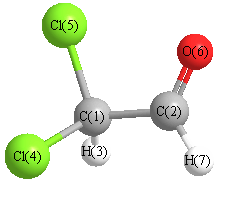 More geometry information
Calculated Bond Angles
| atom1 |
atom2 |
atom3 |
angle |
|
atom1 |
atom2 |
atom3 |
angle |
| C1 |
C2 |
O6 |
122.336 |
|
C1 |
C2 |
H7 |
113.689 |
| C2 |
C1 |
H3 |
111.090 |
|
C2 |
C1 |
Cl4 |
107.928 |
| C2 |
C1 |
Cl5 |
107.928 |
|
H3 |
C1 |
Cl4 |
109.078 |
| H3 |
C1 |
Cl5 |
109.078 |
|
Cl4 |
C1 |
Cl5 |
111.746 |
| O6 |
C2 |
H7 |
123.975 |
|
Electronic energy levels
Charges, Dipole, Quadrupole and Polarizability
Jump to
S1C1
Energy calculated at MP2/6-31G(2df,p)
| | hartrees |
|---|
| Energy at 0K | -1071.598099 |
| Energy at 298.15K | |
| HF Energy | -1070.722179 |
| Nuclear repulsion energy | 267.329046 |
The energy at 298.15K was derived from the energy at 0K
and an integrated heat capacity that used the calculated vibrational frequencies.
Vibrational Frequencies calculated at MP2/6-31G(2df,p)
| Mode Number |
Symmetry |
Frequency
(cm-1) |
Scaled Frequency
(cm-1) |
IR Intensities
(km mol-1) |
Raman Act
(Å4/u) |
Dep P |
Dep U |
|---|
| 1 |
A |
3165 |
2989 |
3.76 |
66.91 |
0.23 |
0.37 |
| 2 |
A |
3019 |
2851 |
42.08 |
112.56 |
0.30 |
0.46 |
| 3 |
A |
1803 |
1703 |
81.08 |
8.39 |
0.43 |
0.60 |
| 4 |
A |
1409 |
1330 |
12.50 |
4.71 |
0.57 |
0.73 |
| 5 |
A |
1279 |
1208 |
13.70 |
3.17 |
0.69 |
0.82 |
| 6 |
A |
1238 |
1169 |
11.46 |
6.48 |
0.72 |
0.84 |
| 7 |
A |
1047 |
989 |
14.92 |
1.84 |
0.39 |
0.56 |
| 8 |
A |
953 |
900 |
6.99 |
4.96 |
0.64 |
0.78 |
| 9 |
A |
851 |
804 |
72.93 |
5.20 |
0.73 |
0.84 |
| 10 |
A |
669 |
632 |
27.06 |
9.96 |
0.07 |
0.12 |
| 11 |
A |
634 |
599 |
29.34 |
4.78 |
0.52 |
0.68 |
| 12 |
A |
349 |
329 |
1.30 |
2.28 |
0.20 |
0.34 |
| 13 |
A |
280 |
264 |
3.38 |
3.87 |
0.63 |
0.78 |
| 14 |
A |
224 |
212 |
2.62 |
0.97 |
0.69 |
0.81 |
| 15 |
A |
94 |
89 |
8.70 |
1.46 |
0.74 |
0.85 |
Unscaled Zero Point Vibrational Energy (zpe) 8506.3 cm
-1
Scaled (by 0.9445) Zero Point Vibrational Energy (zpe) 8034.2 cm
-1
See section
III.C.1 List or set vibrational scaling factors
to change the scale factors used here.
See section
III.C.2
Calculate a vibrational scaling factor for a given set of molecules
to determine the least squares best scaling factor.
Geometric Data calculated at MP2/6-31G(2df,p)
Point Group is C1
Cartesians (Å)
| Atom |
x (Å) |
y (Å) |
z (Å) |
|---|
| C1 |
0.106 |
-0.016 |
0.531 |
| C2 |
-0.696 |
-1.280 |
0.210 |
| H3 |
0.245 |
0.078 |
1.609 |
| Cl4 |
1.723 |
-0.246 |
-0.175 |
| Cl5 |
-0.685 |
1.431 |
-0.058 |
| O6 |
-1.771 |
-1.281 |
-0.330 |
| H7 |
-0.175 |
-2.201 |
0.529 |
Atom - Atom Distances (Å)
| |
C1 |
C2 |
H3 |
Cl4 |
Cl5 |
O6 |
H7 |
| C1 | | 1.5305 | 1.0906 | 1.7790 | 1.7513 | 2.4216 | 2.2030 |
C2 | 1.5305 | | 2.1639 | 2.6580 | 2.7237 | 1.2034 | 1.1052 | H3 | 1.0906 | 2.1639 | | 2.3390 | 2.3399 | 3.1092 | 2.5564 | Cl4 | 1.7790 | 2.6580 | 2.3390 | | 2.9367 | 3.6468 | 2.8141 | Cl5 | 1.7513 | 2.7237 | 2.3399 | 2.9367 | | 2.9332 | 3.7142 | O6 | 2.4216 | 1.2034 | 3.1092 | 3.6468 | 2.9332 | | 2.0326 | H7 | 2.2030 | 1.1052 | 2.5564 | 2.8141 | 3.7142 | 2.0326 | |
More geometry information
Calculated Bond Angles
| atom1 |
atom2 |
atom3 |
angle |
|
atom1 |
atom2 |
atom3 |
angle |
| C1 |
C2 |
O6 |
124.253 |
|
C1 |
C2 |
H7 |
112.405 |
| C2 |
C1 |
H3 |
110.164 |
|
C2 |
C1 |
Cl4 |
106.624 |
| C2 |
C1 |
Cl5 |
112.007 |
|
H3 |
C1 |
Cl4 |
106.726 |
| H3 |
C1 |
Cl5 |
108.601 |
|
Cl4 |
C1 |
Cl5 |
112.580 |
| O6 |
C2 |
H7 |
123.341 |
|
Electronic energy levels
Charges, Dipole, Quadrupole and Polarizability
