Jump to
S1C2
Energy calculated at CID/3-21G
| | hartrees |
|---|
| Energy at 0K | -451.583367 |
| Energy at 298.15K | -451.587076 |
| HF Energy | -451.408321 |
| Nuclear repulsion energy | 55.404742 |
The energy at 298.15K was derived from the energy at 0K
and an integrated heat capacity that used the calculated vibrational frequencies.
Vibrational Frequencies calculated at CID/3-21G
| Mode Number |
Symmetry |
Frequency
(cm-1) |
Scaled Frequency
(cm-1) |
IR Intensities
(km mol-1) |
Raman Act
(Å4/u) |
Dep P |
Dep U |
|---|
| 1 |
A' |
3469 |
3232 |
2.48 |
|
|
|
| 2 |
A' |
2451 |
2283 |
47.68 |
|
|
|
| 3 |
A' |
1726 |
1608 |
15.98 |
|
|
|
| 4 |
A' |
1000 |
931 |
37.55 |
|
|
|
| 5 |
A' |
914 |
851 |
57.34 |
|
|
|
| 6 |
A' |
576 |
537 |
39.68 |
|
|
|
| 7 |
A" |
3584 |
3339 |
3.50 |
|
|
|
| 8 |
A" |
1161 |
1082 |
0.31 |
|
|
|
| 9 |
A" |
433 |
403 |
95.72 |
|
|
|
Unscaled Zero Point Vibrational Energy (zpe) 7656.6 cm
-1
Scaled (by 0.9316) Zero Point Vibrational Energy (zpe) 7132.9 cm
-1
See section
III.C.1 List or set vibrational scaling factors
to change the scale factors used here.
See section
III.C.2
Calculate a vibrational scaling factor for a given set of molecules
to determine the least squares best scaling factor.
Geometric Data calculated at CID/3-21G
Point Group is Cs
Cartesians (Å)
| Atom |
x (Å) |
y (Å) |
z (Å) |
|---|
| N1 |
0.016 |
1.170 |
0.000 |
| S2 |
0.016 |
-0.649 |
0.000 |
| H3 |
-1.344 |
-0.816 |
0.000 |
| H4 |
0.485 |
1.505 |
0.841 |
| H5 |
0.485 |
1.505 |
-0.841 |
Atom - Atom Distances (Å)
| |
N1 |
S2 |
H3 |
H4 |
H5 |
| N1 | | 1.8189 | 2.4074 | 1.0195 | 1.0195 |
S2 | 1.8189 | | 1.3705 | 2.3593 | 2.3593 | H3 | 2.4074 | 1.3705 | | 3.0727 | 3.0727 | H4 | 1.0195 | 2.3593 | 3.0727 | | 1.6818 | H5 | 1.0195 | 2.3593 | 3.0727 | 1.6818 | |
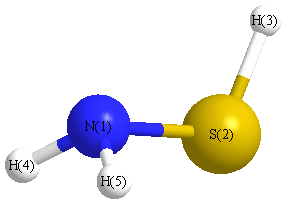 More geometry information
Calculated Bond Angles
| atom1 |
atom2 |
atom3 |
angle |
|
atom1 |
atom2 |
atom3 |
angle |
| N1 |
S2 |
H3 |
97.016 |
|
S2 |
N1 |
H4 |
109.185 |
| S2 |
N1 |
H5 |
109.185 |
|
H4 |
N1 |
H5 |
111.148 |
Electronic energy levels
Charges, Dipole, Quadrupole and Polarizability
Jump to
S1C1
Energy calculated at CID/3-21G
| | hartrees |
|---|
| Energy at 0K | -451.580372 |
| Energy at 298.15K | -451.584092 |
| HF Energy | -451.406237 |
| Nuclear repulsion energy | 55.932216 |
The energy at 298.15K was derived from the energy at 0K
and an integrated heat capacity that used the calculated vibrational frequencies.
Vibrational Frequencies calculated at CID/3-21G
| Mode Number |
Symmetry |
Frequency
(cm-1) |
Scaled Frequency
(cm-1) |
IR Intensities
(km mol-1) |
Raman Act
(Å4/u) |
Dep P |
Dep U |
|---|
| 1 |
A' |
3514 |
3274 |
0.91 |
|
|
|
| 2 |
A' |
2298 |
2141 |
123.77 |
|
|
|
| 3 |
A' |
1711 |
1594 |
11.90 |
|
|
|
| 4 |
A' |
985 |
917 |
51.79 |
|
|
|
| 5 |
A' |
866 |
807 |
44.89 |
|
|
|
| 6 |
A' |
495 |
461 |
196.53 |
|
|
|
| 7 |
A" |
3644 |
3395 |
7.46 |
|
|
|
| 8 |
A" |
1136 |
1059 |
1.05 |
|
|
|
| 9 |
A" |
542 |
505 |
6.48 |
|
|
|
Unscaled Zero Point Vibrational Energy (zpe) 7595.4 cm
-1
Scaled (by 0.9316) Zero Point Vibrational Energy (zpe) 7075.8 cm
-1
See section
III.C.1 List or set vibrational scaling factors
to change the scale factors used here.
See section
III.C.2
Calculate a vibrational scaling factor for a given set of molecules
to determine the least squares best scaling factor.
Geometric Data calculated at CID/3-21G
Point Group is Cs
Cartesians (Å)
| Atom |
x (Å) |
y (Å) |
z (Å) |
|---|
| N1 |
0.080 |
1.146 |
0.000 |
| S2 |
0.080 |
-0.636 |
0.000 |
| H3 |
-1.273 |
-0.952 |
0.000 |
| H4 |
-0.287 |
1.557 |
0.852 |
| H5 |
-0.287 |
1.557 |
-0.852 |
Atom - Atom Distances (Å)
| |
N1 |
S2 |
H3 |
H4 |
H5 |
| N1 | | 1.7818 | 2.4966 | 1.0149 | 1.0149 |
S2 | 1.7818 | | 1.3902 | 2.3812 | 2.3812 | H3 | 2.4966 | 1.3902 | | 2.8270 | 2.8270 | H4 | 1.0149 | 2.3812 | 2.8270 | | 1.7038 | H5 | 1.0149 | 2.3812 | 2.8270 | 1.7038 | |
More geometry information
Calculated Bond Angles
| atom1 |
atom2 |
atom3 |
angle |
|
atom1 |
atom2 |
atom3 |
angle |
| N1 |
S2 |
H3 |
103.132 |
|
S2 |
N1 |
H4 |
113.897 |
| S2 |
N1 |
H5 |
113.897 |
|
H4 |
N1 |
H5 |
114.149 |
Electronic energy levels
Charges, Dipole, Quadrupole and Polarizability
