Jump to
S1C2
Energy calculated at HF/3-21G
| | hartrees |
|---|
| Energy at 0K | -2598.814835 |
| Energy at 298.15K | -2598.818597 |
| HF Energy | -2598.814835 |
| Nuclear repulsion energy | 78.012041 |
The energy at 298.15K was derived from the energy at 0K
and an integrated heat capacity that used the calculated vibrational frequencies.
Vibrational Frequencies calculated at HF/3-21G
| Mode Number |
Symmetry |
Frequency
(cm-1) |
Scaled Frequency
(cm-1) |
IR Intensities
(km mol-1) |
Raman Act
(Å4/u) |
Dep P |
Dep U |
|---|
| 1 |
A' |
3336 |
3021 |
6.35 |
|
|
|
| 2 |
A' |
1472 |
1333 |
56.64 |
|
|
|
| 3 |
A' |
654 |
592 |
20.30 |
|
|
|
| 4 |
A' |
250 |
226 |
94.37 |
|
|
|
| 5 |
A" |
3504 |
3174 |
0.00 |
|
|
|
| 6 |
A" |
953 |
863 |
0.93 |
|
|
|
Unscaled Zero Point Vibrational Energy (zpe) 5084.4 cm
-1
Scaled (by 0.9056) Zero Point Vibrational Energy (zpe) 4604.4 cm
-1
See section
III.C.1 List or set vibrational scaling factors
to change the scale factors used here.
See section
III.C.2
Calculate a vibrational scaling factor for a given set of molecules
to determine the least squares best scaling factor.
Geometric Data calculated at HF/3-21G
Point Group is Cs
Cartesians (Å)
| Atom |
x (Å) |
y (Å) |
z (Å) |
|---|
| C1 |
-0.005 |
1.550 |
0.000 |
| Br2 |
-0.005 |
-0.382 |
0.000 |
| H3 |
0.104 |
2.032 |
0.946 |
| H4 |
0.104 |
2.032 |
-0.946 |
Atom - Atom Distances (Å)
| |
C1 |
Br2 |
H3 |
H4 |
| C1 | | 1.9324 | 1.0672 | 1.0672 |
Br2 | 1.9324 | | 2.5951 | 2.5951 | H3 | 1.0672 | 2.5951 | | 1.8923 | H4 | 1.0672 | 2.5951 | 1.8923 | |
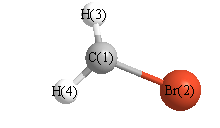 More geometry information
Calculated Bond Angles
| atom1 |
atom2 |
atom3 |
angle |
|
atom1 |
atom2 |
atom3 |
angle |
| Br2 |
C1 |
H3 |
116.826 |
|
Br2 |
C1 |
H4 |
116.826 |
| H3 |
C1 |
H4 |
124.884 |
|
Electronic energy levels
Charges, Dipole, Quadrupole and Polarizability
Charges from optimized geometry at HF/3-21G
Charges (e)
| Number |
Element |
Mulliken |
CHELPG |
AIM |
ESP |
| 1 |
C |
-0.610 |
|
|
|
| 2 |
Br |
0.084 |
|
|
|
| 3 |
H |
0.263 |
|
|
|
| 4 |
H |
0.263 |
|
|
|
Electric dipole moments
Electric dipole components in Debye
(What's a Debye? See section
VII.A.3)
| |
x |
y |
z |
Total |
| |
0.228 |
1.493 |
0.000 |
1.511 |
| CHELPG |
|
|
|
|
| AIM |
|
|
|
|
| ESP |
|
|
|
|
Electric Quadrupole moment
Quadrupole components in D Å
| Primitive |
|---|
| | x | y | z |
|---|
| x |
-26.434 |
0.457 |
0.000 |
| y |
0.457 |
-21.663 |
0.000 |
| z |
0.000 |
0.000 |
-24.378 |
|
| Traceless |
|---|
| | x | y | z |
|---|
| x |
-3.414 |
0.457 |
0.000 |
| y |
0.457 |
3.743 |
0.000 |
| z |
0.000 |
0.000 |
-0.329 |
|
| Polar |
|---|
| 3z2-r2 | -0.658 |
|---|
| x2-y2 | -4.771 |
|---|
| xy | 0.457 |
|---|
| xz | 0.000 |
|---|
| yz | 0.000 |
|---|
|
Polarizabilities
Components of the polarizability tensor.
Units are
Å
3 (Angstrom cubed)
Change units.
| |
x |
y |
z |
| x |
0.966 |
0.080 |
0.000 |
| y |
0.080 |
4.950 |
0.000 |
| z |
0.000 |
0.000 |
1.901 |
<r2> (average value of r
2) Å
2
| <r2> |
44.689 |
| (<r2>)1/2 |
6.685 |
Jump to
S1C1
Energy calculated at HF/3-21G
| | hartrees |
|---|
| Energy at 0K | -2598.814814 |
| Energy at 298.15K | |
| HF Energy | -2598.814814 |
| Nuclear repulsion energy | 78.064674 |
The energy at 298.15K was derived from the energy at 0K
and an integrated heat capacity that used the calculated vibrational frequencies.
Vibrational Frequencies calculated at HF/3-21G
| Mode Number |
Symmetry |
Frequency
(cm-1) |
Scaled Frequency
(cm-1) |
IR Intensities
(km mol-1) |
Raman Act
(Å4/u) |
Dep P |
Dep U |
|---|
| 1 |
A1 |
3338 |
3023 |
5.63 |
109.85 |
0.12 |
0.21 |
| 2 |
A1 |
1468 |
1329 |
59.39 |
0.51 |
0.58 |
0.74 |
| 3 |
A1 |
654 |
593 |
19.11 |
20.42 |
0.36 |
0.53 |
| 4 |
B1 |
177i |
161i |
105.83 |
2.01 |
0.75 |
0.86 |
| 5 |
B2 |
3510 |
3179 |
0.02 |
55.43 |
0.75 |
0.86 |
| 6 |
B2 |
946 |
857 |
0.99 |
8.22 |
0.75 |
0.86 |
Unscaled Zero Point Vibrational Energy (zpe) 4869.3 cm
-1
Scaled (by 0.9056) Zero Point Vibrational Energy (zpe) 4409.7 cm
-1
See section
III.C.1 List or set vibrational scaling factors
to change the scale factors used here.
See section
III.C.2
Calculate a vibrational scaling factor for a given set of molecules
to determine the least squares best scaling factor.
Geometric Data calculated at HF/3-21G
Point Group is C2v
Cartesians (Å)
| Atom |
x (Å) |
y (Å) |
z (Å) |
|---|
| C1 |
0.000 |
0.000 |
-1.548 |
| Br2 |
0.000 |
0.000 |
0.382 |
| H3 |
0.000 |
0.949 |
-2.037 |
| H4 |
0.000 |
-0.949 |
-2.037 |
Atom - Atom Distances (Å)
| |
C1 |
Br2 |
H3 |
H4 |
| C1 | | 1.9302 | 1.0668 | 1.0668 |
Br2 | 1.9302 | | 2.5978 | 2.5978 | H3 | 1.0668 | 2.5978 | | 1.8971 | H4 | 1.0668 | 2.5978 | 1.8971 | |
More geometry information
Calculated Bond Angles
| atom1 |
atom2 |
atom3 |
angle |
|
atom1 |
atom2 |
atom3 |
angle |
| Br2 |
C1 |
H3 |
117.236 |
|
Br2 |
C1 |
H4 |
117.236 |
| H3 |
C1 |
H4 |
125.527 |
|
Electronic energy levels
Charges, Dipole, Quadrupole and Polarizability
Charges from optimized geometry at HF/3-21G
Charges (e)
| Number |
Element |
Mulliken |
CHELPG |
AIM |
ESP |
| 1 |
C |
-0.616 |
|
|
|
| 2 |
Br |
0.087 |
|
|
|
| 3 |
H |
0.264 |
|
|
|
| 4 |
H |
0.264 |
|
|
|
Electric dipole moments
Electric dipole components in Debye
(What's a Debye? See section
VII.A.3)
| |
x |
y |
z |
Total |
| |
0.000 |
0.000 |
-1.488 |
1.488 |
| CHELPG |
|
|
|
|
| AIM |
|
|
|
|
| ESP |
|
|
|
|
Electric Quadrupole moment
Quadrupole components in D Å
| Primitive |
|---|
| | x | y | z |
|---|
| x |
-26.466 |
0.000 |
0.000 |
| y |
0.000 |
-24.348 |
0.000 |
| z |
0.000 |
0.000 |
-21.616 |
|
| Traceless |
|---|
| | x | y | z |
|---|
| x |
-3.483 |
0.000 |
0.000 |
| y |
0.000 |
-0.307 |
0.000 |
| z |
0.000 |
0.000 |
3.790 |
|
| Polar |
|---|
| 3z2-r2 | 7.581 |
|---|
| x2-y2 | -2.118 |
|---|
| xy | 0.000 |
|---|
| xz | 0.000 |
|---|
| yz | 0.000 |
|---|
|
Polarizabilities
Components of the polarizability tensor.
Units are
Å
3 (Angstrom cubed)
Change units.
| |
x |
y |
z |
| x |
0.953 |
0.000 |
0.000 |
| y |
0.000 |
1.898 |
0.000 |
| z |
0.000 |
0.000 |
4.932 |
<r2> (average value of r
2) Å
2
| <r2> |
44.661 |
| (<r2>)1/2 |
6.683 |
