Jump to
S1C2
Energy calculated at HF/3-21G
| | hartrees |
|---|
| Energy at 0K | -113.146287 |
| Energy at 298.15K | -113.147709 |
| HF Energy | -113.146287 |
| Nuclear repulsion energy | 30.344632 |
The energy at 298.15K was derived from the energy at 0K
and an integrated heat capacity that used the calculated vibrational frequencies.
Vibrational Frequencies calculated at HF/3-21G
| Mode Number |
Symmetry |
Frequency
(cm-1) |
Scaled Frequency
(cm-1) |
IR Intensities
(km mol-1) |
Raman Act
(Å4/u) |
Dep P |
Dep U |
|---|
| 1 |
A' |
3853 |
3489 |
79.61 |
|
|
|
| 2 |
A' |
3013 |
2729 |
145.72 |
|
|
|
| 3 |
A' |
1601 |
1450 |
40.17 |
|
|
|
| 4 |
A' |
1336 |
1210 |
36.00 |
|
|
|
| 5 |
A' |
1286 |
1165 |
257.99 |
|
|
|
| 6 |
A" |
1098 |
994 |
190.51 |
|
|
|
Unscaled Zero Point Vibrational Energy (zpe) 6093.4 cm
-1
Scaled (by 0.9056) Zero Point Vibrational Energy (zpe) 5518.1 cm
-1
See section
III.C.1 List or set vibrational scaling factors
to change the scale factors used here.
See section
III.C.2
Calculate a vibrational scaling factor for a given set of molecules
to determine the least squares best scaling factor.
Geometric Data calculated at HF/3-21G
Point Group is Cs
Cartesians (Å)
| Atom |
x (Å) |
y (Å) |
z (Å) |
|---|
| C1 |
0.011 |
0.758 |
0.000 |
| O2 |
0.011 |
-0.576 |
0.000 |
| H3 |
-1.062 |
1.009 |
0.000 |
| H4 |
0.904 |
-0.948 |
0.000 |
Atom - Atom Distances (Å)
| |
C1 |
O2 |
H3 |
H4 |
| C1 | | 1.3345 | 1.1021 | 1.9255 |
O2 | 1.3345 | | 1.9144 | 0.9668 | H3 | 1.1021 | 1.9144 | | 2.7738 | H4 | 1.9255 | 0.9668 | 2.7738 | |
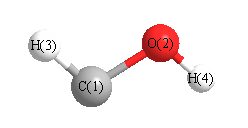 More geometry information
Calculated Bond Angles
| atom1 |
atom2 |
atom3 |
angle |
|
atom1 |
atom2 |
atom3 |
angle |
| C1 |
O2 |
H4 |
112.606 |
|
O2 |
C1 |
H3 |
103.156 |
Electronic energy levels
Charges, Dipole, Quadrupole and Polarizability
Charges from optimized geometry at HF/3-21G
Charges (e)
| Number |
Element |
Mulliken |
CHELPG |
AIM |
ESP |
| 1 |
C |
0.091 |
|
|
|
| 2 |
O |
-0.675 |
|
|
|
| 3 |
H |
0.157 |
|
|
|
| 4 |
H |
0.427 |
|
|
|
Electric dipole moments
Electric dipole components in Debye
(What's a Debye? See section
VII.A.3)
| |
x |
y |
z |
Total |
| |
0.369 |
-1.120 |
0.000 |
1.179 |
| CHELPG |
|
|
|
|
| AIM |
|
|
|
|
| ESP |
|
|
|
|
Electric Quadrupole moment
Quadrupole components in D Å
| Primitive |
|---|
| | x | y | z |
|---|
| x |
-10.877 |
-4.136 |
0.000 |
| y |
-4.136 |
-13.546 |
0.000 |
| z |
0.000 |
0.000 |
-11.514 |
|
| Traceless |
|---|
| | x | y | z |
|---|
| x |
1.653 |
-4.136 |
0.000 |
| y |
-4.136 |
-2.351 |
0.000 |
| z |
0.000 |
0.000 |
0.698 |
|
| Polar |
|---|
| 3z2-r2 | 1.396 |
|---|
| x2-y2 | 2.669 |
|---|
| xy | -4.136 |
|---|
| xz | 0.000 |
|---|
| yz | 0.000 |
|---|
|
Polarizabilities
Components of the polarizability tensor.
Units are
Å
3 (Angstrom cubed)
Change units.
| |
x |
y |
z |
| x |
1.993 |
-0.705 |
0.000 |
| y |
-0.705 |
2.017 |
0.000 |
| z |
0.000 |
0.000 |
1.135 |
<r2> (average value of r
2) Å
2
| <r2> |
17.451 |
| (<r2>)1/2 |
4.177 |
Jump to
S1C1
Energy calculated at HF/3-21G
| | hartrees |
|---|
| Energy at 0K | -113.136252 |
| Energy at 298.15K | -113.137663 |
| HF Energy | -113.136252 |
| Nuclear repulsion energy | 30.295523 |
The energy at 298.15K was derived from the energy at 0K
and an integrated heat capacity that used the calculated vibrational frequencies.
Vibrational Frequencies calculated at HF/3-21G
| Mode Number |
Symmetry |
Frequency
(cm-1) |
Scaled Frequency
(cm-1) |
IR Intensities
(km mol-1) |
Raman Act
(Å4/u) |
Dep P |
Dep U |
|---|
| 1 |
A' |
3760 |
3405 |
20.82 |
|
|
|
| 2 |
A' |
2862 |
2592 |
219.87 |
|
|
|
| 3 |
A' |
1570 |
1421 |
77.59 |
|
|
|
| 4 |
A' |
1343 |
1216 |
84.73 |
|
|
|
| 5 |
A' |
1308 |
1185 |
127.48 |
|
|
|
| 6 |
A" |
1016 |
920 |
66.76 |
|
|
|
Unscaled Zero Point Vibrational Energy (zpe) 5928.9 cm
-1
Scaled (by 0.9056) Zero Point Vibrational Energy (zpe) 5369.3 cm
-1
See section
III.C.1 List or set vibrational scaling factors
to change the scale factors used here.
See section
III.C.2
Calculate a vibrational scaling factor for a given set of molecules
to determine the least squares best scaling factor.
Geometric Data calculated at HF/3-21G
Point Group is Cs
Cartesians (Å)
| Atom |
x (Å) |
y (Å) |
z (Å) |
|---|
| C1 |
0.119 |
0.757 |
0.000 |
| O2 |
0.119 |
-0.573 |
0.000 |
| H3 |
-0.943 |
1.094 |
0.000 |
| H4 |
-0.725 |
-1.053 |
0.000 |
Atom - Atom Distances (Å)
| |
C1 |
O2 |
H3 |
H4 |
| C1 | | 1.3292 | 1.1144 | 1.9966 |
O2 | 1.3292 | | 1.9766 | 0.9710 | H3 | 1.1144 | 1.9766 | | 2.1584 | H4 | 1.9966 | 0.9710 | 2.1584 | |
More geometry information
Calculated Bond Angles
| atom1 |
atom2 |
atom3 |
angle |
|
atom1 |
atom2 |
atom3 |
angle |
| C1 |
O2 |
H4 |
119.647 |
|
O2 |
C1 |
H3 |
107.647 |
Electronic energy levels
Charges, Dipole, Quadrupole and Polarizability
Charges from optimized geometry at HF/3-21G
Charges (e)
| Number |
Element |
Mulliken |
CHELPG |
AIM |
ESP |
| 1 |
C |
0.154 |
|
|
|
| 2 |
O |
-0.671 |
|
|
|
| 3 |
H |
0.108 |
|
|
|
| 4 |
H |
0.409 |
|
|
|
Electric dipole moments
Electric dipole components in Debye
(What's a Debye? See section
VII.A.3)
| |
x |
y |
z |
Total |
| |
-3.481 |
-1.279 |
0.000 |
3.708 |
| CHELPG |
|
|
|
|
| AIM |
|
|
|
|
| ESP |
|
|
|
|
Electric Quadrupole moment
Quadrupole components in D Å
| Primitive |
|---|
| | x | y | z |
|---|
| x |
-12.305 |
0.136 |
0.000 |
| y |
0.136 |
-13.112 |
0.000 |
| z |
0.000 |
0.000 |
-11.516 |
|
| Traceless |
|---|
| | x | y | z |
|---|
| x |
0.009 |
0.136 |
0.000 |
| y |
0.136 |
-1.201 |
0.000 |
| z |
0.000 |
0.000 |
1.192 |
|
| Polar |
|---|
| 3z2-r2 | 2.384 |
|---|
| x2-y2 | 0.807 |
|---|
| xy | 0.136 |
|---|
| xz | 0.000 |
|---|
| yz | 0.000 |
|---|
|
Polarizabilities
Components of the polarizability tensor.
Units are
Å
3 (Angstrom cubed)
Change units.
| |
x |
y |
z |
| x |
1.833 |
-0.147 |
0.000 |
| y |
-0.147 |
2.328 |
0.000 |
| z |
0.000 |
0.000 |
1.188 |
<r2> (average value of r
2) Å
2
| <r2> |
17.666 |
| (<r2>)1/2 |
4.203 |
