Jump to
S1C2
Energy calculated at HF/3-21G
| | hartrees |
|---|
| Energy at 0K | -952.752107 |
| Energy at 298.15K | |
| HF Energy | -952.752107 |
| Nuclear repulsion energy | 120.496338 |
The energy at 298.15K was derived from the energy at 0K
and an integrated heat capacity that used the calculated vibrational frequencies.
Vibrational Frequencies calculated at HF/3-21G
| Mode Number |
Symmetry |
Frequency
(cm-1) |
Scaled Frequency
(cm-1) |
IR Intensities
(km mol-1) |
Raman Act
(Å4/u) |
Dep P |
Dep U |
|---|
| 1 |
A1 |
3455 |
3129 |
3.35 |
|
|
|
| 2 |
A1 |
663 |
601 |
17.71 |
|
|
|
| 3 |
A1 |
281 |
254 |
1.67 |
|
|
|
| 4 |
B1 |
478i |
433i |
69.63 |
|
|
|
| 5 |
B2 |
1228 |
1112 |
103.26 |
|
|
|
| 6 |
B2 |
836 |
757 |
105.30 |
|
|
|
Unscaled Zero Point Vibrational Energy (zpe) 2992.8 cm
-1
Scaled (by 0.9056) Zero Point Vibrational Energy (zpe) 2710.3 cm
-1
See section
III.C.1 List or set vibrational scaling factors
to change the scale factors used here.
See section
III.C.2
Calculate a vibrational scaling factor for a given set of molecules
to determine the least squares best scaling factor.
Geometric Data calculated at HF/3-21G
Point Group is C2v
Cartesians (Å)
| Atom |
x (Å) |
y (Å) |
z (Å) |
|---|
| C1 |
0.000 |
0.000 |
0.733 |
| H2 |
0.000 |
0.000 |
1.797 |
| Cl3 |
0.000 |
1.533 |
-0.182 |
| Cl4 |
0.000 |
-1.533 |
-0.182 |
Atom - Atom Distances (Å)
| |
C1 |
H2 |
Cl3 |
Cl4 |
| C1 | | 1.0645 | 1.7855 | 1.7855 |
H2 | 1.0645 | | 2.5038 | 2.5038 | Cl3 | 1.7855 | 2.5038 | | 3.0667 | Cl4 | 1.7855 | 2.5038 | 3.0667 | |
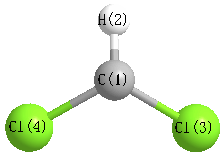 More geometry information
Calculated Bond Angles
| atom1 |
atom2 |
atom3 |
angle |
|
atom1 |
atom2 |
atom3 |
angle |
| Cl3 |
C1 |
H2 |
120.821 |
|
Cl3 |
C1 |
Cl4 |
118.359 |
| Cl4 |
C1 |
H2 |
120.821 |
|
Electronic energy levels
Charges, Dipole, Quadrupole and Polarizability
Charges from optimized geometry at HF/3-21G
Charges (e)
| Number |
Element |
Mulliken |
CHELPG |
AIM |
ESP |
| 1 |
C |
-0.537 |
|
|
|
| 2 |
H |
0.322 |
|
|
|
| 3 |
Cl |
0.107 |
|
|
|
| 4 |
Cl |
0.107 |
|
|
|
Electric dipole moments
Electric dipole components in Debye
(What's a Debye? See section
VII.A.3)
| |
x |
y |
z |
Total |
| |
0.000 |
0.000 |
1.686 |
1.686 |
| CHELPG |
|
|
|
|
| AIM |
|
|
|
|
| ESP |
|
|
|
|
Electric Quadrupole moment
Quadrupole components in D Å
| Primitive |
|---|
| | x | y | z |
|---|
| x |
-32.884 |
0.000 |
0.000 |
| y |
0.000 |
-34.079 |
0.000 |
| z |
0.000 |
0.000 |
-29.164 |
|
| Traceless |
|---|
| | x | y | z |
|---|
| x |
-1.263 |
0.000 |
0.000 |
| y |
0.000 |
-3.055 |
0.000 |
| z |
0.000 |
0.000 |
4.318 |
|
| Polar |
|---|
| 3z2-r2 | 8.636 |
|---|
| x2-y2 | 1.195 |
|---|
| xy | 0.000 |
|---|
| xz | 0.000 |
|---|
| yz | 0.000 |
|---|
|
Polarizabilities
Components of the polarizability tensor.
Units are
Å
3 (Angstrom cubed)
Change units.
| |
x |
y |
z |
| x |
1.276 |
0.000 |
0.000 |
| y |
0.000 |
6.184 |
0.000 |
| z |
0.000 |
0.000 |
3.011 |
<r2> (average value of r
2) Å
2
| <r2> |
107.533 |
| (<r2>)1/2 |
10.370 |
Jump to
S1C1
Energy calculated at HF/3-21G
| | hartrees |
|---|
| Energy at 0K | -952.754011 |
| Energy at 298.15K | -952.754789 |
| HF Energy | -952.754011 |
| Nuclear repulsion energy | 120.195863 |
The energy at 298.15K was derived from the energy at 0K
and an integrated heat capacity that used the calculated vibrational frequencies.
Vibrational Frequencies calculated at HF/3-21G
| Mode Number |
Symmetry |
Frequency
(cm-1) |
Scaled Frequency
(cm-1) |
IR Intensities
(km mol-1) |
Raman Act
(Å4/u) |
Dep P |
Dep U |
|---|
| 1 |
A' |
3425 |
3102 |
2.38 |
|
|
|
| 2 |
A' |
700 |
634 |
29.37 |
|
|
|
| 3 |
A' |
570 |
517 |
13.73 |
|
|
|
| 4 |
A' |
283 |
256 |
1.37 |
|
|
|
| 5 |
A" |
1272 |
1152 |
70.77 |
|
|
|
| 6 |
A" |
804 |
728 |
143.62 |
|
|
|
Unscaled Zero Point Vibrational Energy (zpe) 3527.0 cm
-1
Scaled (by 0.9056) Zero Point Vibrational Energy (zpe) 3194.1 cm
-1
See section
III.C.1 List or set vibrational scaling factors
to change the scale factors used here.
See section
III.C.2
Calculate a vibrational scaling factor for a given set of molecules
to determine the least squares best scaling factor.
Geometric Data calculated at HF/3-21G
Point Group is Cs
Cartesians (Å)
| Atom |
x (Å) |
y (Å) |
z (Å) |
|---|
| C1 |
0.014 |
0.765 |
0.000 |
| H2 |
-0.564 |
1.663 |
0.000 |
| Cl3 |
0.014 |
-0.184 |
1.530 |
| Cl4 |
0.014 |
-0.184 |
-1.530 |
Atom - Atom Distances (Å)
| |
C1 |
H2 |
Cl3 |
Cl4 |
| C1 | | 1.0674 | 1.8006 | 1.8006 |
H2 | 1.0674 | | 2.4668 | 2.4668 | Cl3 | 1.8006 | 2.4668 | | 3.0602 | Cl4 | 1.8006 | 2.4668 | 3.0602 | |
More geometry information
Calculated Bond Angles
| atom1 |
atom2 |
atom3 |
angle |
|
atom1 |
atom2 |
atom3 |
angle |
| Cl3 |
C1 |
H2 |
116.306 |
|
Cl3 |
C1 |
Cl4 |
116.372 |
| Cl4 |
C1 |
H2 |
116.306 |
|
Electronic energy levels
Charges, Dipole, Quadrupole and Polarizability
Charges from optimized geometry at HF/3-21G
Charges (e)
| Number |
Element |
Mulliken |
CHELPG |
AIM |
ESP |
| 1 |
C |
-0.481 |
|
|
|
| 2 |
H |
0.316 |
|
|
|
| 3 |
Cl |
0.082 |
|
|
|
| 4 |
Cl |
0.082 |
|
|
|
Electric dipole moments
Electric dipole components in Debye
(What's a Debye? See section
VII.A.3)
| |
x |
y |
z |
Total |
| |
-0.686 |
1.614 |
0.000 |
1.754 |
| CHELPG |
|
|
|
|
| AIM |
|
|
|
|
| ESP |
|
|
|
|
Electric Quadrupole moment
Quadrupole components in D Å
| Primitive |
|---|
| | x | y | z |
|---|
| x |
-32.448 |
-1.140 |
0.000 |
| y |
-1.140 |
-29.865 |
0.000 |
| z |
0.000 |
0.000 |
-34.526 |
|
| Traceless |
|---|
| | x | y | z |
|---|
| x |
-0.252 |
-1.140 |
0.000 |
| y |
-1.140 |
3.622 |
0.000 |
| z |
0.000 |
0.000 |
-3.369 |
|
| Polar |
|---|
| 3z2-r2 | -6.739 |
|---|
| x2-y2 | -2.583 |
|---|
| xy | -1.140 |
|---|
| xz | 0.000 |
|---|
| yz | 0.000 |
|---|
|
Polarizabilities
Components of the polarizability tensor.
Units are
Å
3 (Angstrom cubed)
Change units.
| |
x |
y |
z |
| x |
1.434 |
-0.281 |
0.000 |
| y |
-0.281 |
3.016 |
0.000 |
| z |
0.000 |
0.000 |
6.366 |
<r2> (average value of r
2) Å
2
| <r2> |
107.517 |
| (<r2>)1/2 |
10.369 |
