Jump to
S1C2
Energy calculated at B2PLYP=FULL/3-21G
| | hartrees |
|---|
| Energy at 0K | -953.977308 |
| Energy at 298.15K | |
| HF Energy | -953.916162 |
| Nuclear repulsion energy | 120.126429 |
The energy at 298.15K was derived from the energy at 0K
and an integrated heat capacity that used the calculated vibrational frequencies.
Vibrational Frequencies calculated at B2PLYP=FULL/3-21G
| Mode Number |
Symmetry |
Frequency
(cm-1) |
Scaled Frequency
(cm-1) |
IR Intensities
(km mol-1) |
Raman Act
(Å4/u) |
Dep P |
Dep U |
|---|
| 1 |
A1 |
3339 |
3179 |
2.33 |
|
|
|
| 2 |
A1 |
650 |
619 |
14.63 |
|
|
|
| 3 |
A1 |
272 |
259 |
0.77 |
|
|
|
| 4 |
B1 |
480i |
457i |
97.87 |
|
|
|
| 5 |
B2 |
1191 |
1134 |
66.69 |
|
|
|
| 6 |
B2 |
801 |
763 |
145.22 |
|
|
|
Unscaled Zero Point Vibrational Energy (zpe) 2886.8 cm
-1
Scaled (by 0.952) Zero Point Vibrational Energy (zpe) 2748.3 cm
-1
See section
III.C.1 List or set vibrational scaling factors
to change the scale factors used here.
See section
III.C.2
Calculate a vibrational scaling factor for a given set of molecules
to determine the least squares best scaling factor.
Geometric Data calculated at B2PLYP=FULL/3-21G
Point Group is C2v
Cartesians (Å)
| Atom |
x (Å) |
y (Å) |
z (Å) |
|---|
| C1 |
0.000 |
0.000 |
0.729 |
| H2 |
0.000 |
0.000 |
1.802 |
| Cl3 |
0.000 |
1.540 |
-0.182 |
| Cl4 |
0.000 |
-1.540 |
-0.182 |
Atom - Atom Distances (Å)
| |
C1 |
H2 |
Cl3 |
Cl4 |
| C1 | | 1.0735 | 1.7888 | 1.7888 |
H2 | 1.0735 | | 2.5112 | 2.5112 | Cl3 | 1.7888 | 2.5112 | | 3.0799 | Cl4 | 1.7888 | 2.5112 | 3.0799 | |
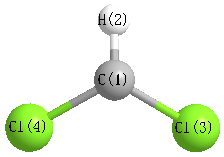 More geometry information
Calculated Bond Angles
| atom1 |
atom2 |
atom3 |
angle |
|
atom1 |
atom2 |
atom3 |
angle |
| Cl3 |
C1 |
H2 |
120.582 |
|
Cl3 |
C1 |
Cl4 |
118.837 |
| Cl4 |
C1 |
H2 |
120.582 |
|
Electronic energy levels
Charges, Dipole, Quadrupole and Polarizability
Jump to
S1C1
Energy calculated at B2PLYP=FULL/3-21G
| | hartrees |
|---|
| Energy at 0K | -953.979623 |
| Energy at 298.15K | -953.980344 |
| HF Energy | -953.917962 |
| Nuclear repulsion energy | 119.413321 |
The energy at 298.15K was derived from the energy at 0K
and an integrated heat capacity that used the calculated vibrational frequencies.
Vibrational Frequencies calculated at B2PLYP=FULL/3-21G
| Mode Number |
Symmetry |
Frequency
(cm-1) |
Scaled Frequency
(cm-1) |
IR Intensities
(km mol-1) |
Raman Act
(Å4/u) |
Dep P |
Dep U |
|---|
| 1 |
A' |
3271 |
3114 |
1.78 |
|
|
|
| 2 |
A' |
703 |
669 |
32.97 |
|
|
|
| 3 |
A' |
545 |
519 |
13.85 |
|
|
|
| 4 |
A' |
269 |
257 |
0.55 |
|
|
|
| 5 |
A" |
1219 |
1160 |
43.18 |
|
|
|
| 6 |
A" |
749 |
713 |
180.49 |
|
|
|
Unscaled Zero Point Vibrational Energy (zpe) 3377.7 cm
-1
Scaled (by 0.952) Zero Point Vibrational Energy (zpe) 3215.6 cm
-1
See section
III.C.1 List or set vibrational scaling factors
to change the scale factors used here.
See section
III.C.2
Calculate a vibrational scaling factor for a given set of molecules
to determine the least squares best scaling factor.
Geometric Data calculated at B2PLYP=FULL/3-21G
Point Group is Cs
Cartesians (Å)
| Atom |
x (Å) |
y (Å) |
z (Å) |
|---|
| C1 |
0.015 |
0.770 |
0.000 |
| H2 |
-0.616 |
1.646 |
0.000 |
| Cl3 |
0.015 |
-0.184 |
1.541 |
| Cl4 |
0.015 |
-0.184 |
-1.541 |
Atom - Atom Distances (Å)
| |
C1 |
H2 |
Cl3 |
Cl4 |
| C1 | | 1.0795 | 1.8123 | 1.8123 |
H2 | 1.0795 | | 2.4741 | 2.4741 | Cl3 | 1.8123 | 2.4741 | | 3.0812 | Cl4 | 1.8123 | 2.4741 | 3.0812 | |
More geometry information
Calculated Bond Angles
| atom1 |
atom2 |
atom3 |
angle |
|
atom1 |
atom2 |
atom3 |
angle |
| Cl3 |
C1 |
H2 |
115.289 |
|
Cl3 |
C1 |
Cl4 |
116.439 |
| Cl4 |
C1 |
H2 |
115.289 |
|
Electronic energy levels
Charges, Dipole, Quadrupole and Polarizability
