Jump to
S1C2
Energy calculated at ROHF/3-21G
| | hartrees |
|---|
| Energy at 0K | -496.049331 |
| Energy at 298.15K | |
| HF Energy | -496.049331 |
| Nuclear repulsion energy | 43.111561 |
The energy at 298.15K was derived from the energy at 0K
and an integrated heat capacity that used the calculated vibrational frequencies.
Vibrational Frequencies calculated at ROHF/3-21G
| Mode Number |
Symmetry |
Frequency
(cm-1) |
Scaled Frequency
(cm-1) |
IR Intensities
(km mol-1) |
Raman Act
(Å4/u) |
Dep P |
Dep U |
|---|
| 1 |
A' |
3339 |
3029 |
7.42 |
|
|
|
| 2 |
A' |
1500 |
1361 |
32.57 |
|
|
|
| 3 |
A' |
762 |
691 |
48.78 |
|
|
|
| 4 |
A' |
657 |
595 |
57.14 |
|
|
|
| 5 |
A" |
3508 |
3182 |
0.01 |
|
|
|
| 6 |
A" |
1047 |
950 |
0.00 |
|
|
|
Unscaled Zero Point Vibrational Energy (zpe) 5406.5 cm
-1
Scaled (by 0.907) Zero Point Vibrational Energy (zpe) 4903.7 cm
-1
See section
III.C.1 List or set vibrational scaling factors
to change the scale factors used here.
See section
III.C.2
Calculate a vibrational scaling factor for a given set of molecules
to determine the least squares best scaling factor.
Geometric Data calculated at ROHF/3-21G
Point Group is Cs
Cartesians (Å)
| Atom |
x (Å) |
y (Å) |
z (Å) |
|---|
| C1 |
-0.022 |
1.208 |
0.000 |
| Cl2 |
-0.022 |
-0.618 |
0.000 |
| H3 |
0.250 |
1.633 |
0.941 |
| H4 |
0.250 |
1.633 |
-0.941 |
Atom - Atom Distances (Å)
| |
C1 |
Cl2 |
H3 |
H4 |
| C1 | | 1.8264 | 1.0674 | 1.0674 |
Cl2 | 1.8264 | | 2.4553 | 2.4553 | H3 | 1.0674 | 2.4553 | | 1.8811 | H4 | 1.0674 | 2.4553 | 1.8811 | |
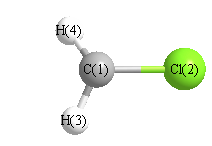 More geometry information
Calculated Bond Angles
| atom1 |
atom2 |
atom3 |
angle |
|
atom1 |
atom2 |
atom3 |
angle |
| Br2 |
C1 |
H3 |
113.480 |
|
Br2 |
C1 |
H4 |
113.480 |
| H3 |
C1 |
H4 |
123.570 |
|
Electronic energy levels
Charges, Dipole, Quadrupole and Polarizability
Charges from optimized geometry at ROHF/3-21G
Charges (e)
| Number |
Element |
Mulliken |
CHELPG |
AIM |
ESP |
| 1 |
C |
-0.496 |
|
|
|
| 2 |
Cl |
-0.038 |
|
|
|
| 3 |
H |
0.267 |
|
|
|
| 4 |
H |
0.267 |
|
|
|
Electric dipole moments
Electric dipole components in Debye
(What's a Debye? See section
VII.A.3)
| |
x |
y |
z |
Total |
| |
0.551 |
2.238 |
0.000 |
2.304 |
| CHELPG |
|
|
|
|
| AIM |
|
|
|
|
| ESP |
|
|
|
|
Electric Quadrupole moment
Quadrupole components in D Å
| Primitive |
|---|
| | x | y | z |
|---|
| x |
-20.739 |
0.842 |
-0.000 |
| y |
0.842 |
-17.670 |
-0.000 |
| z |
-0.000 |
-0.000 |
-18.852 |
|
| Traceless |
|---|
| | x | y | z |
|---|
| x |
-2.478 |
0.842 |
-0.000 |
| y |
0.842 |
2.126 |
-0.000 |
| z |
-0.000 |
-0.000 |
0.352 |
|
| Polar |
|---|
| 3z2-r2 | 0.704 |
|---|
| x2-y2 | -3.069 |
|---|
| xy | 0.842 |
|---|
| xz | -0.000 |
|---|
| yz | -0.000 |
|---|
|
Polarizabilities
Components of the polarizability tensor.
Units are
Å
3 (Angstrom cubed)
Change units.
| |
x |
y |
z |
| x |
0.000 |
0.000 |
0.000 |
| y |
0.000 |
0.000 |
0.000 |
| z |
0.000 |
0.000 |
0.000 |
<r2> (average value of r
2) Å
2
| <r2> |
34.419 |
| (<r2>)1/2 |
5.867 |
Jump to
S1C1
Energy calculated at ROHF/3-21G
| | hartrees |
|---|
| Energy at 0K | -496.048144 |
| Energy at 298.15K | |
| HF Energy | -496.048144 |
| Nuclear repulsion energy | 43.320551 |
The energy at 298.15K was derived from the energy at 0K
and an integrated heat capacity that used the calculated vibrational frequencies.
Vibrational Frequencies calculated at ROHF/3-21G
| Mode Number |
Symmetry |
Frequency
(cm-1) |
Scaled Frequency
(cm-1) |
IR Intensities
(km mol-1) |
Raman Act
(Å4/u) |
Dep P |
Dep U |
|---|
| 1 |
A1 |
3370 |
3056 |
2.85 |
|
|
|
| 2 |
A1 |
1477 |
1340 |
43.71 |
|
|
|
| 3 |
A1 |
725 |
658 |
49.29 |
|
|
|
| 4 |
B1 |
564i |
512i |
111.11 |
|
|
|
| 5 |
B2 |
3561 |
3230 |
1.36 |
|
|
|
| 6 |
B2 |
1012 |
917 |
0.00 |
|
|
|
Unscaled Zero Point Vibrational Energy (zpe) 4790.3 cm
-1
Scaled (by 0.907) Zero Point Vibrational Energy (zpe) 4344.8 cm
-1
See section
III.C.1 List or set vibrational scaling factors
to change the scale factors used here.
See section
III.C.2
Calculate a vibrational scaling factor for a given set of molecules
to determine the least squares best scaling factor.
Geometric Data calculated at ROHF/3-21G
Point Group is C2v
Cartesians (Å)
| Atom |
x (Å) |
y (Å) |
z (Å) |
|---|
| C1 |
0.000 |
0.000 |
-1.195 |
| Cl2 |
0.000 |
0.000 |
0.617 |
| H3 |
0.000 |
0.957 |
-1.659 |
| H4 |
0.000 |
-0.957 |
-1.659 |
Atom - Atom Distances (Å)
| |
C1 |
Cl2 |
H3 |
H4 |
| C1 | | 1.8120 | 1.0638 | 1.0638 |
Cl2 | 1.8120 | | 2.4693 | 2.4693 | H3 | 1.0638 | 2.4693 | | 1.9143 | H4 | 1.0638 | 2.4693 | 1.9143 | |
More geometry information
Calculated Bond Angles
| atom1 |
atom2 |
atom3 |
angle |
|
atom1 |
atom2 |
atom3 |
angle |
| Br2 |
C1 |
H3 |
115.877 |
|
Br2 |
C1 |
H4 |
115.877 |
| H3 |
C1 |
H4 |
128.247 |
|
Electronic energy levels
Charges, Dipole, Quadrupole and Polarizability
Charges from optimized geometry at ROHF/3-21G
Charges (e)
| Number |
Element |
Mulliken |
CHELPG |
AIM |
ESP |
| 1 |
C |
-0.538 |
|
|
|
| 2 |
Cl |
-0.017 |
|
|
|
| 3 |
H |
0.277 |
|
|
|
| 4 |
H |
0.277 |
|
|
|
Electric dipole moments
Electric dipole components in Debye
(What's a Debye? See section
VII.A.3)
| |
x |
y |
z |
Total |
| |
0.000 |
0.000 |
-2.201 |
2.201 |
| CHELPG |
|
|
|
|
| AIM |
|
|
|
|
| ESP |
|
|
|
|
Electric Quadrupole moment
Quadrupole components in D Å
| Primitive |
|---|
| | x | y | z |
|---|
| x |
-20.929 |
0.000 |
0.000 |
| y |
0.000 |
-18.638 |
-0.001 |
| z |
0.000 |
-0.001 |
-17.410 |
|
| Traceless |
|---|
| | x | y | z |
|---|
| x |
-2.905 |
0.000 |
0.000 |
| y |
0.000 |
0.531 |
-0.001 |
| z |
0.000 |
-0.001 |
2.374 |
|
| Polar |
|---|
| 3z2-r2 | 4.748 |
|---|
| x2-y2 | -2.291 |
|---|
| xy | 0.000 |
|---|
| xz | 0.000 |
|---|
| yz | -0.001 |
|---|
|
Polarizabilities
Components of the polarizability tensor.
Units are
Å
3 (Angstrom cubed)
Change units.
| |
x |
y |
z |
| x |
0.000 |
0.000 |
0.000 |
| y |
0.000 |
0.000 |
0.000 |
| z |
0.000 |
0.000 |
0.000 |
<r2> (average value of r
2) Å
2
| <r2> |
34.240 |
| (<r2>)1/2 |
5.852 |
