Jump to
S2C1
Energy calculated at B2PLYP=FULL/STO-3G
| | hartrees |
|---|
| Energy at 0K | -149.044426 |
| Energy at 298.15K | -149.042243 |
| HF Energy | -148.983444 |
| Nuclear repulsion energy | 44.021766 |
The energy at 298.15K was derived from the energy at 0K
and an integrated heat capacity that used the calculated vibrational frequencies.
Geometric Data calculated at B2PLYP=FULL/STO-3G
Point Group is C∞v
Cartesians (Å)
| Atom |
x (Å) |
y (Å) |
z (Å) |
|---|
| C1 |
0.000 |
0.000 |
-1.462 |
| C2 |
0.000 |
0.000 |
-0.080 |
| O3 |
0.000 |
0.000 |
1.157 |
Atom - Atom Distances (Å)
| |
C1 |
C2 |
O3 |
| C1 | | 1.3821 | 2.6188 |
C2 | 1.3821 | | 1.2367 | O3 | 2.6188 | 1.2367 | |
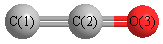 More geometry information
Calculated Bond Angles
| atom1 |
atom2 |
atom3 |
angle |
|
atom1 |
atom2 |
atom3 |
angle |
| C1 |
C2 |
O3 |
180.000 |
|
Electronic energy levels
Charges, Dipole, Quadrupole and Polarizability
Jump to
S1C1
Energy calculated at B2PLYP=FULL/STO-3G
| | hartrees |
|---|
| Energy at 0K | -149.006286 |
| Energy at 298.15K | -149.004342 |
| HF Energy | -148.932071 |
| Nuclear repulsion energy | 43.830854 |
The energy at 298.15K was derived from the energy at 0K
and an integrated heat capacity that used the calculated vibrational frequencies.
Geometric Data calculated at B2PLYP=FULL/STO-3G
Point Group is C∞v
Cartesians (Å)
| Atom |
x (Å) |
y (Å) |
z (Å) |
|---|
| C1 |
0.000 |
0.000 |
-1.466 |
| C2 |
0.000 |
0.000 |
-0.084 |
| O3 |
0.000 |
0.000 |
1.162 |
Atom - Atom Distances (Å)
| |
C1 |
C2 |
O3 |
| C1 | | 1.3824 | 2.6284 |
C2 | 1.3824 | | 1.2460 | O3 | 2.6284 | 1.2460 | |
More geometry information
Calculated Bond Angles
| atom1 |
atom2 |
atom3 |
angle |
|
atom1 |
atom2 |
atom3 |
angle |
| C1 |
C2 |
O3 |
180.000 |
|
Electronic energy levels
Charges, Dipole, Quadrupole and Polarizability
