Jump to
S1C2
S1C3
Energy calculated at HF/STO-3G
| | hartrees |
|---|
| Energy at 0K | -250.986177 |
| Energy at 298.15K | -250.985970 |
| HF Energy | -250.986177 |
| Nuclear repulsion energy | 48.471071 |
The energy at 298.15K was derived from the energy at 0K
and an integrated heat capacity that used the calculated vibrational frequencies.
Geometric Data calculated at HF/STO-3G
Point Group is C∞v
Cartesians (Å)
| Atom |
x (Å) |
y (Å) |
z (Å) |
|---|
| C1 |
0.000 |
0.000 |
-0.621 |
| N2 |
0.000 |
0.000 |
-1.777 |
| Na3 |
0.000 |
0.000 |
1.470 |
Atom - Atom Distances (Å)
| |
C1 |
N2 |
Na3 |
| C1 | | 1.1564 | 2.0909 |
N2 | 1.1564 | | 3.2473 | Na3 | 2.0909 | 3.2473 | |
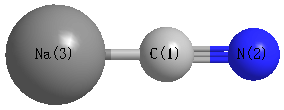 More geometry information
Calculated Bond Angles
| atom1 |
atom2 |
atom3 |
angle |
|
atom1 |
atom2 |
atom3 |
angle |
| C1 |
N2 |
Na3 |
0.000 |
|
C1 |
Na3 |
N2 |
0.000 |
| N2 |
C1 |
Na3 |
180.000 |
|
Electronic energy levels
Charges, Dipole, Quadrupole and Polarizability
Charges from optimized geometry at HF/STO-3G
Charges (e)
| Number |
Element |
Mulliken |
CHELPG |
AIM |
ESP |
| 1 |
C |
-0.356 |
|
|
|
| 2 |
N |
-0.403 |
|
|
|
| 3 |
Na |
0.759 |
|
|
|
Electric dipole moments
Electric dipole components in Debye
(What's a Debye? See section
VII.A.3)
| |
x |
y |
z |
Total |
| |
0.000 |
0.000 |
10.275 |
10.275 |
| CHELPG |
|
|
|
|
| AIM |
|
|
|
|
| ESP |
|
|
|
|
Electric Quadrupole moment
Quadrupole components in D Å
| Primitive |
|---|
| | x | y | z |
|---|
| x |
-13.643 |
0.000 |
0.000 |
| y |
0.000 |
-13.643 |
0.000 |
| z |
0.000 |
0.000 |
-12.458 |
|
| Traceless |
|---|
| | x | y | z |
|---|
| x |
-0.593 |
0.000 |
0.000 |
| y |
0.000 |
-0.593 |
0.000 |
| z |
0.000 |
0.000 |
1.186 |
|
| Polar |
|---|
| 3z2-r2 | 2.371 |
|---|
| x2-y2 | 0.000 |
|---|
| xy | 0.000 |
|---|
| xz | 0.000 |
|---|
| yz | 0.000 |
|---|
|
Polarizabilities
Components of the polarizability tensor.
Units are
Å
3 (Angstrom cubed)
Change units.
| |
x |
y |
z |
| x |
0.562 |
0.000 |
0.000 |
| y |
0.000 |
0.562 |
0.000 |
| z |
0.000 |
0.000 |
2.231 |
<r2> (average value of r
2) Å
2
| <r2> |
56.469 |
| (<r2>)1/2 |
7.515 |
Jump to
S1C1
S1C3
Energy calculated at HF/STO-3G
| | hartrees |
|---|
| Energy at 0K | -250.986711 |
| Energy at 298.15K | -250.986671 |
| HF Energy | -250.986711 |
| Nuclear repulsion energy | 54.279366 |
The energy at 298.15K was derived from the energy at 0K
and an integrated heat capacity that used the calculated vibrational frequencies.
Geometric Data calculated at HF/STO-3G
Point Group is Cs
Cartesians (Å)
| Atom |
x (Å) |
y (Å) |
z (Å) |
|---|
| C1 |
1.089 |
0.562 |
0.000 |
| N2 |
0.000 |
1.008 |
0.000 |
| Na3 |
-0.594 |
-0.948 |
0.000 |
Atom - Atom Distances (Å)
| |
C1 |
N2 |
Na3 |
| C1 | | 1.1764 | 2.2609 |
N2 | 1.1764 | | 2.0436 | Na3 | 2.2609 | 2.0436 | |
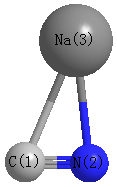 More geometry information
Calculated Bond Angles
| atom1 |
atom2 |
atom3 |
angle |
|
atom1 |
atom2 |
atom3 |
angle |
| C1 |
N2 |
Na3 |
84.646 |
|
C1 |
Na3 |
N2 |
31.202 |
| N2 |
C1 |
Na3 |
64.152 |
|
Electronic energy levels
Charges, Dipole, Quadrupole and Polarizability
Charges from optimized geometry at HF/STO-3G
Charges (e)
| Number |
Element |
Mulliken |
CHELPG |
AIM |
ESP |
| 1 |
C |
-0.261 |
|
|
|
| 2 |
N |
-0.519 |
|
|
|
| 3 |
Na |
0.780 |
|
|
|
Electric dipole moments
Electric dipole components in Debye
(What's a Debye? See section
VII.A.3)
| |
x |
y |
z |
Total |
| |
-4.519 |
-6.920 |
0.000 |
8.265 |
| CHELPG |
|
|
|
|
| AIM |
|
|
|
|
| ESP |
|
|
|
|
Electric Quadrupole moment
Quadrupole components in D Å
| Primitive |
|---|
| | x | y | z |
|---|
| x |
-16.773 |
2.828 |
0.000 |
| y |
2.828 |
-12.094 |
0.000 |
| z |
0.000 |
0.000 |
-13.617 |
|
| Traceless |
|---|
| | x | y | z |
|---|
| x |
-3.918 |
2.828 |
0.000 |
| y |
2.828 |
3.101 |
0.000 |
| z |
0.000 |
0.000 |
0.816 |
|
| Polar |
|---|
| 3z2-r2 | 1.632 |
|---|
| x2-y2 | -4.679 |
|---|
| xy | 2.828 |
|---|
| xz | 0.000 |
|---|
| yz | 0.000 |
|---|
|
Polarizabilities
Components of the polarizability tensor.
Units are
Å
3 (Angstrom cubed)
Change units.
| |
x |
y |
z |
| x |
1.438 |
0.049 |
0.000 |
| y |
0.049 |
1.112 |
0.000 |
| z |
0.000 |
0.000 |
0.581 |
<r2> (average value of r
2) Å
2
| <r2> |
38.722 |
| (<r2>)1/2 |
6.223 |
Jump to
S1C1
S1C2
Energy calculated at HF/STO-3G
| | hartrees |
|---|
| Energy at 0K | -250.985777 |
| Energy at 298.15K | -250.985365 |
| HF Energy | -250.985777 |
| Nuclear repulsion energy | 50.663830 |
The energy at 298.15K was derived from the energy at 0K
and an integrated heat capacity that used the calculated vibrational frequencies.
Geometric Data calculated at HF/STO-3G
Point Group is C∞v
Cartesians (Å)
| Atom |
x (Å) |
y (Å) |
z (Å) |
|---|
| C1 |
0.000 |
0.000 |
-1.785 |
| N2 |
0.000 |
0.000 |
-0.619 |
| Na3 |
0.000 |
0.000 |
1.367 |
Atom - Atom Distances (Å)
| |
C1 |
N2 |
Na3 |
| C1 | | 1.1652 | 3.1520 |
N2 | 1.1652 | | 1.9867 | Na3 | 3.1520 | 1.9867 | |
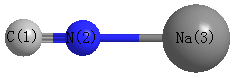 More geometry information
Calculated Bond Angles
| atom1 |
atom2 |
atom3 |
angle |
|
atom1 |
atom2 |
atom3 |
angle |
| C1 |
N2 |
Na3 |
180.000 |
|
C1 |
Na3 |
N2 |
0.000 |
| N2 |
C1 |
Na3 |
0.000 |
|
Electronic energy levels
Charges, Dipole, Quadrupole and Polarizability
Charges from optimized geometry at HF/STO-3G
Charges (e)
| Number |
Element |
Mulliken |
CHELPG |
AIM |
ESP |
| 1 |
C |
-0.186 |
|
|
|
| 2 |
N |
-0.604 |
|
|
|
| 3 |
Na |
0.790 |
|
|
|
Electric dipole moments
Electric dipole components in Debye
(What's a Debye? See section
VII.A.3)
| |
x |
y |
z |
Total |
| |
0.000 |
0.000 |
10.245 |
10.245 |
| CHELPG |
|
|
|
|
| AIM |
|
|
|
|
| ESP |
|
|
|
|
Electric Quadrupole moment
Quadrupole components in D Å
| Primitive |
|---|
| | x | y | z |
|---|
| x |
-13.520 |
0.000 |
0.000 |
| y |
0.000 |
-13.520 |
0.000 |
| z |
0.000 |
0.000 |
-14.174 |
|
| Traceless |
|---|
| | x | y | z |
|---|
| x |
0.327 |
0.000 |
0.000 |
| y |
0.000 |
0.327 |
0.000 |
| z |
0.000 |
0.000 |
-0.654 |
|
| Polar |
|---|
| 3z2-r2 | -1.309 |
|---|
| x2-y2 | 0.000 |
|---|
| xy | 0.000 |
|---|
| xz | 0.000 |
|---|
| yz | 0.000 |
|---|
|
Polarizabilities
Components of the polarizability tensor.
Units are
Å
3 (Angstrom cubed)
Change units.
| |
x |
y |
z |
| x |
0.576 |
0.000 |
0.000 |
| y |
0.000 |
0.576 |
0.000 |
| z |
0.000 |
0.000 |
2.106 |
<r2> (average value of r
2) Å
2
| <r2> |
50.941 |
| (<r2>)1/2 |
7.137 |
