Jump to
S1C2
S1C3
Energy calculated at HF/STO-3G
| | hartrees |
|---|
| Energy at 0K | -684.199857 |
| Energy at 298.15K | -684.199639 |
| HF Energy | -684.199857 |
| Nuclear repulsion energy | 61.933078 |
The energy at 298.15K was derived from the energy at 0K
and an integrated heat capacity that used the calculated vibrational frequencies.
Geometric Data calculated at HF/STO-3G
Point Group is C∞v
Cartesians (Å)
| Atom |
x (Å) |
y (Å) |
z (Å) |
|---|
| K1 |
0.000 |
0.000 |
1.286 |
| C2 |
0.000 |
0.000 |
-1.256 |
| N3 |
0.000 |
0.000 |
-2.414 |
Atom - Atom Distances (Å)
| |
K1 |
C2 |
N3 |
| K1 | | 2.5419 | 3.7006 |
C2 | 2.5419 | | 1.1587 | N3 | 3.7006 | 1.1587 | |
 More geometry information
Calculated Bond Angles
| atom1 |
atom2 |
atom3 |
angle |
|
atom1 |
atom2 |
atom3 |
angle |
| K1 |
C2 |
N3 |
180.000 |
|
K1 |
N3 |
C2 |
0.000 |
| C2 |
K1 |
N3 |
0.000 |
|
Electronic energy levels
Charges, Dipole, Quadrupole and Polarizability
Charges from optimized geometry at HF/STO-3G
Charges (e)
| Number |
Element |
Mulliken |
CHELPG |
AIM |
ESP |
| 1 |
K |
0.568 |
|
|
|
| 2 |
C |
-0.192 |
|
|
|
| 3 |
N |
-0.376 |
|
|
|
Electric dipole moments
Electric dipole components in Debye
(What's a Debye? See section
VII.A.3)
| |
x |
y |
z |
Total |
| |
0.000 |
0.000 |
11.164 |
11.164 |
| CHELPG |
|
|
|
|
| AIM |
|
|
|
|
| ESP |
|
|
|
|
Electric Quadrupole moment
Quadrupole components in D Å
| Primitive |
|---|
| | x | y | z |
|---|
| x |
-20.819 |
0.000 |
0.000 |
| y |
0.000 |
-20.819 |
0.000 |
| z |
0.000 |
0.000 |
-27.089 |
|
| Traceless |
|---|
| | x | y | z |
|---|
| x |
3.135 |
0.000 |
0.000 |
| y |
0.000 |
3.135 |
0.000 |
| z |
0.000 |
0.000 |
-6.270 |
|
| Polar |
|---|
| 3z2-r2 | -12.539 |
|---|
| x2-y2 | 0.000 |
|---|
| xy | 0.000 |
|---|
| xz | 0.000 |
|---|
| yz | 0.000 |
|---|
|
Polarizabilities
Components of the polarizability tensor.
Units are
Å
3 (Angstrom cubed)
Change units.
| |
x |
y |
z |
| x |
1.159 |
0.000 |
0.000 |
| y |
0.000 |
1.159 |
0.000 |
| z |
0.000 |
0.000 |
4.439 |
<r2> (average value of r
2) Å
2
| <r2> |
96.005 |
| (<r2>)1/2 |
9.798 |
Jump to
S1C1
S1C3
Energy calculated at HF/STO-3G
| | hartrees |
|---|
| Energy at 0K | -684.190796 |
| Energy at 298.15K | -684.190120 |
| HF Energy | -684.190796 |
| Nuclear repulsion energy | 65.003193 |
The energy at 298.15K was derived from the energy at 0K
and an integrated heat capacity that used the calculated vibrational frequencies.
Geometric Data calculated at HF/STO-3G
Point Group is C∞v
Cartesians (Å)
| Atom |
x (Å) |
y (Å) |
z (Å) |
|---|
| K1 |
0.000 |
0.000 |
1.200 |
| C2 |
0.000 |
0.000 |
-2.383 |
| N3 |
0.000 |
0.000 |
-1.215 |
Atom - Atom Distances (Å)
| |
K1 |
C2 |
N3 |
| K1 | | 3.5833 | 2.4150 |
C2 | 3.5833 | | 1.1682 | N3 | 2.4150 | 1.1682 | |
 More geometry information
Calculated Bond Angles
| atom1 |
atom2 |
atom3 |
angle |
|
atom1 |
atom2 |
atom3 |
angle |
| K1 |
C2 |
N3 |
0.000 |
|
K1 |
N3 |
C2 |
180.000 |
| C2 |
K1 |
N3 |
0.000 |
|
Electronic energy levels
Charges, Dipole, Quadrupole and Polarizability
Charges from optimized geometry at HF/STO-3G
Charges (e)
| Number |
Element |
Mulliken |
CHELPG |
AIM |
ESP |
| 1 |
K |
0.662 |
|
|
|
| 2 |
C |
-0.164 |
|
|
|
| 3 |
N |
-0.498 |
|
|
|
Electric dipole moments
Electric dipole components in Debye
(What's a Debye? See section
VII.A.3)
| |
x |
y |
z |
Total |
| |
0.000 |
0.000 |
11.329 |
11.329 |
| CHELPG |
|
|
|
|
| AIM |
|
|
|
|
| ESP |
|
|
|
|
Electric Quadrupole moment
Quadrupole components in D Å
| Primitive |
|---|
| | x | y | z |
|---|
| x |
-20.420 |
0.000 |
0.000 |
| y |
0.000 |
-20.420 |
0.000 |
| z |
0.000 |
0.000 |
-28.422 |
|
| Traceless |
|---|
| | x | y | z |
|---|
| x |
4.001 |
0.000 |
0.000 |
| y |
0.000 |
4.001 |
0.000 |
| z |
0.000 |
0.000 |
-8.002 |
|
| Polar |
|---|
| 3z2-r2 | -16.005 |
|---|
| x2-y2 | 0.000 |
|---|
| xy | 0.000 |
|---|
| xz | 0.000 |
|---|
| yz | 0.000 |
|---|
|
Polarizabilities
Components of the polarizability tensor.
Units are
Å
3 (Angstrom cubed)
Change units.
| |
x |
y |
z |
| x |
0.998 |
0.000 |
0.000 |
| y |
0.000 |
0.998 |
0.000 |
| z |
0.000 |
0.000 |
4.206 |
<r2> (average value of r
2) Å
2
| <r2> |
86.193 |
| (<r2>)1/2 |
9.284 |
Jump to
S1C1
S1C2
Energy calculated at HF/STO-3G
| | hartrees |
|---|
| Energy at 0K | -684.203787 |
| Energy at 298.15K | -684.203847 |
| HF Energy | -684.203787 |
| Nuclear repulsion energy | 70.052529 |
The energy at 298.15K was derived from the energy at 0K
and an integrated heat capacity that used the calculated vibrational frequencies.
Geometric Data calculated at HF/STO-3G
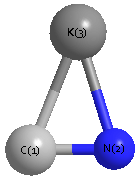
Point Group is Cs
Cartesians (Å)
| Atom |
x (Å) |
y (Å) |
z (Å) |
|---|
| K1 |
0.000 |
1.010 |
0.000 |
| C2 |
0.634 |
-1.516 |
0.000 |
| N3 |
-0.543 |
-1.441 |
0.000 |
Atom - Atom Distances (Å)
| |
K1 |
C2 |
N3 |
| K1 | | 2.6038 | 2.5104 |
C2 | 2.6038 | | 1.1792 | N3 | 2.5104 | 1.1792 | |
 More geometry information
Calculated Bond Angles
| atom1 |
atom2 |
atom3 |
angle |
|
atom1 |
atom2 |
atom3 |
angle |
| K1 |
C2 |
N3 |
72.287 |
|
K1 |
N3 |
C2 |
81.131 |
| C2 |
K1 |
N3 |
26.581 |
|
Electronic energy levels
Charges, Dipole, Quadrupole and Polarizability
Charges from optimized geometry at HF/STO-3G
Charges (e)
| Number |
Element |
Mulliken |
CHELPG |
AIM |
ESP |
| 1 |
K |
0.608 |
|
|
|
| 2 |
C |
-0.184 |
|
|
|
| 3 |
N |
-0.424 |
|
|
|
Electric dipole moments
Electric dipole components in Debye
(What's a Debye? See section
VII.A.3)
| |
x |
y |
z |
Total |
| |
-0.207 |
9.129 |
0.000 |
9.131 |
| CHELPG |
|
|
|
|
| AIM |
|
|
|
|
| ESP |
|
|
|
|
Electric Quadrupole moment
Quadrupole components in D Å
| Primitive |
|---|
| | x | y | z |
|---|
| x |
-24.979 |
0.385 |
0.000 |
| y |
0.385 |
-22.427 |
0.000 |
| z |
0.000 |
0.000 |
-20.766 |
|
| Traceless |
|---|
| | x | y | z |
|---|
| x |
-3.382 |
0.385 |
0.000 |
| y |
0.385 |
0.445 |
0.000 |
| z |
0.000 |
0.000 |
2.937 |
|
| Polar |
|---|
| 3z2-r2 | 5.874 |
|---|
| x2-y2 | -2.552 |
|---|
| xy | 0.385 |
|---|
| xz | 0.000 |
|---|
| yz | 0.000 |
|---|
|
Polarizabilities
Components of the polarizability tensor.
Units are
Å
3 (Angstrom cubed)
Change units.
| |
x |
y |
z |
| x |
1.824 |
-0.142 |
0.000 |
| y |
-0.142 |
2.793 |
0.000 |
| z |
0.000 |
0.000 |
1.111 |
<r2> (average value of r
2) Å
2
| <r2> |
66.363 |
| (<r2>)1/2 |
8.146 |
