Jump to
S1C2
S2C1
S2C2
Energy calculated at HF/STO-3G
| | hartrees |
|---|
| Energy at 0K | -129.034597 |
| Energy at 298.15K | -129.033650 |
| HF Energy | -129.034597 |
| Nuclear repulsion energy | 45.807235 |
The energy at 298.15K was derived from the energy at 0K
and an integrated heat capacity that used the calculated vibrational frequencies.
Vibrational Frequencies calculated at HF/STO-3G
| Mode Number |
Symmetry |
Frequency
(cm-1) |
Scaled Frequency
(cm-1) |
IR Intensities
(km mol-1) |
Raman Act
(Å4/u) |
Dep P |
Dep U |
|---|
| 1 |
A' |
3771 |
3079 |
54.20 |
|
|
|
| 2 |
A' |
1529 |
1249 |
101.63 |
|
|
|
| 3 |
A' |
1129 |
922 |
16.89 |
|
|
|
| 4 |
A' |
533 |
436 |
6.62 |
|
|
|
| 5 |
A' |
325 |
265 |
0.70 |
|
|
|
| 6 |
A" |
359 |
293 |
0.00 |
|
|
|
Unscaled Zero Point Vibrational Energy (zpe) 3823.1 cm
-1
Scaled (by 0.8165) Zero Point Vibrational Energy (zpe) 3121.5 cm
-1
See section
III.C.1 List or set vibrational scaling factors
to change the scale factors used here.
See section
III.C.2
Calculate a vibrational scaling factor for a given set of molecules
to determine the least squares best scaling factor.
Geometric Data calculated at HF/STO-3G
Point Group is Cs
Cartesians (Å)
| Atom |
x (Å) |
y (Å) |
z (Å) |
|---|
| C1 |
0.859 |
-0.907 |
0.000 |
| C2 |
0.000 |
0.079 |
0.000 |
| N3 |
-1.008 |
0.879 |
0.000 |
| H4 |
1.900 |
-1.184 |
0.000 |
Atom - Atom Distances (Å)
| |
C1 |
C2 |
N3 |
H4 |
| C1 | | 1.3084 | 2.5845 | 1.0768 |
C2 | 1.3084 | | 1.2870 | 2.2819 | N3 | 2.5845 | 1.2870 | | 3.5660 | H4 | 1.0768 | 2.2819 | 3.5660 | |
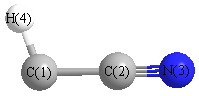 More geometry information
Calculated Bond Angles
| atom1 |
atom2 |
atom3 |
angle |
|
atom1 |
atom2 |
atom3 |
angle |
| C1 |
C2 |
N3 |
169.494 |
|
C2 |
C1 |
H4 |
145.972 |
Electronic energy levels
Charges, Dipole, Quadrupole and Polarizability
Jump to
S1C1
S2C1
S2C2
Energy calculated at HF/STO-3G
| | hartrees |
|---|
| Energy at 0K | -129.033373 |
| Energy at 298.15K | |
| HF Energy | -129.033373 |
| Nuclear repulsion energy | 45.972678 |
The energy at 298.15K was derived from the energy at 0K
and an integrated heat capacity that used the calculated vibrational frequencies.
Vibrational Frequencies calculated at HF/STO-3G
| Mode Number |
Symmetry |
Frequency
(cm-1) |
Scaled Frequency
(cm-1) |
IR Intensities
(km mol-1) |
Raman Act
(Å4/u) |
Dep P |
Dep U |
|---|
| 1 |
Σ |
3828 |
3126 |
113.34 |
|
|
|
| 2 |
Σ |
1541 |
1258 |
82.15 |
|
|
|
| 3 |
Σ |
1126 |
920 |
37.26 |
|
|
|
| 4 |
Π |
363 |
297 |
0.05 |
|
|
|
| 4 |
Π |
363 |
297 |
0.05 |
|
|
|
| 5 |
Π |
282i |
231i |
12.75 |
|
|
|
| 5 |
Π |
282i |
231i |
12.75 |
|
|
|
Unscaled Zero Point Vibrational Energy (zpe) 3328.6 cm
-1
Scaled (by 0.8165) Zero Point Vibrational Energy (zpe) 2717.8 cm
-1
See section
III.C.1 List or set vibrational scaling factors
to change the scale factors used here.
See section
III.C.2
Calculate a vibrational scaling factor for a given set of molecules
to determine the least squares best scaling factor.
Geometric Data calculated at HF/STO-3G
Point Group is C∞v
Cartesians (Å)
| Atom |
x (Å) |
y (Å) |
z (Å) |
|---|
| C1 |
0.000 |
0.000 |
-1.228 |
| C2 |
0.000 |
0.000 |
0.038 |
| N3 |
0.000 |
0.000 |
1.349 |
| H4 |
0.000 |
0.000 |
-2.298 |
Atom - Atom Distances (Å)
| |
C1 |
C2 |
N3 |
H4 |
| C1 | | 1.2658 | 2.5768 | 1.0696 |
C2 | 1.2658 | | 1.3110 | 2.3354 | N3 | 2.5768 | 1.3110 | | 3.6464 | H4 | 1.0696 | 2.3354 | 3.6464 | |
More geometry information
Calculated Bond Angles
| atom1 |
atom2 |
atom3 |
angle |
|
atom1 |
atom2 |
atom3 |
angle |
| C1 |
C2 |
N3 |
180.000 |
|
C2 |
C1 |
H4 |
180.000 |
Electronic energy levels
Charges, Dipole, Quadrupole and Polarizability
Charges from optimized geometry at HF/STO-3G
Charges (e)
| Number |
Element |
Mulliken |
CHELPG |
AIM |
ESP |
| 1 |
C |
-0.058 |
|
|
|
| 2 |
C |
0.009 |
|
|
|
| 3 |
N |
-0.077 |
|
|
|
| 4 |
H |
0.126 |
|
|
|
Electric dipole moments
Electric dipole components in Debye
(What's a Debye? See section
VII.A.3)
| |
x |
y |
z |
Total |
| |
0.000 |
0.000 |
-2.251 |
2.251 |
| CHELPG |
|
|
|
|
| AIM |
|
|
|
|
| ESP |
|
|
|
|
Electric Quadrupole moment
Quadrupole components in D Å
| Primitive |
|---|
| | x | y | z |
|---|
| x |
-15.277 |
0.000 |
0.000 |
| y |
0.000 |
-15.277 |
0.000 |
| z |
0.000 |
0.000 |
-15.066 |
|
| Traceless |
|---|
| | x | y | z |
|---|
| x |
-0.106 |
0.000 |
0.000 |
| y |
0.000 |
-0.106 |
0.000 |
| z |
0.000 |
0.000 |
0.211 |
|
| Polar |
|---|
| 3z2-r2 | 0.422 |
|---|
| x2-y2 | 0.000 |
|---|
| xy | 0.000 |
|---|
| xz | 0.000 |
|---|
| yz | 0.000 |
|---|
|
Polarizabilities
Components of the polarizability tensor.
Units are
Å
3 (Angstrom cubed)
Change units.
| |
x |
y |
z |
| x |
0.611 |
0.000 |
0.000 |
| y |
0.000 |
0.611 |
0.000 |
| z |
0.000 |
0.000 |
3.317 |
<r2> (average value of r
2) Å
2
| <r2> |
36.568 |
| (<r2>)1/2 |
6.047 |
Jump to
S1C1
S1C2
S2C2
Energy calculated at HF/STO-3G
| | hartrees |
|---|
| Energy at 0K | -128.940204 |
| Energy at 298.15K | -128.939665 |
| HF Energy | -128.940204 |
| Nuclear repulsion energy | 46.200582 |
The energy at 298.15K was derived from the energy at 0K
and an integrated heat capacity that used the calculated vibrational frequencies.
Vibrational Frequencies calculated at HF/STO-3G
| Mode Number |
Symmetry |
Frequency
(cm-1) |
Scaled Frequency
(cm-1) |
IR Intensities
(km mol-1) |
Raman Act
(Å4/u) |
Dep P |
Dep U |
|---|
| 1 |
A' |
3471 |
2834 |
5.56 |
|
|
|
| 2 |
A' |
2462 |
2010 |
102.67 |
|
|
|
| 3 |
A' |
1296 |
1058 |
23.85 |
|
|
|
| 4 |
A' |
999 |
815 |
44.03 |
|
|
|
| 5 |
A' |
464 |
379 |
17.67 |
|
|
|
| 6 |
A" |
396 |
324 |
7.54 |
|
|
|
Unscaled Zero Point Vibrational Energy (zpe) 4543.7 cm
-1
Scaled (by 0.8165) Zero Point Vibrational Energy (zpe) 3709.9 cm
-1
See section
III.C.1 List or set vibrational scaling factors
to change the scale factors used here.
See section
III.C.2
Calculate a vibrational scaling factor for a given set of molecules
to determine the least squares best scaling factor.
Geometric Data calculated at HF/STO-3G
Point Group is Cs
Cartesians (Å)
| Atom |
x (Å) |
y (Å) |
z (Å) |
|---|
| C1 |
-0.190 |
-1.323 |
0.000 |
| C2 |
0.000 |
0.117 |
0.000 |
| N3 |
0.042 |
1.284 |
0.000 |
| H4 |
0.845 |
-1.752 |
0.000 |
Atom - Atom Distances (Å)
| |
C1 |
C2 |
N3 |
H4 |
| C1 | | 1.4525 | 2.6173 | 1.1205 |
C2 | 1.4525 | | 1.1678 | 2.0513 | N3 | 2.6173 | 1.1678 | | 3.1405 | H4 | 1.1205 | 2.0513 | 3.1405 | |
More geometry information
Electronic energy levels
Charges, Dipole, Quadrupole and Polarizability
Charges from optimized geometry at HF/STO-3G
Charges (e)
| Number |
Element |
Mulliken |
CHELPG |
AIM |
ESP |
| 1 |
C |
0.061 |
|
|
|
| 2 |
C |
0.014 |
|
|
|
| 3 |
N |
-0.139 |
|
|
|
| 4 |
H |
0.064 |
|
|
|
Electric dipole moments
Electric dipole components in Debye
(What's a Debye? See section
VII.A.3)
| |
x |
y |
z |
Total |
| |
1.255 |
-1.557 |
0.000 |
2.000 |
| CHELPG |
|
|
|
|
| AIM |
|
|
|
|
| ESP |
|
|
|
|
Electric Quadrupole moment
Quadrupole components in D Å
| Primitive |
|---|
| | x | y | z |
|---|
| x |
-16.081 |
-2.502 |
0.000 |
| y |
-2.502 |
-19.593 |
0.000 |
| z |
0.000 |
0.000 |
-14.200 |
|
| Traceless |
|---|
| | x | y | z |
|---|
| x |
0.816 |
-2.502 |
0.000 |
| y |
-2.502 |
-4.453 |
0.000 |
| z |
0.000 |
0.000 |
3.637 |
|
| Polar |
|---|
| 3z2-r2 | 7.274 |
|---|
| x2-y2 | 3.512 |
|---|
| xy | -2.502 |
|---|
| xz | 0.000 |
|---|
| yz | 0.000 |
|---|
|
Polarizabilities
Components of the polarizability tensor.
Units are
Å
3 (Angstrom cubed)
Change units.
| |
x |
y |
z |
| x |
0.904 |
-0.189 |
0.000 |
| y |
-0.189 |
3.301 |
0.000 |
| z |
0.000 |
0.000 |
1.229 |
<r2> (average value of r
2) Å
2
| <r2> |
36.522 |
| (<r2>)1/2 |
6.043 |
Jump to
S1C1
S1C2
S2C1
Energy calculated at HF/STO-3G
| | hartrees |
|---|
| Energy at 0K | -128.940204 |
| Energy at 298.15K | -128.939665 |
| HF Energy | -128.940204 |
| Nuclear repulsion energy | 46.200582 |
The energy at 298.15K was derived from the energy at 0K
and an integrated heat capacity that used the calculated vibrational frequencies.
Vibrational Frequencies calculated at HF/STO-3G
Geometric Data calculated at HF/STO-3G
Point Group is Cs
Electronic energy levels
Charges, Dipole, Quadrupole and Polarizability
