Jump to
S1C2
Energy calculated at HF/STO-3G
| | hartrees |
|---|
| Energy at 0K | -947.078376 |
| Energy at 298.15K | |
| HF Energy | -947.078376 |
| Nuclear repulsion energy | 121.380438 |
The energy at 298.15K was derived from the energy at 0K
and an integrated heat capacity that used the calculated vibrational frequencies.
Vibrational Frequencies calculated at HF/STO-3G
| Mode Number |
Symmetry |
Frequency
(cm-1) |
Scaled Frequency
(cm-1) |
IR Intensities
(km mol-1) |
Raman Act
(Å4/u) |
Dep P |
Dep U |
|---|
| 1 |
A1 |
3693 |
3015 |
13.27 |
|
|
|
| 2 |
A1 |
823 |
672 |
26.44 |
|
|
|
| 3 |
A1 |
308 |
252 |
5.05 |
|
|
|
| 4 |
B1 |
565i |
461i |
20.57 |
|
|
|
| 5 |
B2 |
1385 |
1131 |
123.70 |
|
|
|
| 6 |
B2 |
1090 |
890 |
47.91 |
|
|
|
Unscaled Zero Point Vibrational Energy (zpe) 3367.2 cm
-1
Scaled (by 0.8165) Zero Point Vibrational Energy (zpe) 2749.3 cm
-1
See section
III.C.1 List or set vibrational scaling factors
to change the scale factors used here.
See section
III.C.2
Calculate a vibrational scaling factor for a given set of molecules
to determine the least squares best scaling factor.
Geometric Data calculated at HF/STO-3G
Point Group is C2v
Cartesians (Å)
| Atom |
x (Å) |
y (Å) |
z (Å) |
|---|
| C1 |
0.000 |
0.000 |
0.700 |
| H2 |
0.000 |
0.000 |
1.788 |
| Cl3 |
0.000 |
1.530 |
-0.176 |
| Cl4 |
0.000 |
-1.530 |
-0.176 |
Atom - Atom Distances (Å)
| |
C1 |
H2 |
Cl3 |
Cl4 |
| C1 | | 1.0881 | 1.7627 | 1.7627 |
H2 | 1.0881 | | 2.4895 | 2.4895 | Cl3 | 1.7627 | 2.4895 | | 3.0591 | Cl4 | 1.7627 | 2.4895 | 3.0591 | |
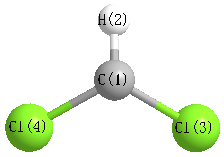 More geometry information
Calculated Bond Angles
| atom1 |
atom2 |
atom3 |
angle |
|
atom1 |
atom2 |
atom3 |
angle |
| Cl3 |
C1 |
H2 |
119.804 |
|
Cl3 |
C1 |
Cl4 |
120.392 |
| Cl4 |
C1 |
H2 |
119.804 |
|
Electronic energy levels
Charges, Dipole, Quadrupole and Polarizability
Charges from optimized geometry at HF/STO-3G
Charges (e)
| Number |
Element |
Mulliken |
CHELPG |
AIM |
ESP |
| 1 |
C |
0.036 |
|
|
|
| 2 |
H |
0.130 |
|
|
|
| 3 |
Cl |
-0.083 |
|
|
|
| 4 |
Cl |
-0.083 |
|
|
|
Electric dipole moments
Electric dipole components in Debye
(What's a Debye? See section
VII.A.3)
| |
x |
y |
z |
Total |
| |
0.000 |
0.000 |
1.693 |
1.693 |
| CHELPG |
|
|
|
|
| AIM |
|
|
|
|
| ESP |
|
|
|
|
Electric Quadrupole moment
Quadrupole components in D Å
| Primitive |
|---|
| | x | y | z |
|---|
| x |
-29.130 |
0.000 |
0.000 |
| y |
0.000 |
-32.416 |
0.000 |
| z |
0.000 |
0.000 |
-26.956 |
|
| Traceless |
|---|
| | x | y | z |
|---|
| x |
0.556 |
0.000 |
0.000 |
| y |
0.000 |
-4.372 |
0.000 |
| z |
0.000 |
0.000 |
3.816 |
|
| Polar |
|---|
| 3z2-r2 | 7.632 |
|---|
| x2-y2 | 3.286 |
|---|
| xy | 0.000 |
|---|
| xz | 0.000 |
|---|
| yz | 0.000 |
|---|
|
Polarizabilities
Components of the polarizability tensor.
Units are
Å
3 (Angstrom cubed)
Change units.
| |
x |
y |
z |
| x |
0.380 |
0.000 |
0.000 |
| y |
0.000 |
3.447 |
0.000 |
| z |
0.000 |
0.000 |
1.427 |
<r2> (average value of r
2) Å
2
| <r2> |
105.161 |
| (<r2>)1/2 |
10.255 |
Jump to
S1C1
Energy calculated at HF/STO-3G
| | hartrees |
|---|
| Energy at 0K | -947.081441 |
| Energy at 298.15K | -947.082316 |
| HF Energy | -947.081441 |
| Nuclear repulsion energy | 121.616057 |
The energy at 298.15K was derived from the energy at 0K
and an integrated heat capacity that used the calculated vibrational frequencies.
Vibrational Frequencies calculated at HF/STO-3G
| Mode Number |
Symmetry |
Frequency
(cm-1) |
Scaled Frequency
(cm-1) |
IR Intensities
(km mol-1) |
Raman Act
(Å4/u) |
Dep P |
Dep U |
|---|
| 1 |
A' |
3663 |
2991 |
8.05 |
|
|
|
| 2 |
A' |
845 |
690 |
31.84 |
|
|
|
| 3 |
A' |
705 |
576 |
0.68 |
|
|
|
| 4 |
A' |
306 |
250 |
4.28 |
|
|
|
| 5 |
A" |
1401 |
1144 |
87.96 |
|
|
|
| 6 |
A" |
1072 |
875 |
83.03 |
|
|
|
Unscaled Zero Point Vibrational Energy (zpe) 3996.1 cm
-1
Scaled (by 0.8165) Zero Point Vibrational Energy (zpe) 3262.8 cm
-1
See section
III.C.1 List or set vibrational scaling factors
to change the scale factors used here.
See section
III.C.2
Calculate a vibrational scaling factor for a given set of molecules
to determine the least squares best scaling factor.
Geometric Data calculated at HF/STO-3G
Point Group is Cs
Cartesians (Å)
| Atom |
x (Å) |
y (Å) |
z (Å) |
|---|
| C1 |
0.015 |
0.740 |
0.000 |
| H2 |
-0.608 |
1.638 |
0.000 |
| Cl3 |
0.015 |
-0.179 |
1.516 |
| Cl4 |
0.015 |
-0.179 |
-1.516 |
Atom - Atom Distances (Å)
| |
C1 |
H2 |
Cl3 |
Cl4 |
| C1 | | 1.0931 | 1.7725 | 1.7725 |
H2 | 1.0931 | | 2.4470 | 2.4470 | Cl3 | 1.7725 | 2.4470 | | 3.0312 | Cl4 | 1.7725 | 2.4470 | 3.0312 | |
More geometry information
Calculated Bond Angles
| atom1 |
atom2 |
atom3 |
angle |
|
atom1 |
atom2 |
atom3 |
angle |
| Cl3 |
C1 |
H2 |
115.219 |
|
Cl3 |
C1 |
Cl4 |
117.536 |
| Cl4 |
C1 |
H2 |
115.219 |
|
Electronic energy levels
Charges, Dipole, Quadrupole and Polarizability
Charges from optimized geometry at HF/STO-3G
Charges (e)
| Number |
Element |
Mulliken |
CHELPG |
AIM |
ESP |
| 1 |
C |
0.065 |
|
|
|
| 2 |
H |
0.125 |
|
|
|
| 3 |
Cl |
-0.095 |
|
|
|
| 4 |
Cl |
-0.095 |
|
|
|
Electric dipole moments
Electric dipole components in Debye
(What's a Debye? See section
VII.A.3)
| |
x |
y |
z |
Total |
| |
-0.434 |
1.686 |
0.000 |
1.741 |
| CHELPG |
|
|
|
|
| AIM |
|
|
|
|
| ESP |
|
|
|
|
Electric Quadrupole moment
Quadrupole components in D Å
| Primitive |
|---|
| | x | y | z |
|---|
| x |
-28.824 |
-0.650 |
0.000 |
| y |
-0.650 |
-27.367 |
0.000 |
| z |
0.000 |
0.000 |
-32.638 |
|
| Traceless |
|---|
| | x | y | z |
|---|
| x |
1.179 |
-0.650 |
0.000 |
| y |
-0.650 |
3.364 |
0.000 |
| z |
0.000 |
0.000 |
-4.542 |
|
| Polar |
|---|
| 3z2-r2 | -9.085 |
|---|
| x2-y2 | -1.457 |
|---|
| xy | -0.650 |
|---|
| xz | 0.000 |
|---|
| yz | 0.000 |
|---|
|
Polarizabilities
Components of the polarizability tensor.
Units are
Å
3 (Angstrom cubed)
Change units.
| |
x |
y |
z |
| x |
0.464 |
-0.230 |
0.000 |
| y |
-0.230 |
1.406 |
0.000 |
| z |
0.000 |
0.000 |
3.510 |
<r2> (average value of r
2) Å
2
| <r2> |
104.029 |
| (<r2>)1/2 |
10.199 |
