Jump to
S1C2
Energy calculated at BLYP/STO-3G
| | hartrees |
|---|
| Energy at 0K | -948.405068 |
| Energy at 298.15K | |
| HF Energy | -948.405068 |
| Nuclear repulsion energy | 119.200321 |
The energy at 298.15K was derived from the energy at 0K
and an integrated heat capacity that used the calculated vibrational frequencies.
Vibrational Frequencies calculated at BLYP/STO-3G
| Mode Number |
Symmetry |
Frequency
(cm-1) |
Scaled Frequency
(cm-1) |
IR Intensities
(km mol-1) |
Raman Act
(Å4/u) |
Dep P |
Dep U |
|---|
| 1 |
A1 |
3358 |
3107 |
7.04 |
|
|
|
| 2 |
A1 |
732 |
677 |
20.00 |
|
|
|
| 3 |
A1 |
280 |
259 |
2.29 |
|
|
|
| 4 |
B1 |
537i |
497i |
45.55 |
|
|
|
| 5 |
B2 |
1224 |
1132 |
81.34 |
|
|
|
| 6 |
B2 |
949 |
878 |
95.05 |
|
|
|
Unscaled Zero Point Vibrational Energy (zpe) 3002.8 cm
-1
Scaled (by 0.9252) Zero Point Vibrational Energy (zpe) 2778.2 cm
-1
See section
III.C.1 List or set vibrational scaling factors
to change the scale factors used here.
See section
III.C.2
Calculate a vibrational scaling factor for a given set of molecules
to determine the least squares best scaling factor.
Geometric Data calculated at BLYP/STO-3G
Point Group is C2v
Cartesians (Å)
| Atom |
x (Å) |
y (Å) |
z (Å) |
|---|
| C1 |
0.000 |
0.000 |
0.706 |
| H2 |
0.000 |
0.000 |
1.813 |
| Cl3 |
0.000 |
1.560 |
-0.178 |
| Cl4 |
0.000 |
-1.560 |
-0.178 |
Atom - Atom Distances (Å)
| |
C1 |
H2 |
Cl3 |
Cl4 |
| C1 | | 1.1070 | 1.7932 | 1.7932 |
H2 | 1.1070 | | 2.5297 | 2.5297 | Cl3 | 1.7932 | 2.5297 | | 3.1198 | Cl4 | 1.7932 | 2.5297 | 3.1198 | |
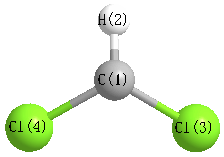 More geometry information
Calculated Bond Angles
| atom1 |
atom2 |
atom3 |
angle |
|
atom1 |
atom2 |
atom3 |
angle |
| Cl3 |
C1 |
H2 |
119.554 |
|
Cl3 |
C1 |
Cl4 |
120.892 |
| Cl4 |
C1 |
H2 |
119.554 |
|
Electronic energy levels
Charges, Dipole, Quadrupole and Polarizability
Charges from optimized geometry at BLYP/STO-3G
Charges (e)
| Number |
Element |
Mulliken |
CHELPG |
AIM |
ESP |
| 1 |
C |
-0.032 |
|
|
|
| 2 |
H |
0.126 |
|
|
|
| 3 |
Cl |
-0.047 |
|
|
|
| 4 |
Cl |
-0.047 |
|
|
|
Electric dipole moments
Electric dipole components in Debye
(What's a Debye? See section
VII.A.3)
| |
x |
y |
z |
Total |
| |
0.000 |
0.000 |
1.270 |
1.270 |
| CHELPG |
|
|
|
|
| AIM |
|
|
|
|
| ESP |
|
|
|
|
Electric Quadrupole moment
Quadrupole components in D Å
| Primitive |
|---|
| | x | y | z |
|---|
| x |
-29.151 |
0.000 |
0.000 |
| y |
0.000 |
-30.832 |
0.000 |
| z |
0.000 |
0.000 |
-26.985 |
|
| Traceless |
|---|
| | x | y | z |
|---|
| x |
-0.243 |
0.000 |
0.000 |
| y |
0.000 |
-2.763 |
0.000 |
| z |
0.000 |
0.000 |
3.006 |
|
| Polar |
|---|
| 3z2-r2 | 6.012 |
|---|
| x2-y2 | 1.680 |
|---|
| xy | 0.000 |
|---|
| xz | 0.000 |
|---|
| yz | 0.000 |
|---|
|
Polarizabilities
Components of the polarizability tensor.
Units are
Å
3 (Angstrom cubed)
Change units.
| |
x |
y |
z |
| x |
0.488 |
0.000 |
0.000 |
| y |
0.000 |
4.250 |
0.000 |
| z |
0.000 |
0.000 |
1.578 |
<r2> (average value of r
2) Å
2
| <r2> |
108.200 |
| (<r2>)1/2 |
10.402 |
Jump to
S1C1
Energy calculated at BLYP/STO-3G
| | hartrees |
|---|
| Energy at 0K | -948.409358 |
| Energy at 298.15K | -948.410076 |
| HF Energy | -948.409358 |
| Nuclear repulsion energy | 118.873180 |
The energy at 298.15K was derived from the energy at 0K
and an integrated heat capacity that used the calculated vibrational frequencies.
Vibrational Frequencies calculated at BLYP/STO-3G
| Mode Number |
Symmetry |
Frequency
(cm-1) |
Scaled Frequency
(cm-1) |
IR Intensities
(km mol-1) |
Raman Act
(Å4/u) |
Dep P |
Dep U |
|---|
| 1 |
A' |
3255 |
3011 |
1.76 |
|
|
|
| 2 |
A' |
776 |
718 |
27.91 |
|
|
|
| 3 |
A' |
636 |
588 |
3.97 |
|
|
|
| 4 |
A' |
273 |
253 |
1.56 |
|
|
|
| 5 |
A" |
1234 |
1142 |
42.79 |
|
|
|
| 6 |
A" |
894 |
827 |
132.32 |
|
|
|
Unscaled Zero Point Vibrational Energy (zpe) 3533.9 cm
-1
Scaled (by 0.9252) Zero Point Vibrational Energy (zpe) 3269.5 cm
-1
See section
III.C.1 List or set vibrational scaling factors
to change the scale factors used here.
See section
III.C.2
Calculate a vibrational scaling factor for a given set of molecules
to determine the least squares best scaling factor.
Geometric Data calculated at BLYP/STO-3G
Point Group is Cs
Cartesians (Å)
| Atom |
x (Å) |
y (Å) |
z (Å) |
|---|
| C1 |
0.018 |
0.767 |
0.000 |
| H2 |
-0.728 |
1.600 |
0.000 |
| Cl3 |
0.018 |
-0.182 |
1.549 |
| Cl4 |
0.018 |
-0.182 |
-1.549 |
Atom - Atom Distances (Å)
| |
C1 |
H2 |
Cl3 |
Cl4 |
| C1 | | 1.1185 | 1.8170 | 1.8170 |
H2 | 1.1185 | | 2.4769 | 2.4769 | Cl3 | 1.8170 | 2.4769 | | 3.0984 | Cl4 | 1.8170 | 2.4769 | 3.0984 | |
More geometry information
Calculated Bond Angles
| atom1 |
atom2 |
atom3 |
angle |
|
atom1 |
atom2 |
atom3 |
angle |
| Cl3 |
C1 |
H2 |
112.909 |
|
Cl3 |
C1 |
Cl4 |
116.997 |
| Cl4 |
C1 |
H2 |
112.909 |
|
Electronic energy levels
Charges, Dipole, Quadrupole and Polarizability
Charges from optimized geometry at BLYP/STO-3G
Charges (e)
| Number |
Element |
Mulliken |
CHELPG |
AIM |
ESP |
| 1 |
C |
-0.005 |
|
|
|
| 2 |
H |
0.123 |
|
|
|
| 3 |
Cl |
-0.059 |
|
|
|
| 4 |
Cl |
-0.059 |
|
|
|
Electric dipole moments
Electric dipole components in Debye
(What's a Debye? See section
VII.A.3)
| |
x |
y |
z |
Total |
| |
-0.651 |
1.160 |
0.000 |
1.331 |
| CHELPG |
|
|
|
|
| AIM |
|
|
|
|
| ESP |
|
|
|
|
Electric Quadrupole moment
Quadrupole components in D Å
| Primitive |
|---|
| | x | y | z |
|---|
| x |
-28.701 |
-0.839 |
0.000 |
| y |
-0.839 |
-27.618 |
0.000 |
| z |
0.000 |
0.000 |
-31.071 |
|
| Traceless |
|---|
| | x | y | z |
|---|
| x |
0.643 |
-0.839 |
0.000 |
| y |
-0.839 |
2.269 |
0.000 |
| z |
0.000 |
0.000 |
-2.912 |
|
| Polar |
|---|
| 3z2-r2 | -5.823 |
|---|
| x2-y2 | -1.084 |
|---|
| xy | -0.839 |
|---|
| xz | 0.000 |
|---|
| yz | 0.000 |
|---|
|
Polarizabilities
Components of the polarizability tensor.
Units are
Å
3 (Angstrom cubed)
Change units.
| |
x |
y |
z |
| x |
0.605 |
-0.216 |
0.000 |
| y |
-0.216 |
1.635 |
0.000 |
| z |
0.000 |
0.000 |
4.452 |
<r2> (average value of r
2) Å
2
| <r2> |
107.562 |
| (<r2>)1/2 |
10.371 |
